Google AI Mode Ads Expand to 10 Countries, Multiturn Ads in US
Google AI Mode ads now run in India, Australia, Canada and seven more markets, and multiturn ads launch in the US. What changes and what to check.


In this article
Google AI Mode ads are now scaling beyond the United States to ten English language markets, including India, Australia and Canada. In the same update, Google is launching multiturn ads in the US, which means ads can appear on the follow-up questions a person asks inside one AI Mode conversation. Google first described the plan in an October 28 announcement on its regional blog, and the Google Ads account confirmed the rollout on X on November 9.
This affects almost every advertiser running Search, Shopping or Performance Max in those markets. There is no new campaign type to build and no separate budget, so your existing campaigns can already be serving in AI Mode. That is good for reach, but it also means spend can move into a placement you cannot report on separately.
Below is what Google has confirmed in its official help page on ads in AI Overviews and AI Mode, what the multiturn change means, and what to check in your account this week.
Where Google AI Mode ads now run
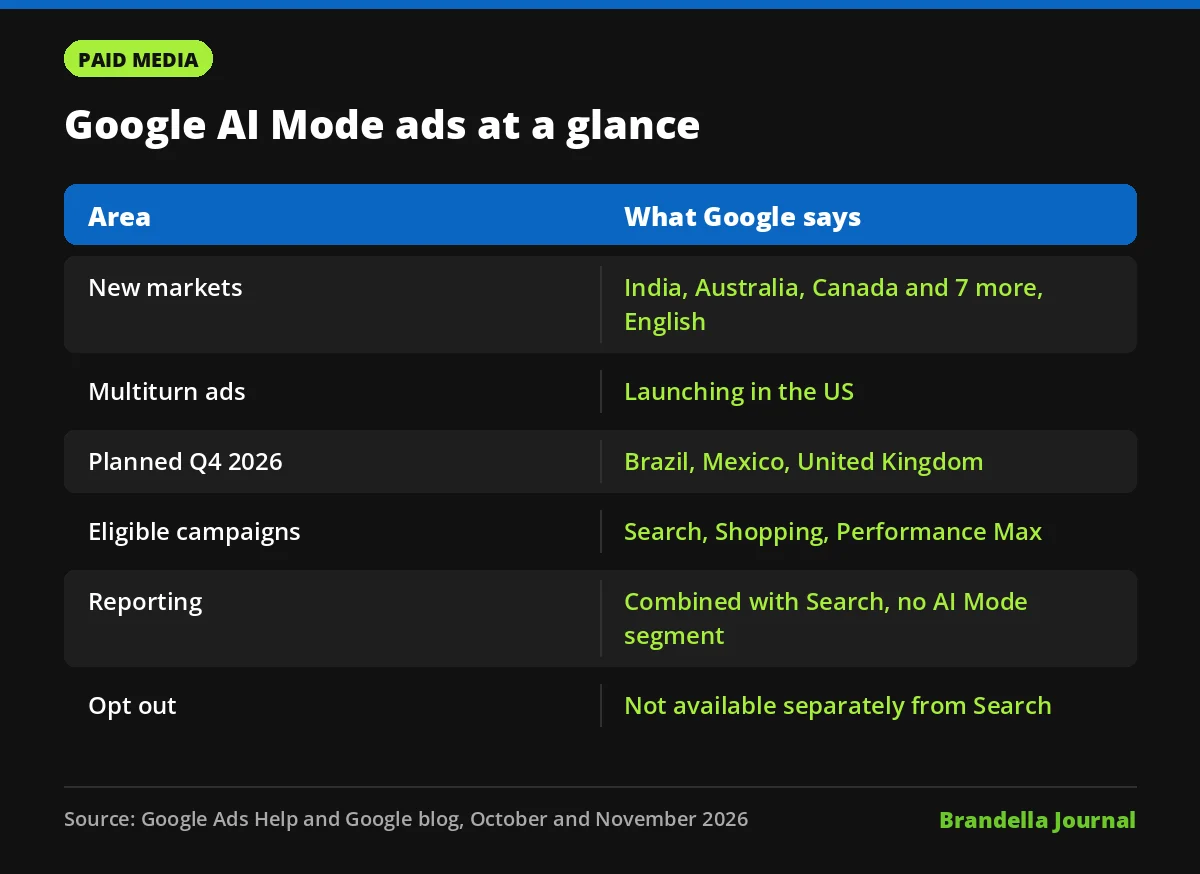
According to Google’s help page, ads within AI Overviews and AI Mode run in the United States, Australia, Canada, India, Kenya, Malaysia, New Zealand, Nigeria, Pakistan, the Philippines and Singapore. Indonesia is listed for AI Overviews only, and Pakistan is limited to text ads. English is the only listed language, and Google notes the list “may not be exhaustive.”
Google’s October post adds that Brazil, Mexico and the United Kingdom are planned for Q4 2026. Ads placed above or below AI Overviews are a separate case: those can already appear in all countries and languages where AI Overviews are available.
| Market | Ads in AI Mode status |
|---|---|
| United States | Live, plus multiturn ads launching |
| India, Australia, Canada, Singapore, New Zealand | Scaling now, English |
| Kenya, Nigeria, Malaysia, Philippines | Scaling now, English |
| Pakistan | Scaling now, text ads only |
| Brazil, Mexico, United Kingdom | Planned for Q4 2026 |
What multiturn ads change
Until now, an AI Mode ad was tied mostly to the first question. With multiturn ads, Google says ads can appear “within or alongside AI responses, including across follow-up questions in AI Mode” when the conversation has commercial relevance.
This matters because AI Mode conversations look different from classic searches. Google’s October post says that “in AI Mode, queries are, on average, three times longer than traditional searches.” A person might start with a broad question about running shoes and only reveal a budget, a size or a brand preference three turns later. Multiturn ads let an advertiser show up at that later, more specific moment.
Google also says that click-through rates “are already similar between sponsored and organic product list items within AI Mode.” It did not publish the actual numbers, so treat that as a directional claim rather than a benchmark.
Which campaigns and keywords are eligible
Existing Search, Shopping and Performance Max campaigns are automatically eligible. Ads are built from your current assets, such as headlines, descriptions, images, prices and landing pages, and are labelled “Sponsored.”
Match type now decides a lot. Google says AI powered targeting, meaning AI Max for Search, broad match on Search, Shopping and Performance Max, can match both direct queries and “contextual” queries that combine the user’s question with the AI response. Exact and phrase match keywords only match when the query itself shows direct commercial intent, and they are not eligible for contextual matching on broader questions.
Some placements also include AI explainers written by Gemini. Google says advertisers cannot write, edit, approve or opt out of that text.
Reporting and controls for Google AI Mode ads
This is the part advertisers will feel most. Impressions, clicks, conversions and cost from AI Mode are included in aggregate in your standard campaign reports, and triggering queries are included in aggregate in the search terms report. There is no separate AI Mode segment.
You also cannot target ads only to AI Overviews or AI Mode, and you cannot opt out of them separately from Search. Your main limits are negative keywords, brand exclusions and asset pinning. Billing works the same way as standard Search, with the same auction and no extra charge to take part.
What advertisers should do now
These steps are Brandella’s recommendations, not official Google instructions.
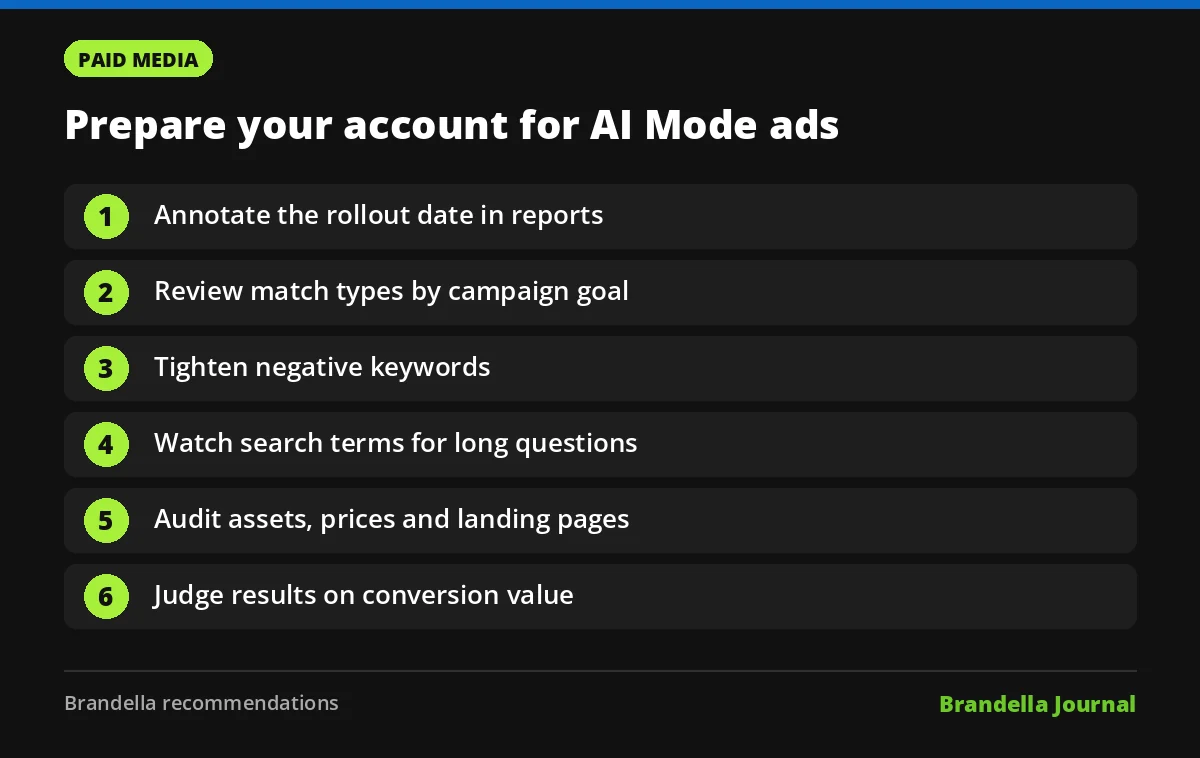
- Mark the date in your reports. If you advertise in India or any other new market, add an annotation for the rollout so you can explain shifts in impressions, CPC or conversion rate later.
- Review match types by goal. Campaigns that need tight control can stay on exact and phrase match. Campaigns where you want AI Mode reach need broad match, AI Max or Performance Max. Our guide to Search campaigns vs Performance Max explains the trade off.
- Tighten negative keywords. Since there is no AI Mode opt out, negatives are your main brake. Revisit your list using our Google Ads negative keywords tips.
- Watch search terms for long questions. Longer, conversational queries in the search terms report are a clue that AI Mode traffic is flowing in, even though Google does not label it.
- Audit your assets and landing pages. Ads are assembled from your existing headlines, descriptions, images and prices, so outdated assets can show up next to AI answers. Make sure prices and offers match your landing pages.
- Check conversion value, not just volume. If AI Mode brings more mid funnel visitors, a rise in clicks may not mean a rise in sales. Tie bidding to value where you can, as covered in value based bidding in Google Ads.
Why this matters for Indian advertisers
India is one of the biggest English language markets on the new list, and many Indian advertisers rely heavily on broad match and Performance Max. That combination is exactly what Google makes eligible for contextual matching in AI Mode, so Indian accounts may see the biggest change in where their ads appear.
If you want a refresher on how AI Mode itself works for users, read what Google AI Mode is. Then spend ten minutes in your search terms report this week. It is the only place where AI Mode traffic leaves any trace in your data.