HubSpot CEO Change: Brian Halligan Returns to Refound HubSpot
HubSpot CEO change: co-founder Brian Halligan replaced Yamini Rangan on November 12, 2026. What the refounding means for marketers and what to check now.

In this article
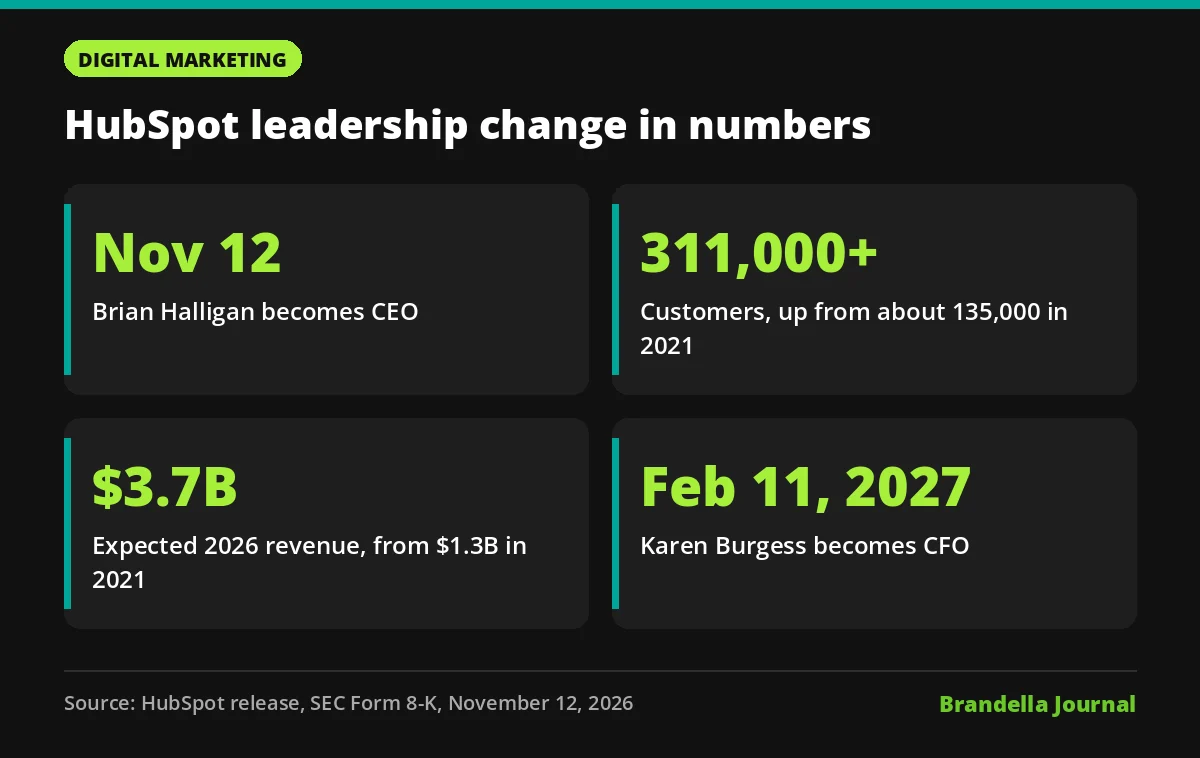
HubSpot has a new CEO, and he is a familiar one. On November 12, 2026, co-founder Brian Halligan was appointed HubSpot CEO with immediate effect, replacing Yamini Rangan, who also left the board. The company announced the change in a press release filed with its SEC Form 8-K.
Halligan calls his return “a refounding” of the company and says he plans to rethink HubSpot across product, go to market and culture. HubSpot also named a new finance chief: Karen Burgess, currently SVP and CFO of Adobe’s Creativity and Productivity business unit, will take over as CFO on February 11, 2027.
For the many marketing teams that run their CRM, email, forms and automation on HubSpot, nothing changes in your portal today. But a refounding at a platform you depend on is a good reason to review your setup, contracts and plans for its AI agents.
Who is the new HubSpot CEO
Halligan co-founded HubSpot in 2005 with CTO Dharmesh Shah and has sat on the board since then. The release says he served as CEO for 16 years. In 2021 he handed the job to Rangan and moved into the executive chairman role, according to HubSpot’s 2021 announcement, effective September 7, 2021.
“This is a refounding, and I can’t wait to start!” Halligan said in the release. He described the next stage as “Chapter three,” focused on “building the customer relationship harness that will enable millions to grow better.”
Board chair Lorrie Norrington said “the Board is united in its support of his refounding of the company.” The release gives no reason for Rangan’s departure. She will stay on until December 1, 2026, to help with the handover.
What changed in HubSpot leadership
The announcement covers more than the CEO seat. Here is the full picture with dates:
| Person | Change | Effective date |
|---|---|---|
| Brian Halligan | Appointed CEO | November 12, 2026 |
| Yamini Rangan | Stepped down as CEO and board member, stays to support transition | Leaves December 1, 2026 |
| Karen Burgess | Joins as EVP, Finance, then becomes CFO | November 30, 2026 and February 11, 2027 |
| Kate Bueker | Retires as CFO (long planned), then advisory role | February 11, 2027, advisory to December 31, 2027 |
HubSpot also reaffirmed the fourth quarter and full year 2026 guidance it first gave on November 4 with its third quarter results. That signals the company does not expect the change to alter its near term plan.
What HubSpot grew into under Rangan
The release credits Rangan’s time as CEO, which started in September 2021, with strong growth. Customers rose from about 135,000 to more than 311,000, and revenue grew from $1.3 billion in 2021 to an expected $3.7 billion in 2026. Her tenure also included building AI into the product.
The context around the change is tougher. CX Today reported that HubSpot cut about 660 jobs, roughly 7% of its workforce, around five weeks before the change and reorganised product teams around customer outcomes. The same report says some Breeze agents, including the Breeze Customer Agent, already use pay per result pricing charged per resolved conversation.
What the refounding could mean for marketers
Halligan has not yet shared his detailed plans, and CX Today reports he said he will do so in the coming days. So any talk of specific product changes is guesswork for now.
What is clear is the direction. The release talks about AI creating new possibilities, and CX Today reports that Shah said HubSpot will build a “Customer Relationship Harness” and accelerate “Headless HubSpot,” with Duncan Lennox named president of product. For marketers, that points to more AI agents, more API style access to HubSpot data, and possibly new ways of paying for results.
Our reading is that the core tools most teams use daily, such as contacts, lists, email, forms and workflows, are unlikely to change suddenly. The bigger shifts are more likely in agents, pricing models and how HubSpot connects with other AI tools.
What HubSpot users should do now
These steps are our recommendations, not advice from HubSpot. They are worth doing in any case, and the leadership change is a good prompt.
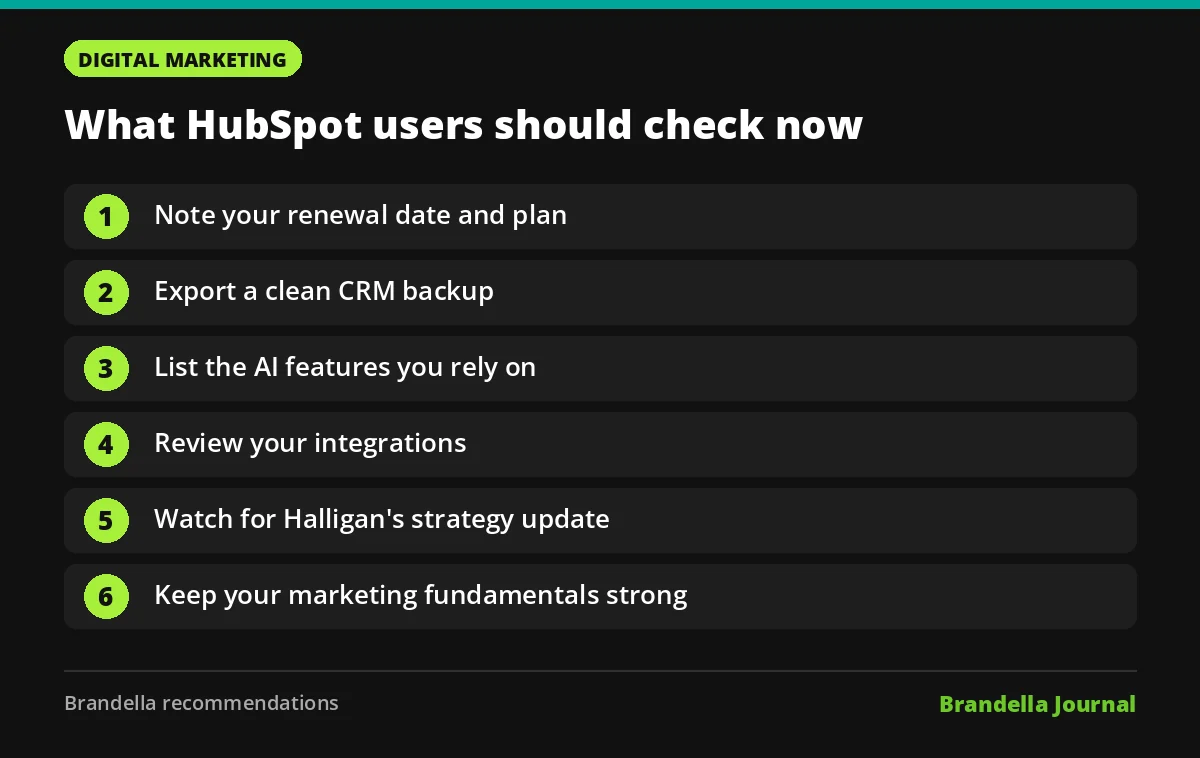
- Note your renewal date and plan. Know when your contract renews, which hubs and seats you pay for, and what your current price is, so any packaging change does not surprise you.
- Export a clean backup of your CRM. Keep a recent export of contacts, companies, deals and key properties. Good data hygiene protects you whatever any vendor does.
- List the AI features you rely on. Write down which Breeze or other AI tools you use, how they are billed and what results they deliver. Compare cost per result with what a human or another tool would cost.
- Review your integrations. Check which apps connect to HubSpot and who owns each one. A push toward headless and API access may bring new options, so know your current map first.
- Watch for Halligan’s plan. Follow HubSpot’s official channels for the strategy update, then review your roadmap with it in hand rather than reacting to rumours.
- Keep your fundamentals strong. A CRM is only as good as the process behind it. Our guides on lead generation, email marketing strategy and conversion rate optimization apply on any platform.
The wider lesson for marketing stacks
HubSpot is one of the best known marketing platforms in the world, and even it is redesigning itself around AI. Your stack will keep changing as vendors chase agents and new pricing models.
The practical answer is to own your data and your process. Keep first party data clean and portable, document how your funnel works, and measure every AI feature on results. Then a change at the top of any vendor becomes a planning question, not an emergency.