United Airlines AI Agents Ban: What Brands Should Learn
The United Airlines AI agents ban blocks unauthorised personal AI assistants from booking. What changed, what stays open to search, and lessons for brands.

In this article
United Airlines AI agents restrictions took effect on November 11, 2026, when the airline said it would stop “unauthorized, third-party personal AI agents or assistants” from using its digital platforms. The move was announced in a United press release titled United Restricts Access for Third-Party AI Agents.
The restriction covers United’s own website and app, and also travel agencies and aggregators. It comes with updates to the airline’s booking, ticketing and distribution policies.
For marketers, this is one of the first big consumer brands to draw a written line between search engines, which can still read its pages, and AI agents, which now need permission to act. Every brand selling online will face the same choice soon.
Why United restricted AI agents
United’s release gives three reasons. First, sharing account credentials with a third party AI assistant can expose sensitive information. Second, actions taken by these tools may lead to unintended purchases, account changes or use of MileagePlus miles.
Third, United says automated actions could conflict with FAA and DOT rules. Its example is check-in, where a person must confirm that bags contain no banned items. An agent cannot honestly make that statement for a traveller.
United says leaders in banking and retail have taken similar steps and encourages other companies to consider them. It also says it will keep evaluating how personal AI assistants interact with its services, so this is not presented as a permanent position.
What the United Airlines AI agents rules change
The press release does not quote the new terms, so the details below come from Search Engine Journal’s review of United’s updated terms and contract of carriage:
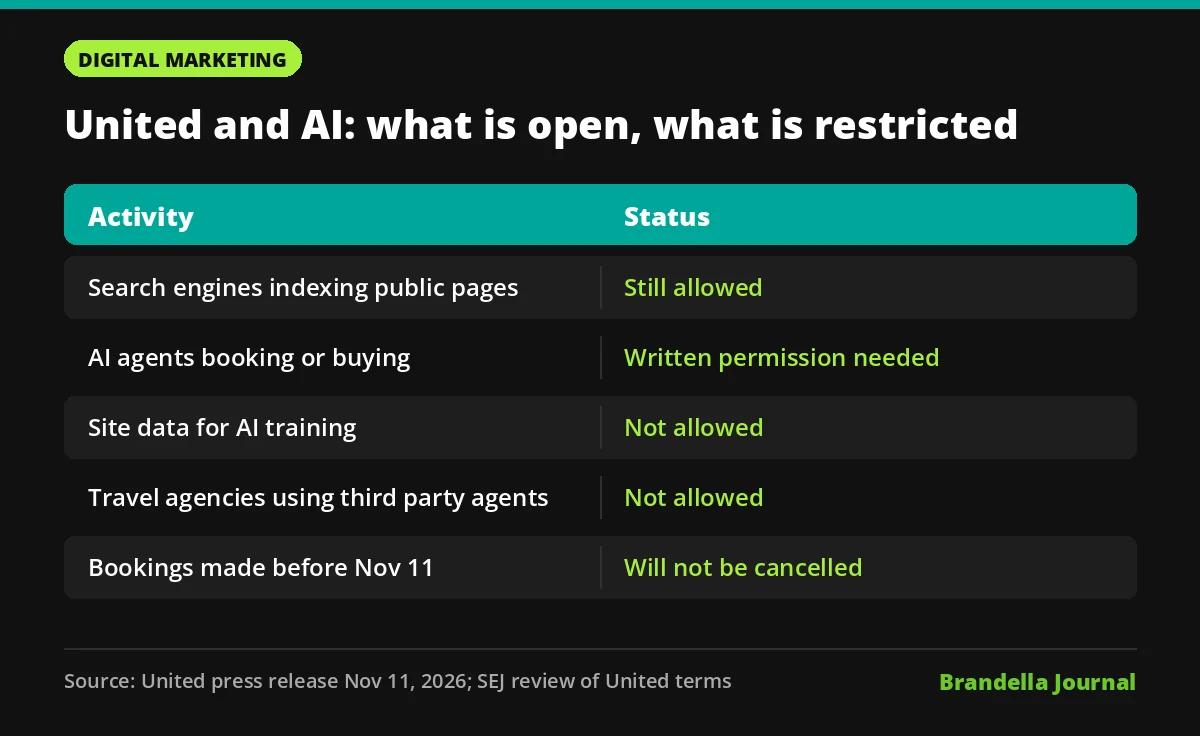
| Area | What the updated documents say, per SEJ |
|---|---|
| Search engines | May still index United’s public pages |
| AI agents booking or buying | Need written permission from United |
| Using site data for AI | Fares, schedules and availability cannot be used to train, fine tune, ground or evaluate AI models |
| Agent made bookings | Listed among bookings United may cancel without notice |
| Bookings before November 11 | Will not be cancelled, per United’s FAQ |
| Travel agencies | Cannot use third party AI agents for United travel |
United also plans to update its Digital Trust Center to explain the rules, how customers can protect accounts, and where to get help if an agent takes an unintended action.
Robots.txt was not the tool United used
Here is the detail SEO teams should note. When we checked United’s robots.txt file during this run, it named no AI crawlers at all. There was no rule for GPTBot, ClaudeBot or Google-Extended. AI crawlers simply fall under the general rules that apply to every bot.
So United did not block AI at the crawl level. It kept discovery open and moved the control to its legal terms and its booking systems. That is a sensible split. Robots.txt is a request about crawling, not a contract about what an agent may buy. Our robots.txt guide explains why it was never designed for that job.
The approach also keeps United visible. Blocking crawlers outright could remove its pages from AI answers and search results, which would hurt direct bookings more than it protects them.
What this means for brands and marketers
AI agents are moving from answering questions to completing tasks. We have covered ChatGPT business profiles and agents and Microsoft Clarity’s agent analytics, both built around this shift.
United shows the other side. A brand can welcome AI discovery while refusing AI transactions it has not approved. Expect more companies in regulated or high fraud sectors, such as travel, finance and ticketing, to follow, and expect official agent partnerships to replace open access.
If your growth plan assumes AI agents will freely shop on any site, build in the risk that key merchants opt out or demand a deal first.
What to do now
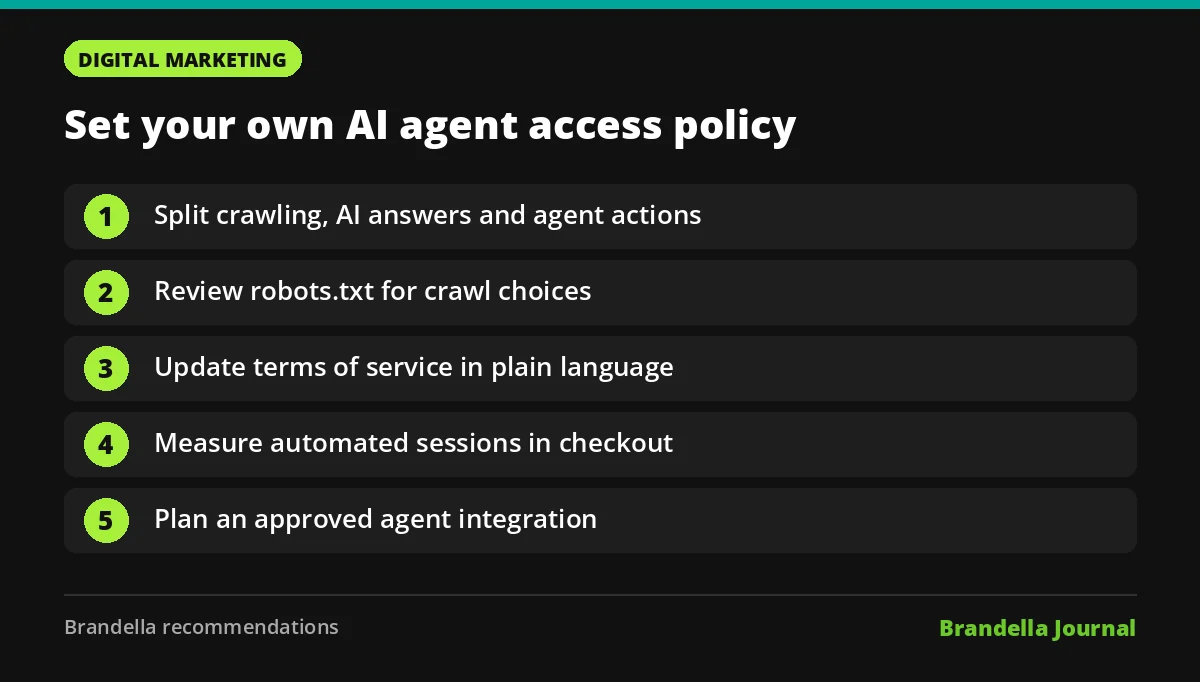
These are Brandella recommendations, not part of United’s announcement:
- Decide your policy in three parts. Separate crawling for search, use of your content in AI answers, and agents acting for users. You may want different answers for each.
- Review your robots.txt. Confirm it reflects your crawl choices, and remember it will not stop an agent that logs in as a user.
- Update your terms of service. If you want to restrict agent purchases or data use for model training, say so in plain language, as United did.
- Measure agent traffic. Check server logs and analytics for automated sessions in checkout and account areas. Our guide on detecting bot traffic in GA4 is a starting point.
- Plan an approved route. If agents matter to your customers, consider an official integration so the experience stays safe and you keep the customer relationship.
Brief your support team too. Customers may ask why their AI assistant failed to complete a booking or purchase, and a clear answer prevents complaints.
What is still unclear
United says it does not yet work with any third party AI agents, according to the SEJ report of its FAQ. It has not said which partners it might approve, what written permission would require, or how it will detect agent activity.
Watch the Digital Trust Center for those details. Until then, treat United’s move as a signal of direction rather than a finished framework.