Internet Licensing Collective: Yahoo Scout to Pay Publishers
The Internet Licensing Collective launched with Yahoo Scout as its first paying licensee. How the AI licensing model works and what publishers can do.

In this article
The Internet Licensing Collective (ILC) launched on November 12, 2026, with Yahoo Scout as its first commercial licensee. The ILC is a nonprofit, publisher led group that sells one blanket license to AI companies and passes the money back to content owners. The details are in the official ILC launch release on GlobeNewswire.
Yahoo Scout is Yahoo’s AI answers tool. Under the deal, Scout gets ongoing access to permissioned content to inform its AI answers, and publishers in the collective get paid when their work is used. The release does not disclose the financial terms.
This matters to anyone who publishes on the web. For two years the main choice for publishers has been to block AI crawlers or let them in for free. A working collective with a paying customer adds a third option: license your content and get a share of AI revenue.
What the Internet Licensing Collective is
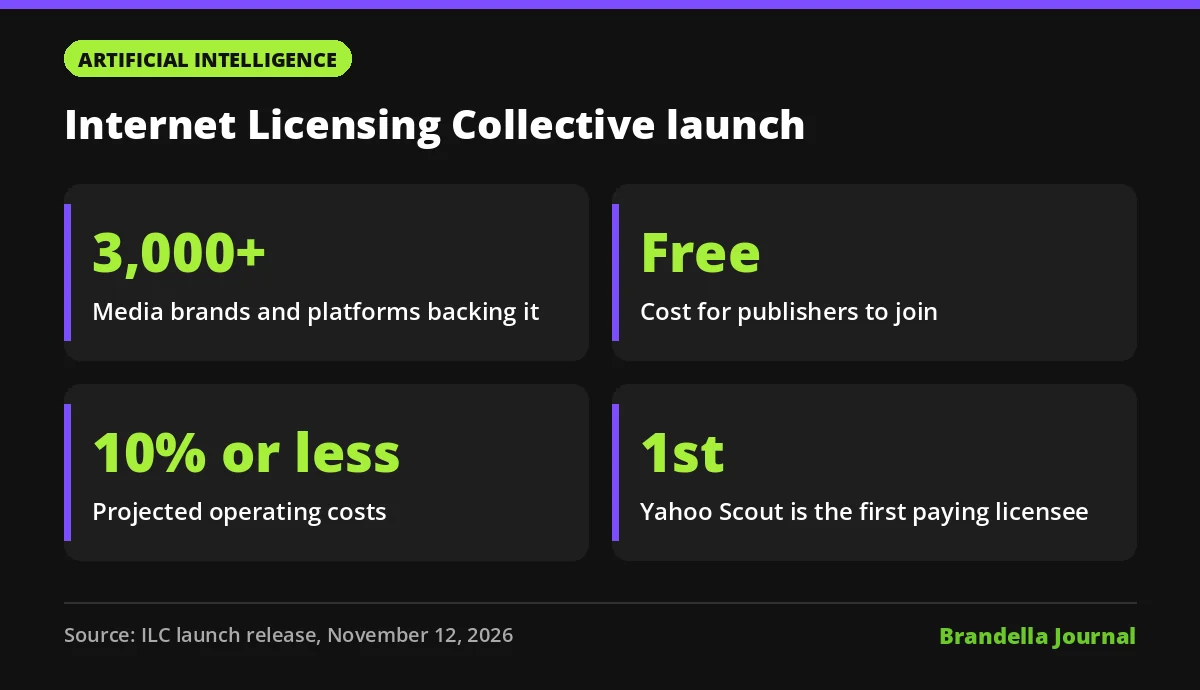
The ILC was formerly called the RSL Collective. It co-authored RSL (Really Simple Licensing), an open standard that lets site owners state machine readable licensing terms for AI uses such as training, grounding, agentic use and AI overviews. The release says RSL launched in 2025 with more than 1,500 supporters, including Yahoo, and that support has since grown to more than 3,000 media brands, content owners and publishing platforms.
According to the original RSL Standard announcement from September 10, 2025, RSL extends robots.txt so publishers can add licensing and royalty terms for AI crawlers, with models such as free, attribution, subscription, pay per crawl and pay per inference. RSL is meant to work alongside simple opt out tools, not replace them. The ILC also says it supports other standards publishers want to use. So the collective is the business side, and RSL is one of the technical ways to say what you allow.
Search Engine Roundtable’s report describes the group the same way: a nonprofit licensing collective that will pay publishers through the ILC when Yahoo Scout uses their content in AI answers.
How the payments are meant to work
AI companies buy a single blanket license and pay for the uses they need. The release lists training, retrieval augmented generation (RAG), grounding, agentic applications and AI generated overviews, with costs that scale with usage.
Money is shared out under the ILC’s Allocation Rules. Payment reflects how much a publisher’s content contributes to AI products, including how it is used, the economic value of the product and how often it is relied on. Catalog size alone does not decide the payout, which is good news for smaller, specialist sites with useful content.
The ILC says it runs at cost, with operating expenses projected at or below 10%. “Every dollar received by the Internet Licensing Collective, after costs, goes to content owners,” said co-founder Doug Leeds.
What publishers keep, and what they give up
The terms for joining are friendly to publishers. Here is the summary from the release:
| Question | Answer from the ILC release |
|---|---|
| Cost to join | Free |
| Which licenses | You choose, and can change your choices at any time |
| Exclusive | No, participation is non-exclusive |
| Existing AI deals | You keep them and can still sign direct deals |
| First paying licensee | Yahoo Scout |
| Financial terms of Yahoo deal | Not disclosed |
The non-exclusive part is important. A large publisher with a direct AI deal does not have to choose between that deal and the collective. A small publisher that could never negotiate alone gets a seat at the table.
Why Yahoo Scout signed first
Yahoo was already a supporter of RSL, so it is a natural first customer. “AI answers are only as good as the sources behind them,” said Eric Feng, SVP and GM of Yahoo Research Group. We looked at how Scout fits into Yahoo Search in our post on Yahoo Scout and Pivot Search.
For marketers, one buyer is a start, not a market. The big test is whether larger AI platforms join. Until they do, the money flowing through the ILC will be limited by how much one AI answer engine uses and pays for.
The bigger numbers, and how to read them
The release cites a Mather Economics report, The Price of Intelligence, released the same day. Mather estimates that collective AI licensing could produce publisher payments equal to 15% to 35% of AI company revenue, a market it says could be worth tens of billions of dollars. Mather states the report was not commissioned or funded by the ILC.
Treat these as forecasts, not promises. The estimate is built on run rate revenue from only the two biggest frontier models, and neither of them has signed with the ILC. The release itself compares the idea with music and video platforms, noting Spotify pays close to 70% of revenue to rights holders and YouTube shares 55% with creators.
This fits a wider trend. Publishers have watched search referrals shrink, as in the Ziff Davis Google referral data and the UK news visibility figures we covered. Licensing is one way to get paid for content that AI tools read but do not click through to.
What publishers and content teams should do now
These steps are our recommendations, not official ILC guidance. None of them stop you from ranking in classic search.
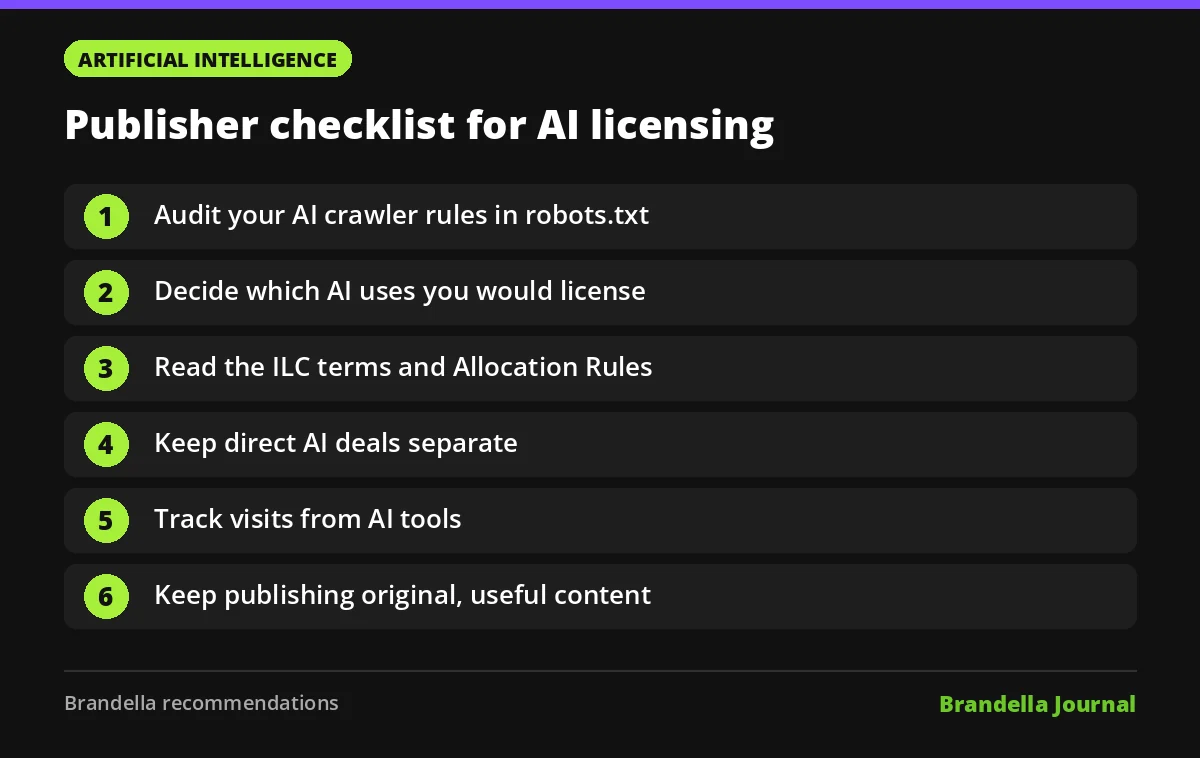
- Audit your AI crawler rules. Check your robots.txt and know which AI bots you block or allow today. Licensing only works if your rules match your intent.
- Decide which uses you are comfortable with. Training, grounding and AI overviews are different uses. Write down which ones you would license and which you would block.
- Read the ILC terms at the source. Joining is free and non-exclusive, but read the Allocation Rules and license choices before you sign up.
- Keep direct deals separate. If you already license content to an AI company, confirm the collective does not conflict with that contract.
- Track AI referrals. Measure visits from AI tools in analytics so you can compare licensing income with any traffic those tools send.
- Keep publishing work worth paying for. Payouts reflect how often content is relied on. In our view, original data, expert guides and first hand reporting are the content most likely to be relied on.
The ILC is early, with one paying partner and undisclosed terms. But it is the first collective model with a live AI customer, and it costs nothing to watch closely or to join.