Meta Commercial Terms Paused: What It Means for Your Website
Meta commercial terms due November 20 are paused with no new date. What the terms would have allowed, which Meta crawlers exist and what to check now.

In this article
The updated Meta commercial terms that were due to take effect on November 20, 2026, are paused, and Meta has not given a new date. According to Nieman Lab’s November 5 report, Meta’s Business Help Center now says the changes “are now paused and will not take effect on November 20, 2026,” and that “our existing terms remain in effect.”
The pause covers four documents: the Meta Commercial Terms, the Product Catalog Terms, the Self-Serve Ad Terms and the Ad Creative Generative AI Terms. Nieman Lab reported that the proposed version would have let Meta scrape websites connected to Meta Business account users.
This matters to anyone who runs ads on Facebook or Instagram, sells through a product catalog, or publishes content and links a website to a Meta Business account. For now nothing changes, but the pause is not a cancellation, so it is a good moment to understand your options.
What Meta paused and what stays in place
Meta’s existing terms keep applying to advertisers and businesses. A Meta spokesperson told Nieman Lab: “We’re pausing the changes as we continue to engage with stakeholders and take our time to get this right.” Nieman Lab also reported that Meta removed the preview page for the proposed terms on November 5.
Search Engine Journal also covered the pause on November 10, noting that no new effective date has been set. If you manage ads, you do not need to accept anything new right now.
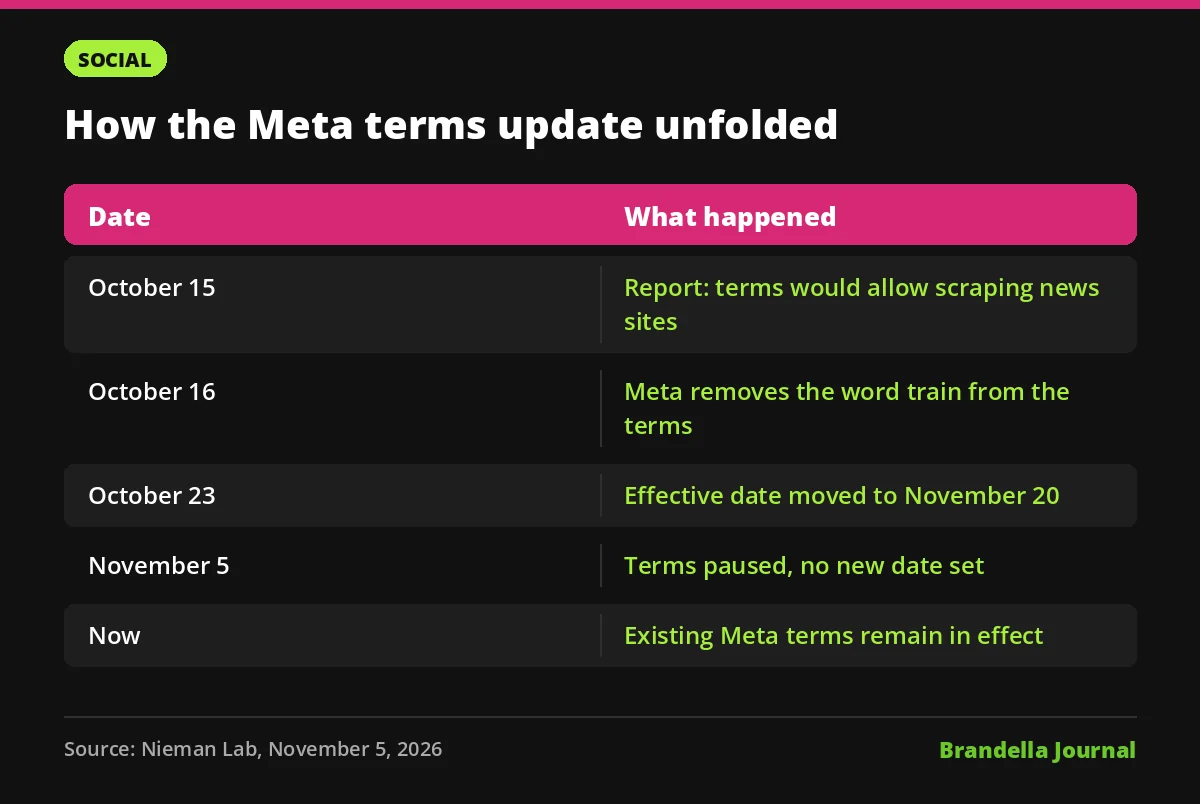
How the Meta commercial terms update unfolded
The pause came after several weeks of pushback, as reported by Nieman Lab:
| Date | What happened |
|---|---|
| October 15 | Nieman Lab reports the proposed terms would allow scraping of news sites |
| October 16 | Meta removes the word “train” and limits scraped content use to ads and business products |
| October 23 | Meta moves the effective date from October 30 to November 20 |
| Late October | Meta pledges to consult publishers; two US senators ask it to withdraw the terms |
| November 5 | Meta pauses the terms indefinitely and removes the preview page |
Nieman Lab also reported that courts in Norway and Brazil issued preliminary injunctions against the terms, and that the UK Competition and Markets Authority opened a formal investigation. On October 28, Meta’s VP of communications Andy Stone said on X that the company does “not plan to make policy changes without a full consultation with industry groups and leaders.”
Which Meta crawlers can visit your site today
The terms debate is about permission, but crawling is already happening through Meta’s published bots. Meta’s web crawler documentation lists five user agents:
- FacebookExternalHit fetches shared links to build the title, description and thumbnail preview on Facebook, Instagram and Messenger.
- Meta-WebIndexer crawls to improve Meta AI search results and help Meta AI cite and link to content.
- Meta-ExternalAds crawls to improve advertising and other business products.
- Meta-ExternalAgent crawls to train foundation AI models or improve products by indexing content.
- Meta-ExternalFetcher fetches single links when a user asks for them, and Meta says it may bypass robots.txt.
Meta also says FacebookExternalHit may ignore robots.txt for security or integrity checks, and that robots.txt changes can take up to 24 hours to apply because crawlers cache the file.
What publishers and advertisers should do now
These steps are Brandella’s recommendations, not official Meta guidance. If your business has legal questions about the terms, speak to your own legal adviser.
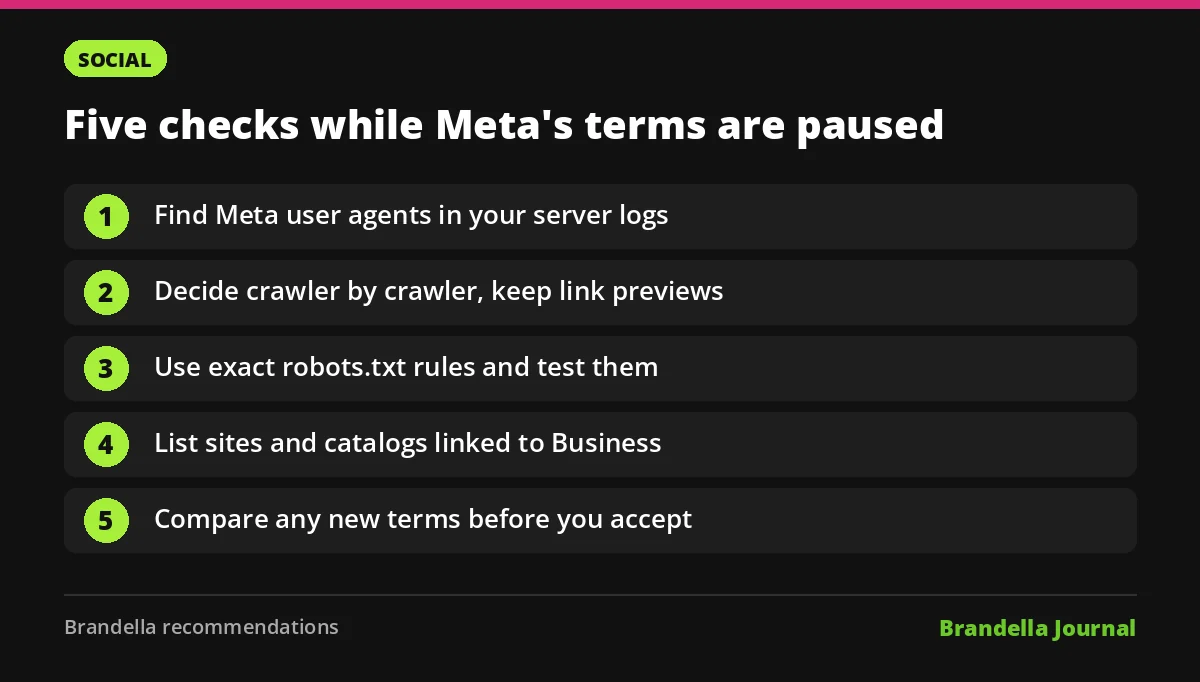
- Check your server logs. Search for the five Meta user agents above so you know which ones already visit your site and how often.
- Decide crawler by crawler. Blocking FacebookExternalHit can break link previews on Facebook and Instagram, which hurts social traffic. Blocking Meta-ExternalAgent is a separate choice about AI training. Our robots.txt guide shows how user agent groups work.
- Use exact rules. Meta’s documentation shows the format, for example a
User-agent: meta-externalagentgroup withDisallow: /. Test the file after any change, and remember the 24 hour cache. - List what is linked to your Business account. Note which websites, catalogs and pixels are connected, since the proposed terms were tied to sites linked to Meta Business accounts.
- Watch for a new effective date. When Meta publishes new terms, compare them with the paused version before you accept, especially anything about crawling or AI use.
Why this matters beyond Meta
Platforms are now asking for content access through business and ad terms, not only through robots.txt. That shifts the decision from your developer to whoever clicks accept in an ad account, so marketing and web teams need to talk.
If you are weighing how AI products use your content more broadly, our explainer on the Google AI search opt out covers the same question for Google, and llms.txt explained looks at another file sites are adding for AI systems. Meta has not confirmed what its next version will say, so keep your existing terms, crawler rules and account links documented until it does.