Anthropic Usage Policy Names AI Answer Seeding: What It Means
The Anthropic usage policy now in force bans using Claude to seed fake sources for AI answers. What the rule says and how marketers should adjust.

In this article
The updated Anthropic usage policy took effect on November 12, 2026, and one line in it speaks directly to marketers chasing visibility in AI answers. Claude may not be used to “manipulate the sources from which search engines or AI systems draw answers by seeding them with content that misrepresents its origin, authorship, or independence.”
Anthropic first published the changes on October 8 in its 2026 Usage Policy update, with November 12 as the date they apply. The full wording sits in the PDF version of the 2026 Usage Policy.
This affects anyone who uses Claude, through the apps or the API, to produce content at scale for SEO, generative engine optimisation or reputation work. Most honest content programmes are untouched. Tactics built on fake independence are now named in writing.
What the Anthropic usage policy now says about deception
The biggest structural change is a new section called “Do Not Engage in Deceptive Campaigns or Artificial Activity.” Anthropic says rules on fake account networks and fabricated news sites used to be spread across its elections, fraud, privacy and disinformation sections. They now live in one place, and the section covers deception of any kind, political or commercial.
Anthropic is clear that this behaviour was already prohibited. The update mostly makes it easier to read. For marketers, that matters because the commercial side is now spelled out next to the political side, not hidden inside election rules.
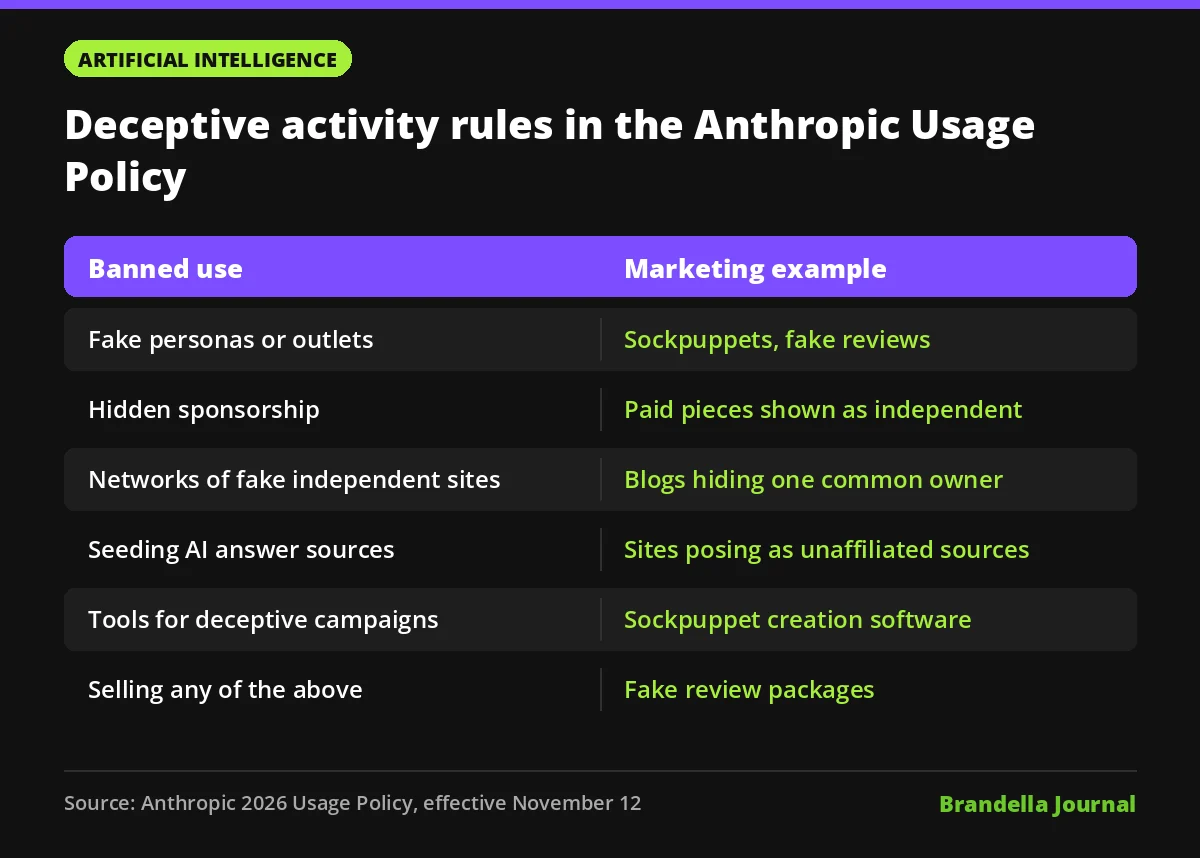
The section lists six things Claude cannot be used for. In plain terms:
| Banned use | Marketing example it would cover |
|---|---|
| Fake personas, accounts, outlets or organisations that mislead people | Sockpuppet accounts, astroturfing, fake reviews, bots that claim to be human |
| Hiding the sponsorship of content meant to influence decision makers | Paid opinion pieces presented as independent |
| Networks of fake or “ostensibly independent” sites hiding a common source | A cluster of blogs run by one company posing as separate voices |
| Seeding content so search engines or AI systems draw on misleading sources | Sites posing as unaffiliated sources that all corroborate the same claims |
| Building tools or infrastructure for deceptive campaigns | Software for sockpuppet creation or scaled impersonation |
| Selling any of the above as a service | Agencies marketing fake review or fake network packages |
Why the AI answer seeding line matters for GEO
The fourth bullet is the one to read twice. Anthropic gives an example: “networks of sites posing as unaffiliated sources corroborating the same claims.” That describes a tactic some practitioners have tried in AI search, where several thin sites repeat the same brand claim so that a chatbot sees apparent consensus.
The key words are origin, authorship and independence. Publishing a strong page about your own product is not the problem. Presenting your own content as if it came from a neutral third party is. If you need a refresher on how this kind of work differs from classic search, see our guide to AEO vs SEO vs GEO.
The word “SEO” does not appear in the policy. The rule is about deception, not about optimisation in general. Writing clear, well sourced content that AI systems want to cite, as covered in our post on how to increase AI search citations, stays well inside it.
Other changes in the 2026 update
Not every change is about marketing, but a few are worth knowing:
- The elections section is now called “Do Not Undermine Democratic Processes.” Anthropic removed the blanket ban on personalised vote and campaign targeting, while deception based targeting and misuse of personal data stay prohibited under other sections.
- Surveillance rules were rewritten. Tracking people without consent is banned, while consented tracking such as fraud monitoring is allowed.
- A new rule covers “sustained and needless abusive or cruel behavior” toward Claude, limited to extreme cases with no clear purpose.
- Claude controlling hardware that takes physical actions now needs a qualified operator who can observe and stop it.
The update also clarifies how the Supported Regions policy is enforced. None of these touch normal content or ad work, but agencies with political clients should read the democratic processes section closely.
What marketers should do now
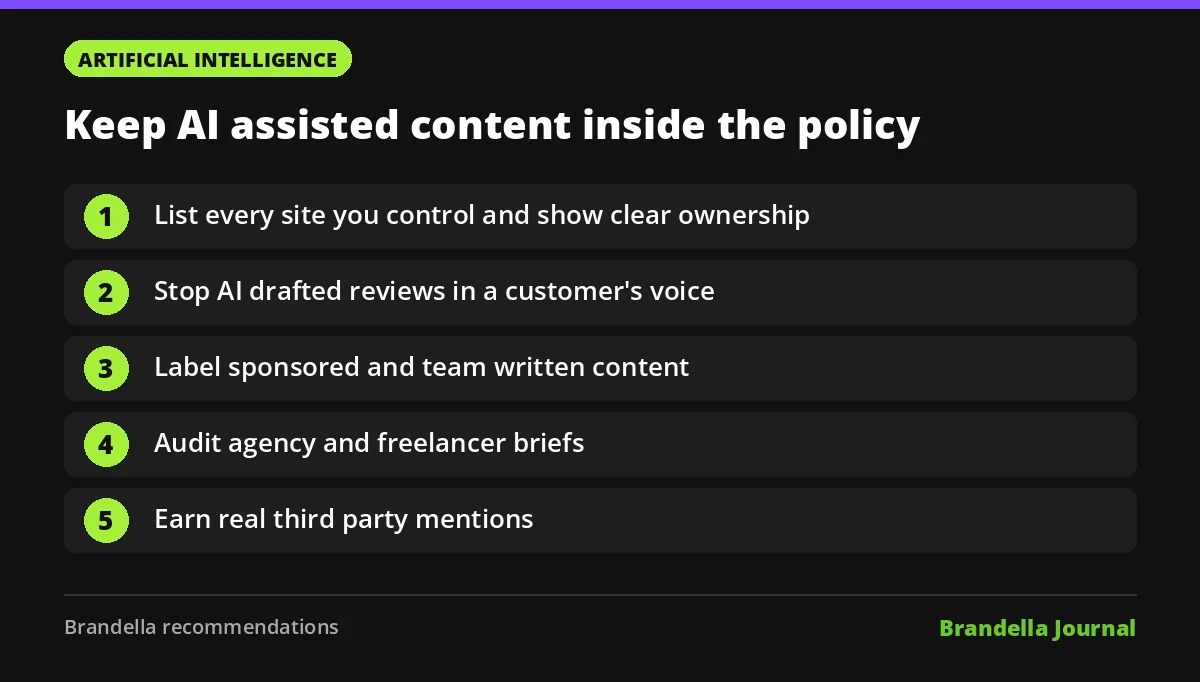
These are Brandella recommendations, not official Anthropic guidance:
- List every site you control. If you run microsites, review hubs or partner blogs, make ownership clear on each one with an about page and consistent company details.
- Check review and testimonial workflows. Any process where Claude drafts reviews, comments or forum posts in a customer’s voice should stop. Use AI to summarise real feedback, not to invent it.
- Label sponsored content. If a piece was paid for or written by your team, say so plainly, especially on comparison or “best of” pages.
- Audit agency and freelancer briefs. Ask partners who use Claude whether any deliverable relies on fake personas or networks of “independent” sites. The ban on selling such services applies to them too.
- Invest in real third party signals. Earn mentions through original data, expert quotes and genuine reviews. Our EEAT guide explains why this also helps in classic search.
Keep a short written record of what you checked and when. If a client or platform later asks how your content is produced, you will have an answer ready.
How this fits the wider AI search picture
AI providers and search engines are both moving against manufactured consensus. Google already strengthened its scaled content abuse policy in 2024 to cover “producing content at scale to boost search ranking,” and our coverage of the August 2026 spam update shows how fast low value networks can lose visibility.
What is new here is that a model provider has written the AI answer version of this rule into its terms. A tactic that once only risked rankings now risks access to the tool itself. Anthropic has not said how it will detect such use, so treat enforcement details as unknown for now.
The practical takeaway is simple. Use Claude to research, draft and improve content that carries your real name. Do not use it to pretend that many independent voices agree with you.