Ziff Davis Google Referrals Fell 37%: What AI Impressions Hide
Ziff Davis Google referrals fell about 37% in Q3 2026 while AI citations hit 2.7 billion. What the numbers mean and how to read your own AI impressions.

In this article
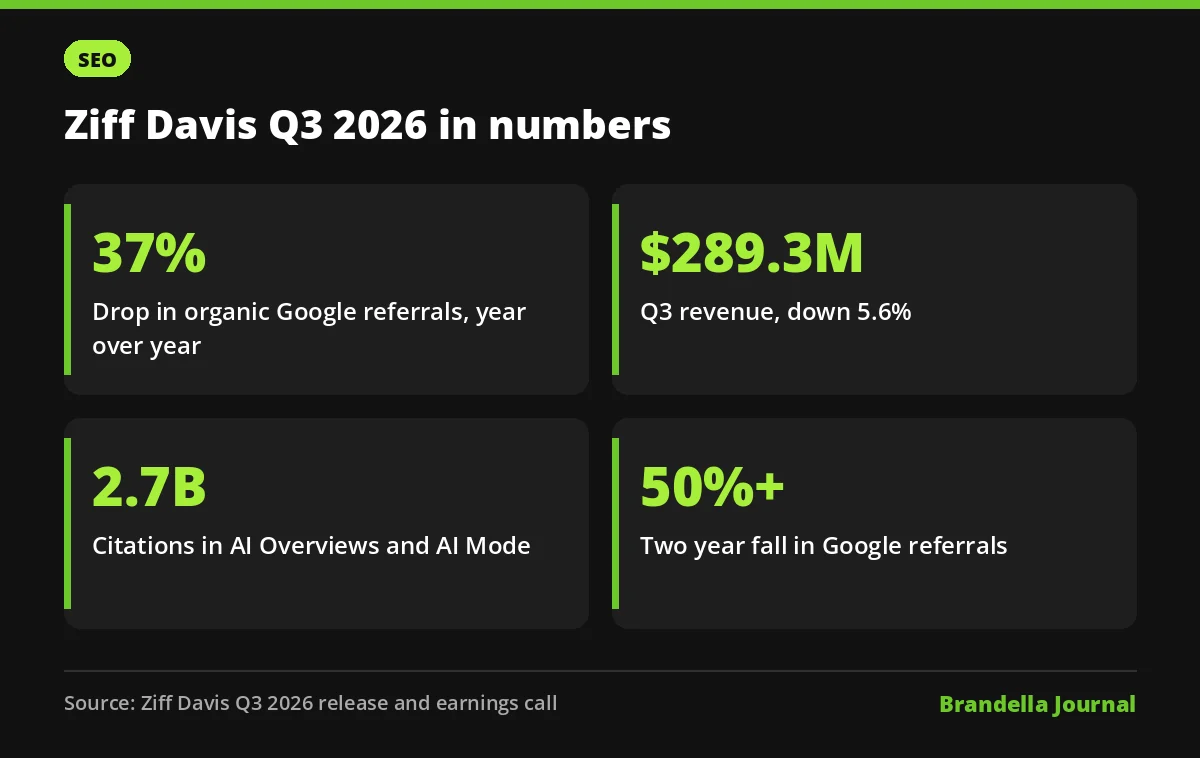
Ziff Davis Google referrals dropped hard in the third quarter of 2026. On the company’s November 6 earnings call, CEO Vivek Shah said organic Google referrals to its properties “declined approximately 37% year-over-year in the third quarter,” after a drop of about 23% in the same quarter last year. He called the two year decline “over 50%.”
Ziff Davis owns large content brands such as IGN, so this is one of the clearest public data points on what AI search is doing to big publishers. It also came with a number many SEOs will recognise from their own dashboards: AI impressions from Google Search Console.
This post covers what Ziff Davis reported, why its AI impressions figure needs careful reading, and the steps you can take to measure your own exposure.
What Ziff Davis reported for Q3 2026
According to the company’s Q3 2026 earnings release, published November 5, 2026, revenue fell 5.6% to $289.3 million, down from $306.5 million a year earlier. Adjusted EBITDA fell 16.0% to $82.2 million.
The earnings presentation shows advertising and performance marketing revenue at $186 million, down 7.7% from $202 million. Subscription and licensing revenue came in at $98 million, compared with $101 million a year earlier.
So a 37% fall in Google referrals did not turn into a 37% fall in revenue. Shah explained why on the call: “not all of the businesses in our portfolio rely on Google traffic,” and the company has subscription, app and newsletter businesses.
The Ziff Davis Google referrals gap in numbers
Here are the main search related figures from the call transcript, all quoted by management.
| Metric | What Ziff Davis said |
|---|---|
| Organic Google referrals, Q3 2026 | Down about 37% year over year |
| Organic Google referrals, Q3 2025 | Down about 23% year over year |
| Two year decline | Over 50% |
| Citations in AI Overviews and AI Mode | Roughly 2.7 billion in the quarter |
| Citations vs Google Search clicks | Nearly 10 times the clicks those sites received |
| Revenue tied to web traffic | Roughly a third, with search about 40% of that traffic |
Shah was also clear about the outlook. He said the company is “not planning on a search recovery” and that “referrals are going to continue to come down.”
Why AI impressions are not the same as lost clicks
The 2.7 billion figure comes from Google’s own reporting. Shah said the statistic “comes from Google’s Google Search Console.” Google’s help page for the Generative AI performance report defines these impressions as how many times links to your site were shown to a user in a generative AI feature on Google Search, covering AI Overviews and AI Mode.
That report shows impressions only. It does not give a click or click through rate for AI features. So when a publisher compares AI impressions with total Google Search clicks, it is comparing two different things: how often a link was displayed inside an AI answer, and how many clicks came from all of Search.
Our view: the comparison is still useful as a signal that content is being used heavily in AI answers. But it is not proof of a specific AI click through rate, and you should not present it that way in your own reports.
How the Ziff Davis Google referrals drop compares with other publishers
Ziff Davis is not alone. In its own Q3 results this month, Tripadvisor told investors search would weigh on its growth into 2027, which we covered in Tripadvisor SEO headwinds will last into 2027.
The difference is in how exposed each business is. Ziff Davis says the majority of its web businesses are not traffic dependent, and its CFO Bret Richter said that before selling its connectivity unit the company was “approaching 50% subscription licensing revenue.” Shah also said IGN, its largest property for search referrals, gets a lot of direct traffic.
On licensing, Shah said the company remains “open to signing licensing deals,” and that its litigation with OpenAI should bring clarity on how content used by AI is valued.
How to check your own exposure in Search Console now
You can run the same kind of analysis on your site today. This is Brandella’s recommended process, not an official Google method.
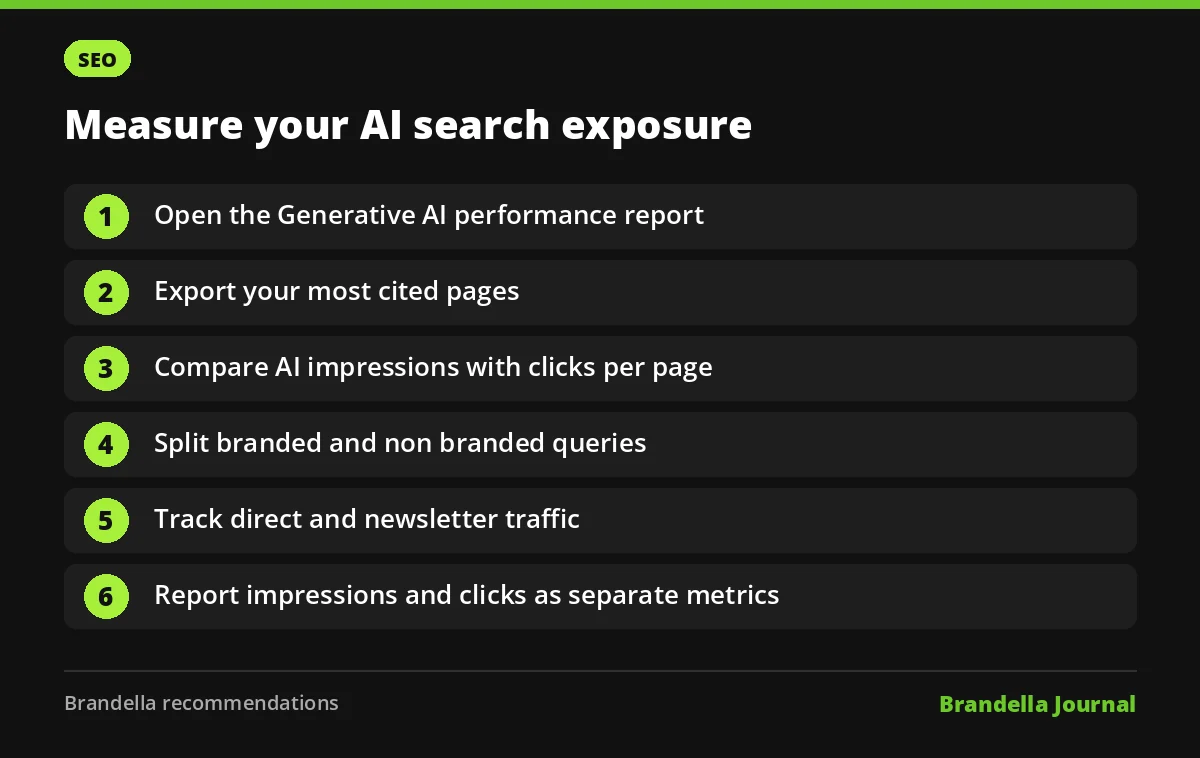
- Open the Generative AI performance report. In Search Console, find the Generative AI performance report (Search). If you do not see it, Google says your site may have too few AI impressions.
- Find your most cited pages. Sort the Pages tab by impressions and export the top pages. These are the pages AI answers lean on most.
- Compare with the main Performance report. For the same pages and date range, check clicks and average position in the Search Console Performance report. Pages with high AI impressions and falling clicks are your biggest risk.
- Separate branded and non branded demand. Use the branded queries filter to see if the loss is in generic informational queries, which is where AI answers usually sit.
- Track direct and newsletter traffic. Ziff Davis leans on direct visits, subscriptions and newsletters. Measure these channels monthly, and tag every campaign link with UTM parameters so they are not lost as direct traffic.
- Report honestly. Show AI impressions and clicks side by side, but label them as different metrics. Do not divide one by the other and call it CTR.
What publishers should take from this
The lesson is not that SEO is over. It is that a business needs revenue that does not depend on one referral source. Ziff Davis saw a far bigger fall in Google referrals than in revenue because it spread its income across subscriptions, apps, licensing and newsletters.
For smaller sites, the practical version is simpler. Build an email list, give readers a reason to come back directly, and make the pages AI answers cite worth clicking with tools, data or depth that a summary cannot replace. Our guide on how to still get cited in AI Overviews covers the content side in more detail.
Keep watching your own Generative AI report each month. If your AI impressions rise while clicks fall, you are seeing the same pattern Ziff Davis described, just at a smaller scale.