
Now Reading: Conversion Rate Optimization: 7 Proven CRO Tips
-
01
Conversion Rate Optimization: 7 Proven CRO Tips
Conversion Rate Optimization: 7 Proven CRO Tips

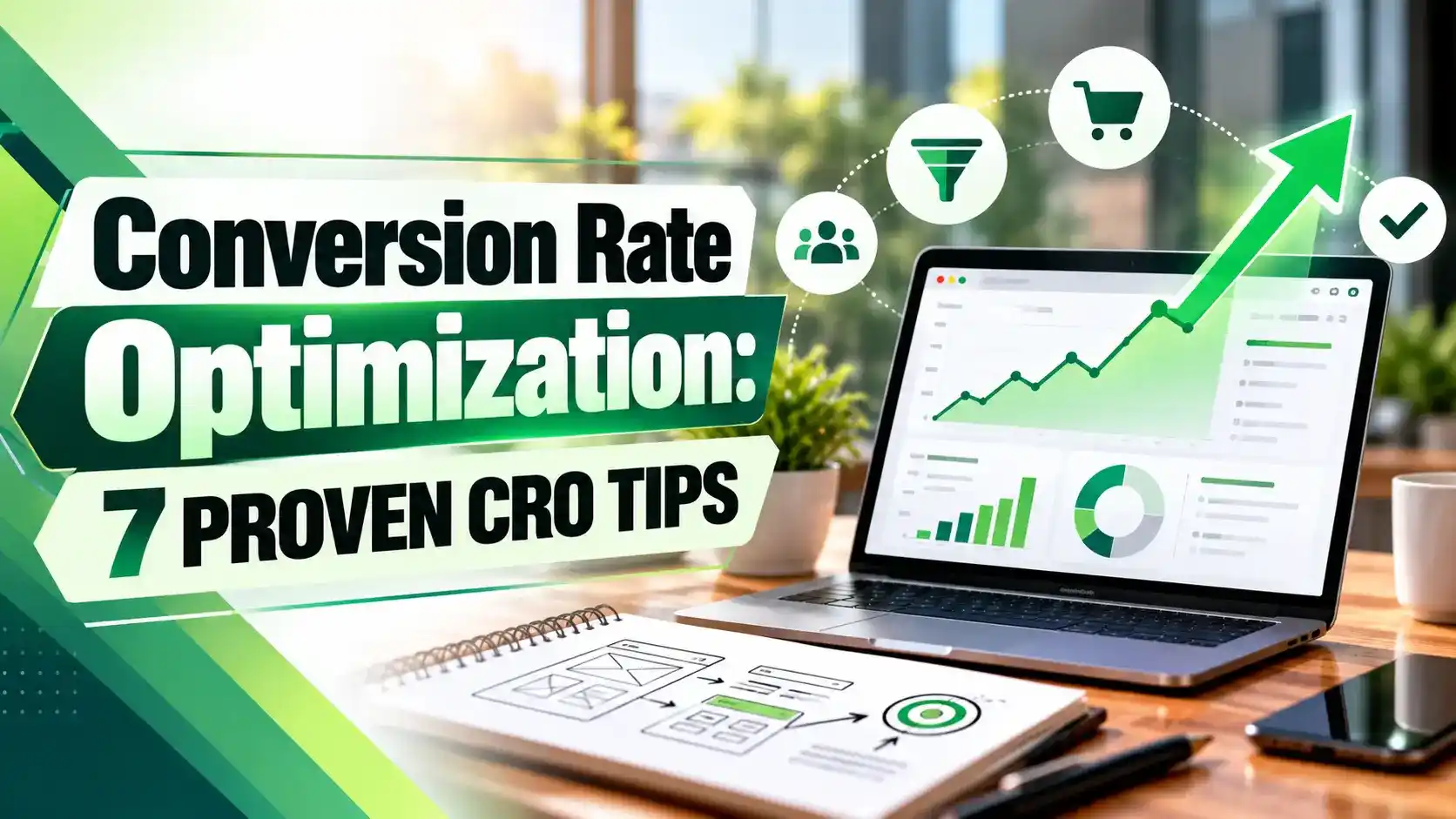
Most sites do not have a traffic problem, they have a conversion problem. This guide walks through seven proven conversion rate optimization tips, from building real hypotheses and reaching statistical significance to picking the right testing tools and fixing landing pages against real industry benchmarks.
Hey! If you have ever watched your traffic graph climb for months while your sales numbers barely move, you already know why conversion rate optimization matters more than one more push for fresh visitors.
Picture this: your landing page pulls a thousand visits a week, and only twelve people actually buy. Conversion rate optimization is not about adding more traffic, it is about turning the visitors you already have into customers, and these seven tips show you exactly where to start.
Conversion Rate Optimization Tip 1: Build Every Test on a Real Hypothesis
Conversion rate optimization starts with a hypothesis, not a hunch. A proper hypothesis names the problem you saw in your data, the change you plan to make, and the result you expect, so you can judge the test honestly once it ends instead of just hoping for green numbers.
Weak teams skip this step and jump straight to moving a button or swapping a headline because a competitor did it. Strong teams start from behavior data, things like where visitors stall in a form, which section gets ignored, or where mobile users give up and leave.
A good source for that behavior data is your own customer journey map, paired with session recordings and heatmaps. Once you can describe the friction point in one sentence, you have a hypothesis worth testing.
Tip
Write your hypothesis before you touch the design tool. If you cannot finish the sentence "Because we saw X, changing Y will cause Z," the test is not ready yet.
Tip 2: Do Not Call a Winner Before You Reach Statistical Significance
This is where most self taught testers get burned. A test that is "winning" after two days with ninety visitors per variant is not a result, it is noise. Before you can say a conversion rate optimization test actually worked, the sample needs to be large enough and the test needs to run long enough to rule out chance.
Wingify's own guidance for VWO breaks this down with real numbers: using a standard confidence level of ninety five percent and a statistical power of eighty percent, a baseline conversion rate of four percent moving to five percent typically needs well over five thousand visitors per variant before you can trust the result, according to Wingify's sample size guide. Smaller samples might show a "winner," but the odds that it is a false positive climb fast.
Run every test through a full business cycle, usually at least one to two full weeks, so day of week and payday effects even out. Pulling the plug early is one of the fastest ways to roll out a "winning" page that quietly performs worse.
Google discontinued Google Optimize and Optimize 360 at the end of September 2023, pushing marketers toward GA4 and third party testing platforms. Search Engine Journal reported that Google planned to expand native experimentation inside GA4 rather than keep a separate tool.
Tip 3: Pick a Testing Tool That Matches Your Traffic
Picking the right stack is part of conversion rate optimization too, and with Google Optimize gone, most teams now split between a dedicated testing platform and a behavior analytics tool, since the two solve different problems. Optimizely and VWO run the actual A/B, multivariate, and multi page experiments, while tools like Microsoft Clarity show you why visitors behave the way they do, which matters just as much as the test results themselves.
Optimizely's own documentation explains that multivariate tests, which compare several page elements and how they interact, need a high traffic site to reach a reliable result quickly, while lower traffic sites usually get to significance faster by running a series of simple A/B tests instead, according to Optimizely's experimentation FAQ.
For the "why," Microsoft Clarity gives you free heatmaps, full session recordings, and a feature called smart events that lets you mark any click or page visit as a tracked conversion goal without writing code, which is genuinely useful for diagnosing a drop in a signup flow, per Microsoft Clarity's own CRO guide.
Tip
Pair your testing tool with real analytics, not vanity metrics. If you have not already set up event tracking, our GA4 metrics guide walks through the basics before you run your first test.
Tip 4: Fix Landing Pages Against Real Benchmarks, Not Guesses
A good conversion rate optimization effort needs a target that is grounded in reality, and benchmarks vary enormously by industry. Unbounce's landing page research puts the overall median conversion rate at 6.6 percent, with a "good" result sitting around the 75th percentile for that industry, per Unbounce's conversion benchmark data.
| Industry | Median Rate | Top 25 Percent |
|---|---|---|
| Ecommerce | 4.2% | 11.4%+ |
| SaaS | 3.8% | 11.6%+ |
| Professional services | 6.1% | 14.1%+ |
| Financial services | 8.3% | 26.1%+ |
| Education | 8.4% | 20.0%+ |
The same research found that copy written at around a fifth to seventh grade reading level converted noticeably better than denser, jargon heavy pages, and that email traffic often converts far better than paid social traffic on the same offer. If you are tracking which channel sends which visitor, our UTM parameters guide will help you separate the two before you blame the page for a traffic problem.
Device also plays a bigger role than most teams assume. The same benchmark report found mobile outperforming desktop in categories like financial services and legal, while desktop still wins for longer, higher consideration purchases such as travel bookings. None of that means much on its own though, since a benchmark table only tells you where you stand, not what to change, which is exactly why the hypothesis step from Tip 1 still has to come first.
Tip 5: Analyze the Whole Funnel, Not Just One Page
A single page rarely tells the full story, and real conversion rate optimization work has to look past it. Most lost conversions happen between steps, not on one screen, so funnel analysis has to track the full path from the ad click to the thank you page, flagging exactly where visitors stall or bounce.
Session recordings and heatmaps, the same tools covered in Tip 3, are most useful when you point them at the specific step your funnel report flags as weak, rather than scrolling through hours of footage at random. Pair the recording with the step number, the device, and the traffic source, and the pattern usually shows up within a few dozen sessions.
If a huge share of visitors drop off between an ad and a landing page, the issue might be a mismatch in offer or messaging rather than the page itself. That is why pairing funnel data with attribution modeling matters: it tells you which channel brought a visitor who was actually ready to convert in the first place, and which one just added clicks to the report.
Tip 6: Avoid the Mistakes That Quietly Kill CRO Programs
Agencies and in house teams fall into the same traps often enough that they are well documented. Conversion Sciences, a firm that has run optimization programs for years, lists several recurring errors that quietly waste a testing budget, per Conversion Sciences' optimization mistakes article.
Tip 7: Treat It as an Ongoing Program, Not a One Time Project
The teams that get the most out of conversion rate optimization never really "finish." They keep a running backlog of hypotheses ranked by expected impact and effort, test one or two at a time, document the result either way, and feed what they learned into the next idea.
That cadence matters more than any single tool. A small ecommerce brand running one careful test a month will usually beat a bigger team that runs five rushed tests and calls every one a winner within three days. For broader context on where testing fits into the rest of your plan, our digital marketing tips roundup covers how CRO connects to the rest of your acquisition strategy.
Build a simple, shared scoreboard that anyone on the team can open: hypothesis, result, confidence level, traffic source, and what you would test next. Within two or three quarters, that record becomes the most valuable asset your conversion rate optimization program owns, more valuable than any single winning variant.
Conversion rate optimization is the structured process of improving the share of website visitors who complete a desired action, such as buying, signing up, or filling out a form, through hypothesis driven testing rather than guesswork.
Most tests need at least one to two full business cycles, often one to two weeks, and enough visitors per variant to reach statistical significance. Ending a test early is one of the most common causes of a false winner.
Google discontinued Google Optimize in September 2023. Marketers have since moved to dedicated platforms such as VWO and Optimizely, often paired with GA4 for measurement and tools like Microsoft Clarity for behavior insight.
It depends heavily on industry. Benchmark research puts the overall median around 6.6 percent, with top performing pages in most industries reaching double digits, so compare your page against its own category rather than a single universal number.
No. Free tools like Microsoft Clarity for heatmaps and session recordings, plus GA4 for measurement, are enough to start forming real hypotheses before you ever pay for a dedicated testing platform.
Learn Today
Conversion Rate Optimization
The structured, data driven process of increasing the share of visitors who complete a desired action.
Statistical Significance
The confidence level showing a test result is unlikely to be due to random chance alone.
Multivariate Test
An experiment comparing several page elements at once to see how they interact.
Funnel Analysis
Tracking visitor drop off across each step of a path, from first click to final conversion.
Session Recording
A replay of an individual visitor's on site behavior, used to spot friction and usability issues.
Smart Event
A custom, code free rule that marks any click or page visit as a tracked conversion goal.
Ready to Start Your Conversion Rate Optimization Plan?
Explore more Brandella Journal guides on SEO and digital marketing.