Customer Journey Mapping for Digital Marketing: The Complete 2026 Guide
Customer journey mapping for digital marketing: the five core stages, how "dark touchpoints" from AI agents change the picture, and how to build a map.

In this article
- 01What Customer Journey Mapping Actually Is
- 02The Five Core Stages
- 03How Customer Journey Mapping Actually Gets Built
- 04Getting Touchpoints Right
- 05Core Elements of a Working Map
- 06Common Customer Journey Mapping Mistakes
- 07Customer Journey Mapping Checklist That Gets Used
- 08Is Your Journey Map Actually Working?
- 09Common Questions
- Build a Complete Customer Understanding Framework
Customer journey mapping is the process of visualizing every interaction a customer has with your brand, from the moment they first hear about you to long after they've bought. It's not a diagram for its own sake, it's how marketing, sales, and support teams finally see the same picture instead of three different ones.
In 2026, that picture has gotten messier. Customers no longer move in a clean line from awareness to decision. They jump around, pause, return weeks later after seeing an AI-generated answer that reframed the whole problem.
Customer journey mapping still works, it just needs to account for that mess rather than pretend it doesn't exist. Here's how to build a map that actually reflects reality and drives real decisions.
01What Customer Journey Mapping Actually Is
HBS Online's guide defines the core components clearly: personas, journey stages, touchpoints, and the emotions or pain points customers experience along the way. Together, these give a holistic view of the customer experience that no single department has on its own.
Factors.ai's guide draws a distinction worth knowing before you start: a customer journey map considers every measurable interaction from awareness to consumption, while a user experience map only covers how customers use the actual product. In B2B especially, the buyer and the end-user are often different people entirely.
02The Five Core Stages
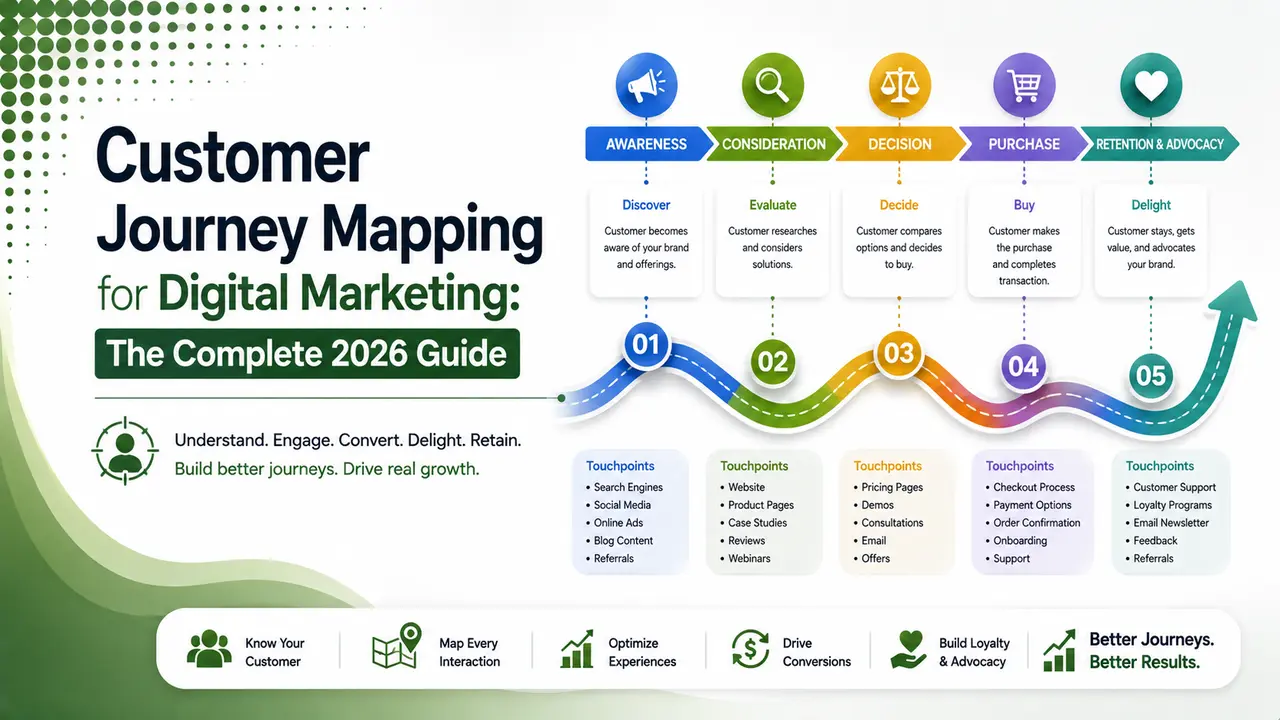
Improvado's guide lays out the standard framework: awareness, consideration, purchase, retention, and advocacy. Most maps vary the exact labels, but this five-stage backbone shows up across nearly every serious framework. If you are new to the channels behind each stage, our beginner guide to understanding digital marketing explains them one by one.
Text.com's guide is honest about how messy this looks in practice today: customers rarely move through these stages in a single clean path anymore. They discover a product through search, compare alternatives a week later, abandon the process, then return after an AI-generated answer reframes the problem entirely.
This shift connects directly to what our marketing attribution guide covers, when journeys stop being linear, first-click and last-click models both miss most of what actually happened along the way.
Userpilot's 2026 guide flags an emerging category worth watching: "dark touchpoints," interactions AI agents have with your brand, like reading your documentation or pricing page, that never show up in your analytics at all. If your content isn't machine-readable, you can become invisible to agent-mediated buying decisions entirely.
03How Customer Journey Mapping Actually Gets Built
The Complete Guide's framework distills a working map down to five essential elements per touchpoint: the stage the customer is in, the specific touchpoint they hit, what they're likely thinking, how they feel about it, and where the real opportunity sits for your team to act.
Koji's 2026 guide recommends narrowing scope aggressively before starting: pick one customer, one goal, one outcome. "Map the entire customer experience" is a doomed scope, "map the trial-to-paid conversion journey for self-serve B2B users in the first 14 days" is one you can actually research properly.
04Getting Touchpoints Right
CustomerThink's guide recommends starting broad, not narrow: list every possible touchpoint across the customer lifecycle without filtering first. Once the full list exists, identify which ones matter most for your business and your customers specifically.
Userpilot's touchpoints guide, referenced above, warns against a common trap: the standard "list all your touchpoints by stage" approach often produces a 40-row spreadsheet nobody acts on, or even opens again. Prioritization matters as much as completeness.
05Core Elements of a Working Map
A quick reference for what a genuinely useful customer journey map includes at every stage.
| Element | What It Captures | Why It Matters |
|---|---|---|
| Persona | Who the customer is, their goals and context | Prevents mapping a generic, unrealistic user |
| Stage | Where they sit in the journey right now | Anchors the touchpoint to a specific moment |
| Touchpoint | The specific interaction happening | The actual thing you can measure and improve |
| Emotion/pain point | How the customer feels, what frustrates them | Surfaces friction data alone won't show |
| Owner | Which team is responsible for that touchpoint | Turns the map into action, not just documentation |
06Common Customer Journey Mapping Mistakes
Userpilot's visualization guide is blunt about the biggest failure mode: a customer journey map that hasn't been updated in six months has become a record of what you assumed last quarter, not a strategy for what to do next.
Market With Boost's guide flags the second, quieter trap: assumption-led maps feel efficient but are risky. Ask internal teams how customers behave and you'll get confident, conflicting answers, marketing blames message clarity, sales blames lead quality, support blames product complexity, and often all of them are partly right without seeing the whole picture. Quantitative data from your attribution setup is what tells you where to actually look first.
07Customer Journey Mapping Checklist That Gets Used
A short list to keep a journey map from becoming a one-time exercise.
Pick one persona and one specific journey, not the entire customer experience at once.
Combine quantitative data with real customer input, don't rely purely on internal team assumptions.
Assign an owner to every touchpoint, so insights turn into action, not just a static diagram.
Update the map on a regular cadence, quarterly at minimum, since customer behavior shifts constantly.
Track emotions and pain points, not just clicks, since friction rarely shows up in raw analytics alone.
08Is Your Journey Map Actually Working?
Answer a few quick questions to check whether your current map is genuinely useful.
Is Your Journey Map Actually Working?
Select the option that matches your current map
09Common Questions
A customer journey map covers every interaction from awareness to advocacy. A UX map only covers how customers use your actual product, a narrower subset, especially important to separate in B2B where the buyer and end-user differ.
At least quarterly. A map that hasn't been touched in six months reflects what you assumed last quarter, not current customer behavior.
No. Start with one persona and one specific, high-impact journey, like trial-to-paid conversion, rather than attempting the entire customer experience in one pass.
A mix of quantitative analytics and real customer input, interviews, surveys, support tickets. Relying purely on internal team assumptions produces confident but often conflicting, inaccurate conclusions.
Usually because no one owns individual touchpoints, or the map was never updated after the initial workshop. A map without assigned action items is just documentation, not a working tool.
What We Learn Today
Journey mapping covers every interaction, UX mapping only the product
Five stages: awareness, consideration, decision, retention, advocacy
Customer journeys are increasingly non-linear and multi-entry in 2026
"Dark touchpoints" from AI agents rarely show up in standard analytics
Narrow scope beats mapping the entire customer experience at once
Maps need assigned owners and quarterly updates to stay useful
Build a Complete Customer Understanding Framework
Journey mapping works best alongside accurate attribution and conversion tracking. Explore both guides next.