YouTube Co-Views Now Count in Public Views: What Changes
YouTube co-views now add estimated TV group viewing to public view counts from November 2026. What changes, which metrics stay clean and how to report fairly.


In this article
YouTube co-views are now part of public view counts. Beginning November 2026, YouTube says public views on watch pages “incorporate co-views by estimating the number of individual viewers watching together on TV screens.” In plain terms, when a family watches a video together on the living room TV, the public counter can now reflect more than one viewer.
The change is documented in YouTube’s help pages How engagement metrics are counted and Understand your YouTube content performance. PPC Land reported it on November 16, 2026.
For creators, brands and agencies, this means view counts on TV heavy content may rise without any change in reach on phones or desktops. It also means old and new numbers are not directly comparable, so reports need a quick rethink.
What YouTube changed
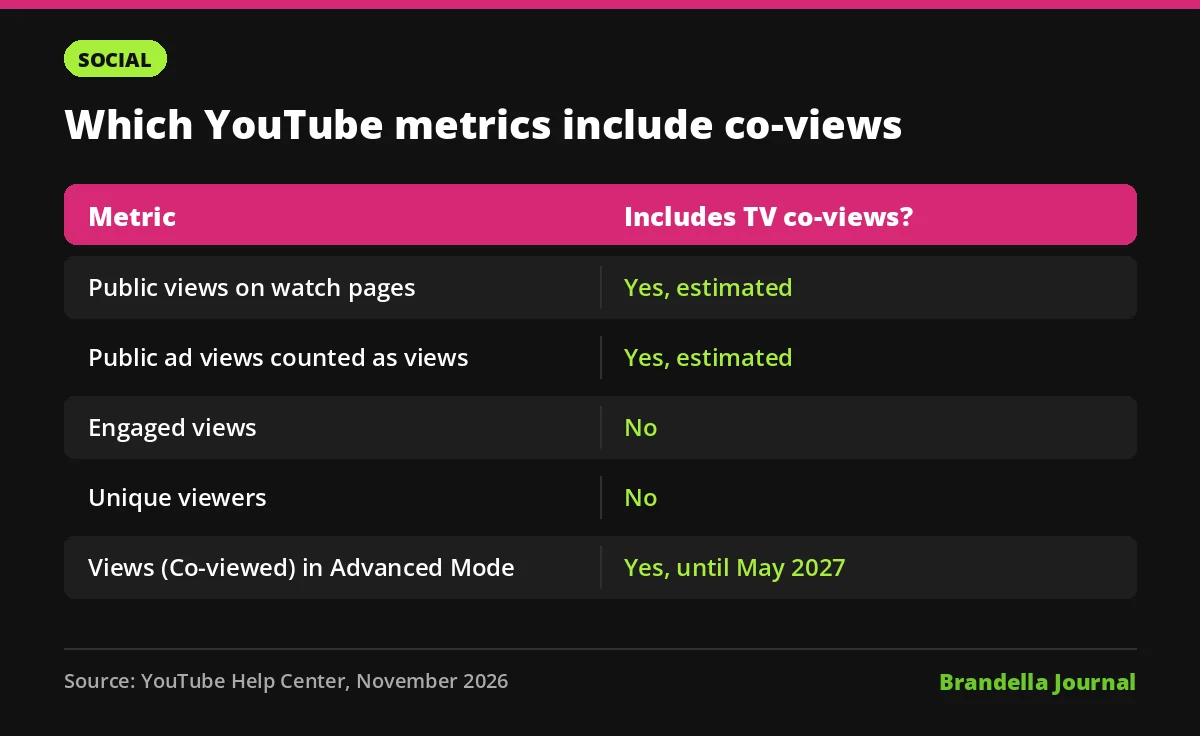
According to YouTube’s help pages and PPC Land’s summary of them, the co-view estimate now feeds into several public facing numbers. Others stay as they were.
| Metric | Includes co-views? |
|---|---|
| Public views on watch pages | Yes, estimated for TV screens |
| Public ad views counted as views | Yes, per the help page |
| Engaged views | No |
| Unique viewers | No |
| Views (Co-viewed) in Insights Advanced Mode | Yes, a separate total |
YouTube’s performance help page describes the co-view rate as “a dedicated metric that helps you understand how co-viewing impacts your overall view count.” It adds that you can divide total views by this rate to estimate baseline views without co-viewers.
The separate “Views (Co-viewed)” metric is described as an “estimated total view count including multiple people watching together.” The help page says it is available in Advanced Mode until May 2027.
How the YouTube co-views estimate works
YouTube has not explained the method. The help pages say only that co-views are estimated for viewers watching together on TV screens. There are no published margins of error or update schedules.
PPC Land reports that a September 2026 Creator Insider video described statistical modelling based on things like demographics, genre and viewing times, but YouTube has not published the model. Treat any co-view figure as an estimate, not a head count.
What it means for monetisation and brand deals
YouTube is clear on one point: “This update won’t impact your YouTube Partner Program (YPP) earnings or eligibility.” Earnings and eligibility still rely on engaged and qualified measures, not the new public total.
Brand deals are a different story. Many sponsors still look at the public view counter. A channel with a big TV audience may now show a larger number than before, even if the people watching on their own screens did not change. That is why sponsors and creators should agree on which metric a deal is priced on. Our guide to social media KPIs every marketer should track covers how to pick metrics that tie to real outcomes.
What creators and marketers should do now
These are Brandella’s recommendations, not official YouTube guidance.
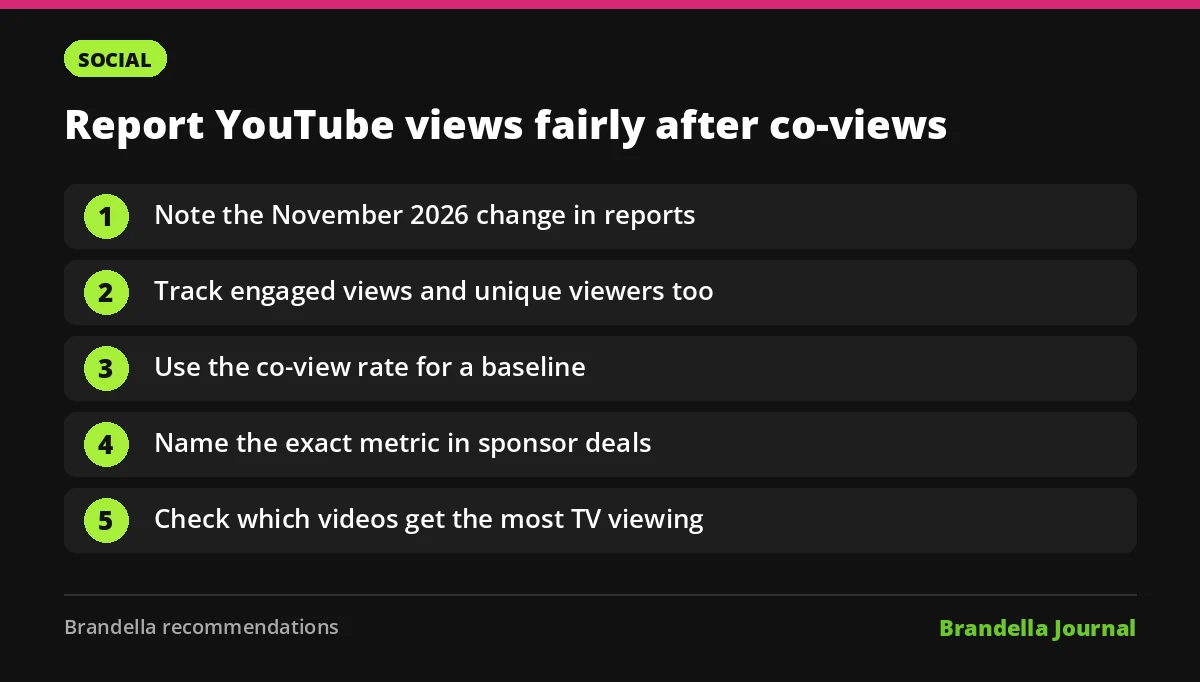
- Mark the change in your reports. Add a note that public views from November 2026 include estimated TV co-views, so nobody reads a jump as pure growth.
- Report engaged views and unique viewers too. Both exclude co-views, so they give a cleaner trend line across the change.
- Use the co-view rate. Divide total views by the co-view rate when you need a baseline comparable with older periods.
- Update sponsor contracts. Name the exact metric for any view based fee or guarantee.
- Check your TV audience share. Videos that do well on TV may see the biggest shifts. Plan TV friendly formats with that in mind.
YouTube’s own tools are also changing. Our coverage of YouTube Studio Insights replacing Analytics explains where these metrics now live, and our note on YouTube Partner Program 2027 updates covers the eligibility changes coming next year.
Why YouTube is doing this
TV has become a major screen for YouTube. PPC Land cites the Creator Insider description of the change, which points to “over 1 billion hours of YouTube on TVs every day” as the reason. When several people watch one screen, a single view undercounts the audience, which matters when YouTube competes with TV networks for brand budgets.
The open questions are still important. PPC Land notes that YouTube has not said whether past counts will be restated, which countries are included, or whether billable ad views change. Advertisers should watch for updates before comparing YouTube views with other channels, and our video marketing ideas guide is a good place to plan creative that works on big screens.
FAQ about YouTube co-views
Do co-views change how much creators earn?
No. YouTube says the update won’t impact YouTube Partner Program earnings or eligibility.
Which metrics do not include co-views?
Engaged views and unique viewers. YouTube’s help page says both exclude co-views.
How can I see views without co-viewers?
Divide total views by the co-view rate shown in YouTube Insights to estimate a baseline without co-viewers.
Does this apply to phone and desktop viewing?
No. YouTube says the estimate covers people watching together on TV screens.