Global Privacy Control: AdSense Adds Louisiana and Vermont
From November 17, Google AdSense honours Global Privacy Control signals for Louisiana and Vermont users. What changes for publishers and what to check now.


In this article
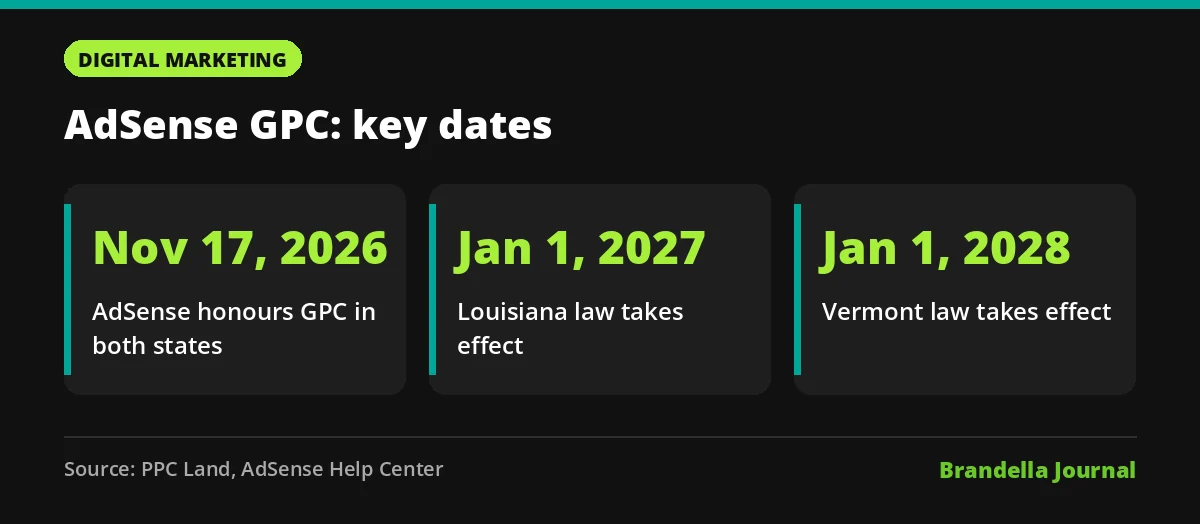
Google AdSense is adding Louisiana and Vermont to the list of US states where it honours Global Privacy Control signals. On or after November 17, 2026, when a visitor from either state has GPC switched on in their browser, Google will automatically limit how it uses data for that ad request.
The change was reported on November 16, 2026 by PPC Land, based on a new AdSense Help Center page titled “Upcoming US states with universal opt-out mechanism.” It follows the same approach Google already uses in other states with similar laws.
This matters to every publisher that earns from AdSense and gets US traffic. Opted out visitors from these states will see non personalized ads, which usually changes what those impressions are worth.
What Global Privacy Control is
Global Privacy Control is a browser setting that sends a signal to every website saying the person does not want their data sold or shared. The Global Privacy Control project maintains the standard, and several US state laws now require businesses to treat it as a valid opt-out.
Google explains its approach in an earlier AdSense notice on universal opt-out provisions: for users in the covered states, “Google will receive GPC signals directly and trigger RDP mode for those ad requests.” That notice, dated June 30, 2025, covered states such as Colorado, Connecticut, Montana, Texas, Minnesota, New Jersey and Maryland.
What changes in AdSense for Louisiana and Vermont
According to PPC Land, the new page says Google will receive GPC signals directly for users in Louisiana and Vermont and apply restricted data processing (RDP) per ad request, starting on or after November 17, 2026.
| Detail | Louisiana | Vermont |
|---|---|---|
| Law | Data Privacy Act (SB 386) | Data Privacy and Online Surveillance Act (S.71) |
| Signed | May 29, 2026 | June 16, 2026 |
| Law takes effect | January 1, 2027 | January 1, 2028 |
| Cure period runs until | July 31, 2027 | June 30, 2029 |
| AdSense honours GPC from | On or after November 17, 2026 | On or after November 17, 2026 |
PPC Land points out a date discrepancy: Google’s page says the state provisions arrive “on or after January 1st 2027,” but law firm analyses place Vermont’s effective date in 2028. Either way, Google is switching on GPC handling well before both laws apply.
What restricted data processing does to your ads
Google’s help page on restricted data processing settings explains what happens when RDP is on. Ads become non personalized, which Google describes as ads that “are not based on a user’s past behavior.”
Instead, ads are targeted using context such as the current page content and coarse location, with geo targeting limited to city level. Interest based audience targeting, including demographic and user list targeting, is not allowed in RDP mode.
For publishers, the practical effect is that opted out visitors from these two states become contextual ad traffic. That is one more reason to make page content clear and topic focused, which also helps SEO.
What publishers should do now
These are Brandella’s recommendations, not legal advice. Google itself says publishers should work with their legal teams to decide whether RDP fits their compliance needs, in its notice on upcoming state privacy laws.
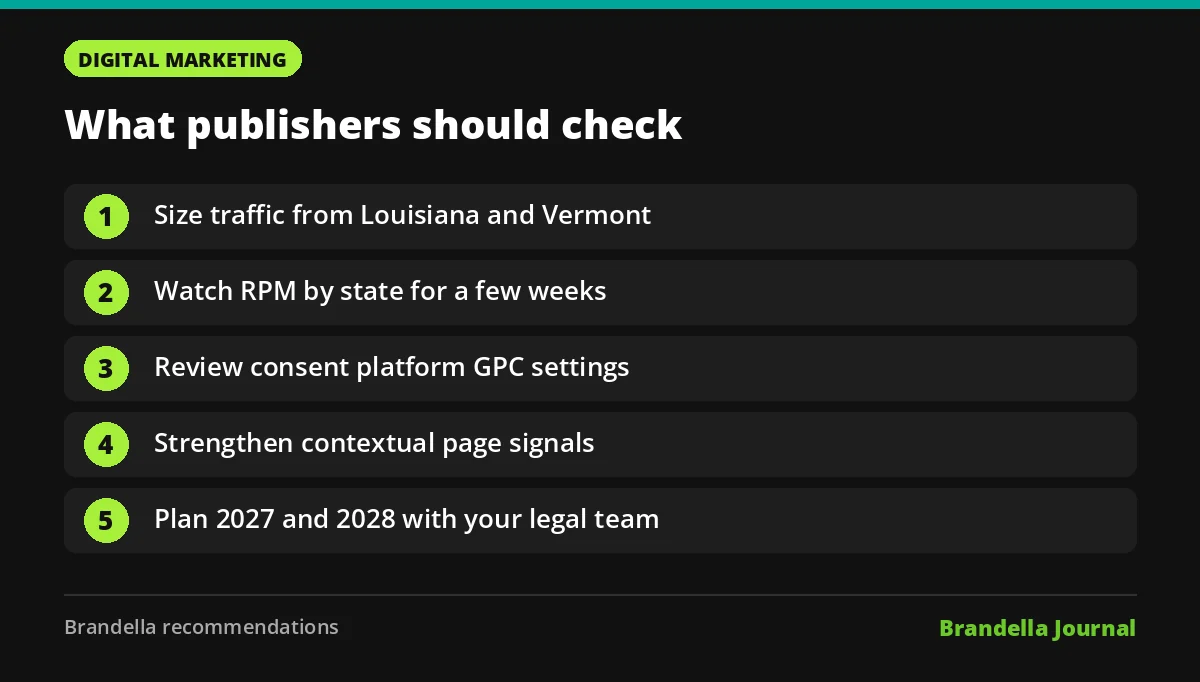
- Check your US traffic split. In your analytics, see how much traffic comes from Louisiana and Vermont so you can size any revenue change.
- Watch RPM by state for a few weeks. Compare page RPM for these states before and after November 17 to see the real effect.
- Review your consent setup. If you use a consent platform, make sure its state list and GPC handling match what Google now does. Our guide to Consent Mode v2 covers how consent signals flow to Google tags.
- Strengthen contextual value. Clear headings, focused topics and good page structure help contextual ads match your content.
- Talk to your legal team about 2027 and 2028. The laws themselves come later, and they cover more than ads.
The bigger trend: privacy signals by default
Every few months another US state joins the list, and new laws are pushing browsers to offer opt-out signals. PPC Land notes that California’s Opt Me Out Act (AB 566) requires browsers to offer opt-out preference signals starting January 2027.
That means the share of visitors sending GPC is likely to grow, not shrink. Building strong first party data and privacy practices now is safer than relying on third party tracking. Publishers outside the US face similar shifts, such as India’s new consent manager registration under DPDP.
FAQ about Global Privacy Control in AdSense
Do I need to change my AdSense code?
Based on Google’s notices, no. Google receives the GPC signal directly and triggers RDP for that ad request.
Will this affect visitors from other states?
This update adds Louisiana and Vermont. Other states were already covered by earlier AdSense notices.
Does Global Privacy Control block all ads?
No. Ads still show, but they are non personalized and based on context.
Is this legal advice for my site?
No. Google recommends that publishers work with their legal teams on compliance.