Top 10 Listicle Warning From Google: What It Really Means
Google told brands to stop the Top 10 listicle and lead with first-hand expertise. What the post and the article behind it say, and how to fix generic content.

In this article
Google’s marketing team wants brands to drop the generic top 10 listicle. On November 19, 2026, the Think with Google account on X posted, as reported by Search Engine Journal: “AI didn’t make your brand invisible in Search. Your content did.” The post paired “Stop the ‘Top 10’ listicle” with “start leading with first-hand expertise.”
Some SEOs read that as Google taking aim at every list post. The article the post links to is narrower than that. It is a Think with Google piece by Brendon Kraham, VP of Search and Commerce Global Ads Solutions at Google, called Building brand authority in the Gemini era of Search, published on October 14, 2026.
This matters to content teams and CMOs who have been blaming AI for lost visibility in Search. Google’s message is that the content itself is the problem, and the fix is expertise only your brand has.
What the Think with Google article argues
Kraham’s article is aimed at CMOs and sets out three priorities: follow what he calls the super-empowered consumer, fuel brand authority with unique expertise, and focus on business outcomes.
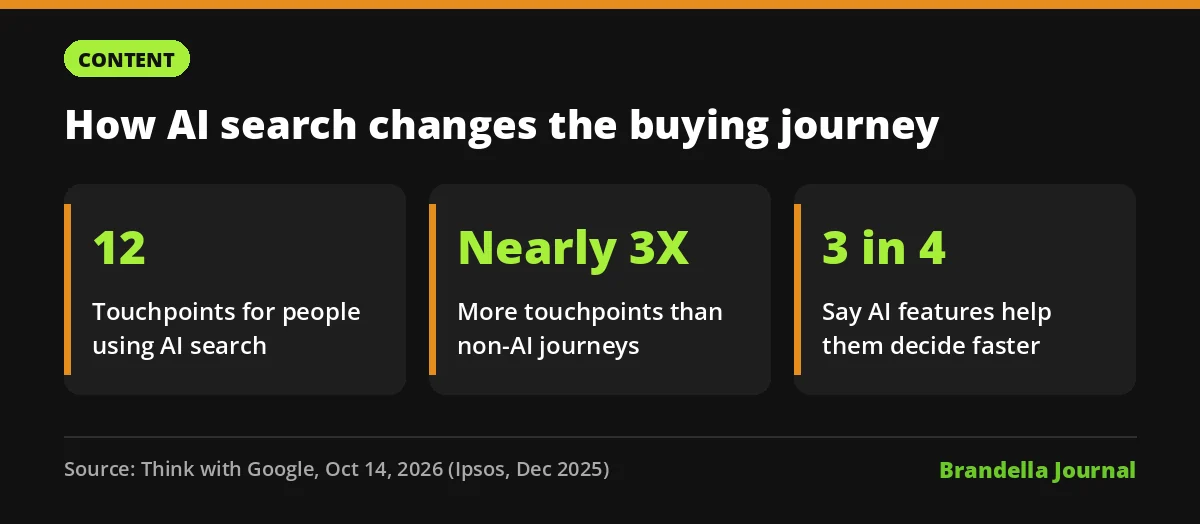
His starting point is that AI search does not shorten the buying journey. “The reality is the new era of Search doesn’t shrink the consumer journey; it expands it,” he writes. Google backs this with Ipsos research it commissioned, the Global Consumer Journeys study from December 2025:
| Finding | Figure |
|---|---|
| Touchpoints for people using AI search in their buying process | 12, nearly 3X more than non-AI journeys |
| People on Google who say AI features help them decide faster and with more confidence | 3 in 4 |
The article also says Google’s generative features highlight blogs, videos and forum discussions, especially for product discovery, and that brands should keep websites, apps and product feeds fast and easy to use.
Where the Top 10 listicle comes in
The listicle line comes from one example. A running store, Kraham writes, could publish a deep-dive video on why a customer’s running shoes collapsed “instead of publishing a generic ‘Top 10 Things to Consider.’” He calls that kind of knowledge “your brand advantage.”
So the target is the generic tips post that any site could write, with no experience behind it. Search Engine Journal points out that neither the article nor Google’s guide to optimizing for generative AI features in Search mentions self-promotional “best” lists. A list built on your own testing or customer data is a different thing from ten tips copied from page one.
Elsewhere in the piece: “Search visibility has always come down to authority and helpfulness,” the article says, which lines up with the experience part of E-E-A-T and the helpful content approach Google has pushed for years.
Top 10 listicle vs first-hand content
Here is how we read the difference, using the article’s own example. This table is Brandella’s interpretation, not a Google rule.
| Generic Top 10 listicle | First-hand expertise content |
|---|---|
| “Top 10 Things to Consider” when buying shoes | A video on why one customer’s shoes collapsed |
| Could be published by any site | Only your team could make it |
| Built from what already ranks | Built from what you have seen and fixed |
| Measured by traffic alone | Measured by leads or sales |
The last row comes straight from the article. Kraham asks brands to keep planning around “real business goals like leads or sales, not unproven proxy metrics.”
What content teams should do now
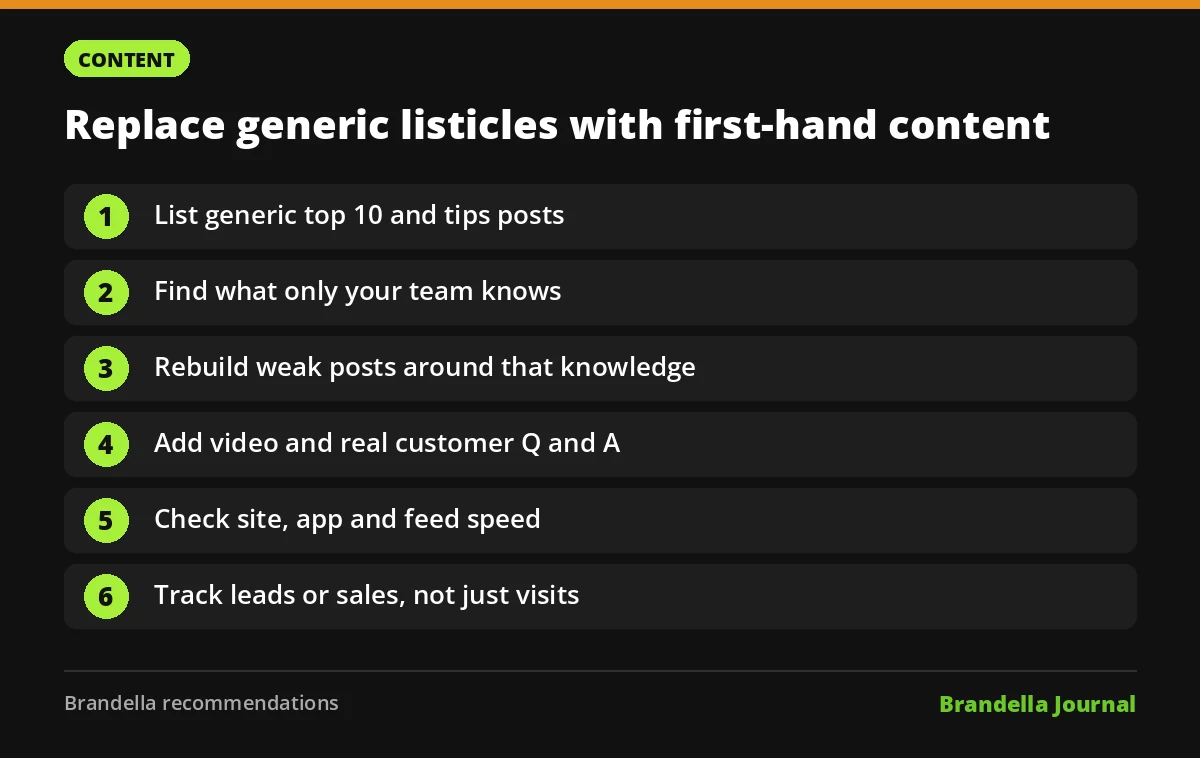
These steps are our recommendations based on the article, not instructions from Google.
- List your generic list posts. Pull every “top 10”, “best tips” or “things to consider” article and note which ones have no original data, photos, tests or customer examples.
- Ask what only you know. For each topic, find the question your sales or support team answers every week, the product failure you have diagnosed, or the result you have measured.
- Rebuild the weakest posts around that knowledge. A list format can stay if each item is backed by your own experience. Cut items you cannot support.
- Add the formats Google says its AI features highlight. The article names blogs, videos and forum discussions, so a short video or a real customer Q and A can sit next to the text.
- Check speed and feeds. The article tells brands to keep websites, apps and product feeds fast and user friendly.
- Change the scorecard. Track leads or sales from each rebuilt page, not just rankings or visits.
Our guide to getting cited in AI Overviews and the list of content writing mistakes cover the page-level details.
FAQ about the Top 10 listicle advice
Did Google say list posts will be penalized?
No. The X post and the article give marketing advice. Neither mentions a ranking penalty or a change to Google’s systems.
Who wrote the article behind the post?
Brendon Kraham, VP of Search and Commerce Global Ads Solutions at Google. It was published on Think with Google on October 14, 2026.
Are all list articles a problem?
The article’s example is a generic “Top 10 Things to Consider” post. Search Engine Journal notes that self-promotional “best” lists are not mentioned. A list built on your own experience fits the article’s advice better.
What research does Google cite?
Google-commissioned Ipsos research from December 2025, which found people using AI search visit 12 touchpoints, nearly 3X more than non-AI journeys.