Gemini 4 Hydrogen in Google Search: What Changes for SEO
Gemini 4 Hydrogen now powers Google Search for all users worldwide. What changed in query fan-out and answers, and what SEO teams should check now.

In this article
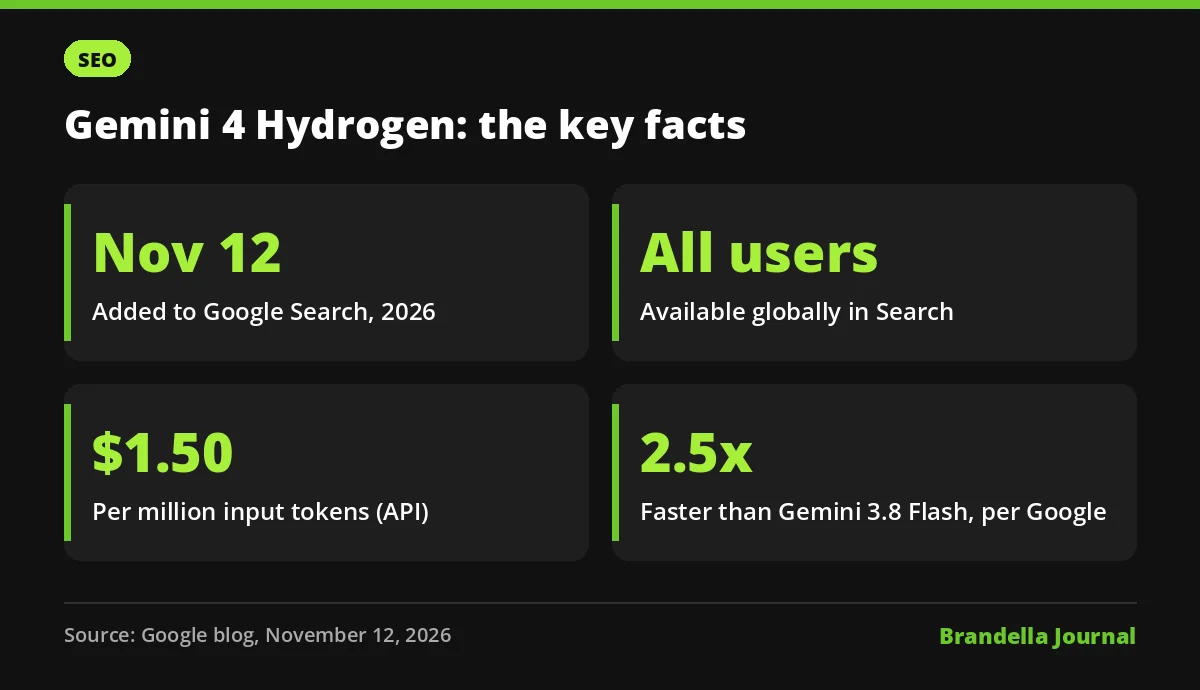
Google added Gemini 4 Hydrogen to Search on November 12, 2026, and called it “the biggest model upgrade to Search yet.” The official Search announcement by Robby Stein, VP of Product for Google Search, says the new model is available globally to all Search users, not only paying subscribers.
That last point is what makes this different from the Gemini 4 Carbon launch two days earlier. Carbon reached AI Mode only as a paid option for AI Ultra subscribers, as we covered in our Gemini 4 Carbon explainer. Hydrogen is the model everyday searchers will meet.
For SEO teams, the interesting part is not the benchmark table. It is Google’s claim that Hydrogen improves query fan-out and surfaces a broader range of links. Here is what Google actually said, what it did not say, and what to check on your own site.
What Gemini 4 Hydrogen is
Hydrogen is the fast, cost efficient member of the Gemini 4 family. The model announcement by Koray Kavukcuoglu of Google DeepMind calls it “our daily driver for agentic workflows,” while the larger Carbon and Argon models handle deep, long running reasoning.
Google’s own numbers say Hydrogen scores 51 on the Artificial Analysis Intelligence Index at its default high thinking level, against 50 for Argon. Compared with Gemini 3.8 Flash, Google says it finishes tasks 2.5 times faster and cuts fabricated claims by more than 5x. These are Google’s figures, so treat them as claims until independent tests appear.
Developers pay $1.50 per million input tokens and $7.50 per million output tokens, with a 1 million token context window. In the Gemini app, free users get Hydrogen through automatic model selection when it fits the prompt.
What changes in Google Search with Gemini 4 Hydrogen
The Search post lists four practical changes. None of them comes with a number, so the descriptions below are Google’s wording, not measured results.
| Area | What Google says changes |
|---|---|
| Understanding intent | Handles more complex questions, including multi-part questions, typos and highly specific requests |
| Query fan-out | Better reasoning runs simultaneous searches across relevant subtopics |
| Links | A broader range of links, including sites people might not have found before |
| Answer format | More images, structured responses, comparison tables and custom tools |
| Languages | More nuanced responses across all supported AI Mode languages |
Google credits better instruction following and tool calling for the improved understanding. In plain terms, the model should do a better job of breaking a messy question into parts and searching for each part.
Why query fan-out matters for your traffic
Query fan-out is the step where Google takes one question and runs several related searches behind the scenes. If Hydrogen fans out more widely, a single long question can pull in pages that rank for sub questions, not only for the main phrase.
That is good news for sites with deep, specific content. A page that clearly answers one narrow part of a bigger question now has more ways to be picked up. It is less good for thin pages that only target a broad head term.
Google says the upgrade surfaces “sites users might not have found before.” That is a direct statement, but it is not a promise of more clicks. AI answers with more tables and custom tools can also answer more of the question on the results page itself.
What Google did not say
The Search announcement leaves several questions open, and it is worth being clear about them before drawing conclusions.
- It does not mention AI Overviews by name. AI Mode appears only in the line about languages.
- It gives no rollout schedule beyond “globally” and does not list the supported languages.
- It shares no data on clicks, traffic or how often links are shown.
- It does not mention ads.
It also landed in the same week as the Google November 2026 core update. If your traffic moves this week, you cannot easily tell which change caused it. Keep both in your notes when you report on November numbers.
What SEO teams should do now
This is Brandella’s recommendation, not official Google guidance. The goal is to see how Hydrogen answers your topics and whether your pages show up as sources.
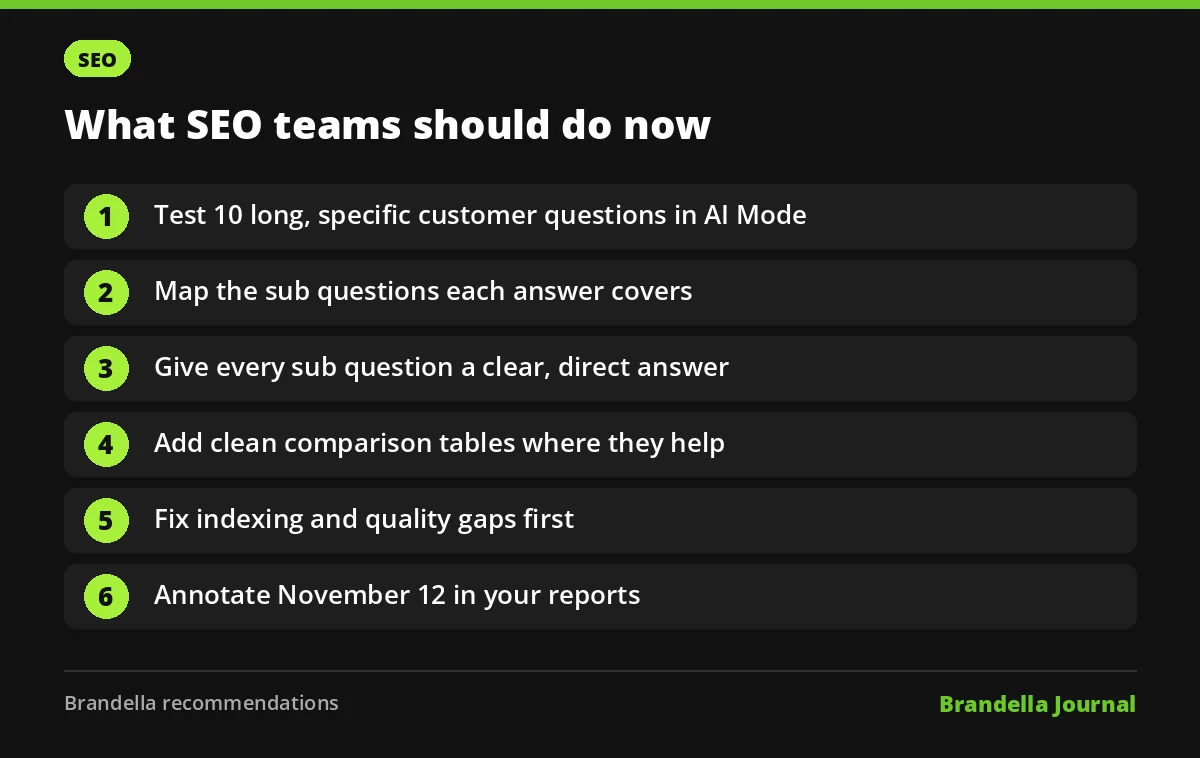
- Test long, specific questions. Take 10 real questions from customers or sales calls, including messy ones with typos, and run them in AI Mode. Note which sites are linked and whether yours appears.
- Map the sub questions. For each test, write down the subtopics the answer covers. Those are the searches fan-out is likely running, and each one is a content gap or an opportunity.
- Give each sub question a clear answer. Short sections with direct headings, a definition, a number or a step list are easier to lift into a structured answer. Our guide on how to get cited in AI Overviews covers the format in more detail.
- Add comparison tables where they help. Google says answers now include more comparison tables. If your page compares options, a clean HTML table gives the model something accurate to work from.
- Fix quality gaps first. A broader link set does not help pages Google chooses not to index. If many URLs sit in the excluded report, start with our note on crawled, currently not indexed pages.
- Annotate your reports. Mark November 12 in Search Console and analytics so the Hydrogen launch and the core update are easy to separate later.
How Hydrogen fits with Carbon and Argon
Hydrogen is not replacing the larger models in every product. In Google Antigravity, Google says an Orchestrator feature switches between Carbon and Hydrogen in one session, and the developer post says Hydrogen can run alongside both Carbon and Argon.
For Search, the split is simple. Hydrogen is the model all users get, and Carbon remains a paid choice in AI Mode for AI Ultra subscribers. That means the answers most of your audience sees this week come from Hydrogen.
The practical takeaway is to stop optimizing for one keyword per page and start checking whether your content answers the follow up questions people actually ask. That habit pays off whether or not Hydrogen sends you more clicks.