Google November 2026 Core Update Is Rolling Out: What to Check
The Google November 2026 core update began on November 10 and may take up to 2 weeks. What Google confirmed, past rollout times and what to check.

In this article
- Rollout status (updated November 13, 2026)
- What Google confirmed about the November 2026 core update
- How this rollout compares with earlier core updates
- Why you should not react on day one
- How to check if the Google November 2026 core update hit your site
- How long recovery can take
- What this means for ecommerce and publishers in late November
- FAQ about the Google November 2026 core update
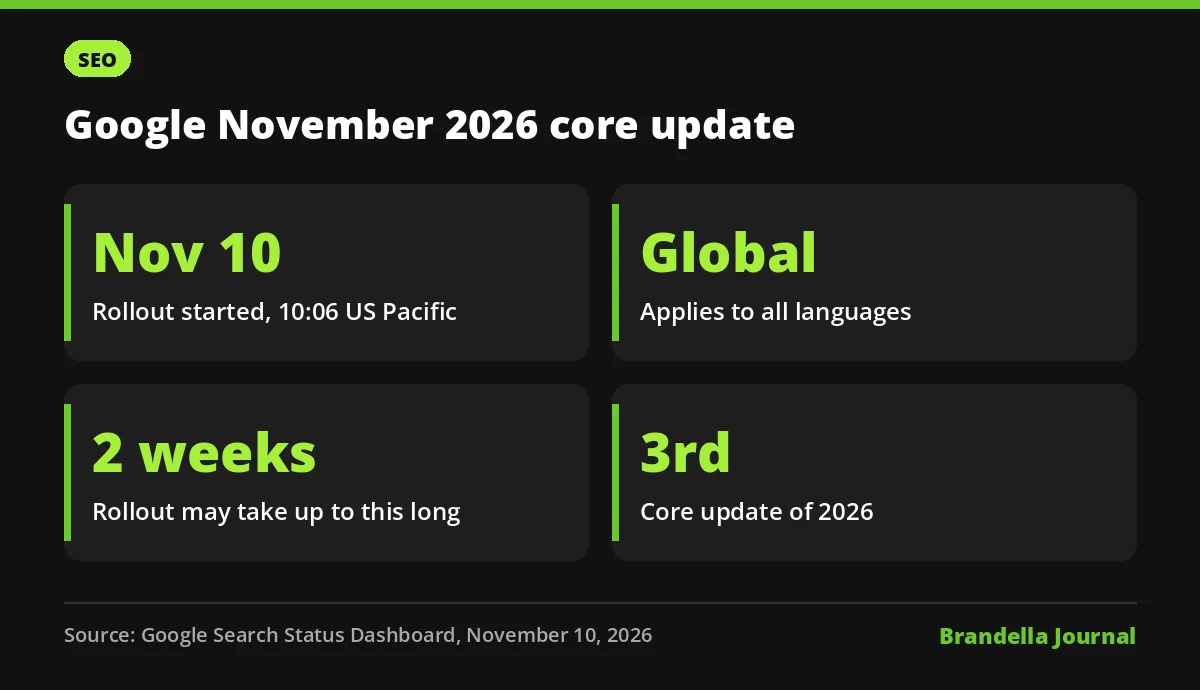
The Google November 2026 core update started rolling out on November 10, 2026. Google’s Search Status Dashboard logged the release at 10:06 US Pacific time, which was 11:36 pm IST the same night, with the note: “Released the November 2026 core update, which applies globally and to all languages.”
Google added that “The rollout may take up to 2 weeks to complete.” So rankings can keep moving until roughly the last week of November, right in the middle of the holiday shopping season.
This affects every site that gets traffic from Google Search, in every country and language. Here is what Google has confirmed, how this update compares with earlier ones, and a calm plan for checking your site without making panic changes.
Rollout status (updated November 13, 2026)
As of November 13, the Google November 2026 core update is still rolling out. Google’s Search Status Dashboard has not marked it complete yet. If it follows the March and May 2026 pattern of about 12 days, expect completion around November 22. We will update this page when Google confirms the end date.
What Google confirmed about the November 2026 core update
The official details are short. The dashboard entry confirms three things: the update is live, it is global, and it covers all languages. It links to Google’s documentation page on core updates and your website.
Search Engine Roundtable reported that Google also announced it on LinkedIn, saying: “This is a regular update designed to better surface relevant, satisfying content for searchers from all types of sites.” Google has not named any specific type of content, niche or signal as a target, and nothing else has been confirmed so far.
That wording matters. A core update is not a penalty and not a spam action. Google’s documentation says these are “significant, broad changes to our search algorithms and systems” that “don’t target specific sites or individual web pages.”
How this rollout compares with earlier core updates
Google’s ranking incident history shows how long recent updates took. This is the third core update of 2026.
| Update | Start date | Rollout time |
|---|---|---|
| December 2025 core update | December 11, 2025 | 18 days 2 hours |
| March 2026 core update | March 27, 2026 | 12 days 4 hours |
| May 2026 core update | May 21, 2026 | 11 days 21 hours |
| November 2026 core update | November 10, 2026 | Up to 2 weeks (Google estimate) |
The two earlier 2026 core updates finished in about 12 days. Google also ran spam updates in June, August and September 2026, so if your traffic moved earlier this year, check which update lines up with the date before you blame this one.
Why you should not react on day one
Google’s own guidance is clear about timing. It recommends “waiting at least a full week after a core update completes before analyzing your site in Search Console.” Then compare the week after the update with the week before it began.
During the rollout, positions often swing up and down. Rewriting pages in the middle of that noise makes it hard to know what actually caused a change. Our advice: log the date, watch your data, and save the real work for after the dashboard marks the update as complete.
Google also notes that it runs smaller core updates that “are not announced because they aren’t widely noticeable.” Some of the movement you see across a month may come from those, not only from this named release.
How to check if the Google November 2026 core update hit your site
These steps follow Google’s documentation, with Brandella’s own recommendations added where noted.
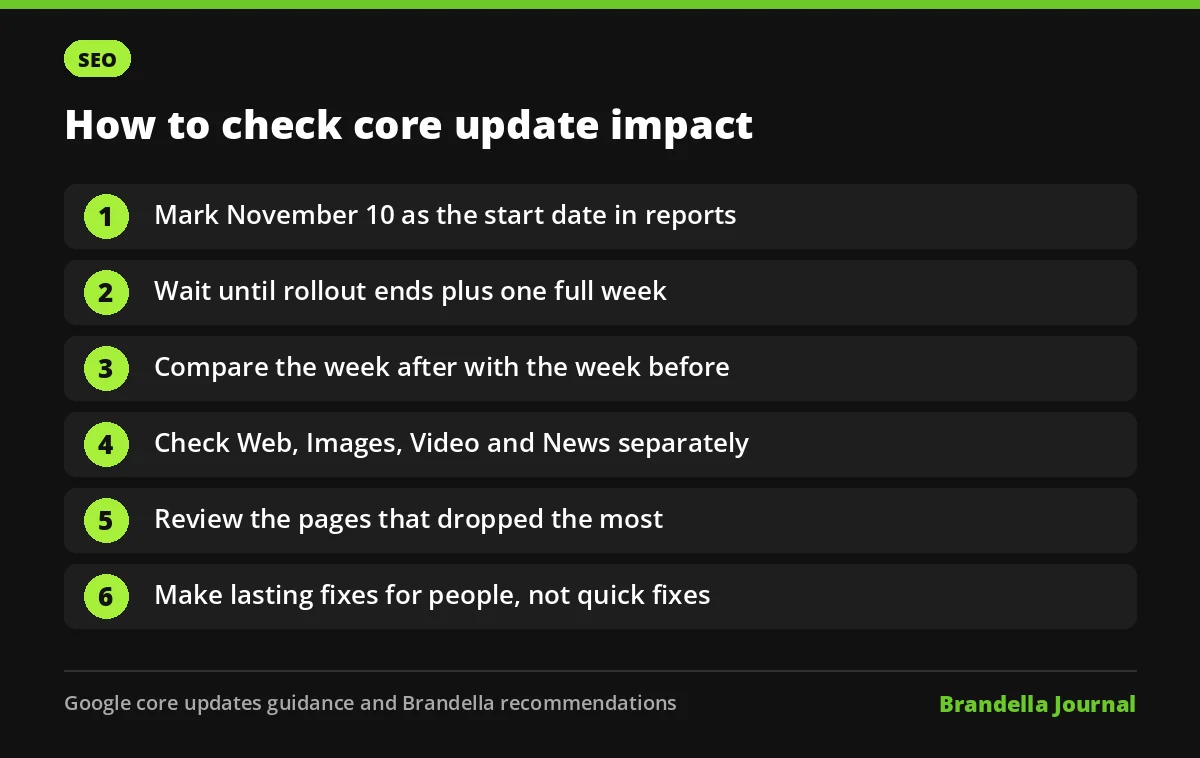
- Mark the dates. Note November 10, 2026 as the start in your reporting tools and add the end date once the dashboard shows it.
- Wait for completion plus one week. Then open the Search Console performance report and compare the week after the update with the week before November 10.
- Check search types separately. Google suggests looking at Web, Images, Video and News on their own, because a drop in one can hide inside the totals.
- Judge the size of the move. Google says a small drop, such as position 2 to 4, does not need drastic action. A large, lasting drop, such as position 4 to 29, deserves a deeper review.
- Review the pages that fell most. Compare them with the pages that now rank above you and ask honestly which one serves the searcher better. Google’s helpful content guidance is a good checklist here.
- Fix for people, not for a quick bounce. Google warns against “quick fix” changes. Rewrite, restructure or update thin pages. Treat deleting content as a last resort, which is also what Google says.
If your data shows a sharp drop, rule out technical causes too. A crawl error, a broken redirect or a slow server can look like an algorithm hit. Our guides to crawl stats in Search Console and 301 vs 302 redirects help you check those quickly.
How long recovery can take
Google is honest that recovery is slow. Its documentation says some changes take effect in a few days, but “it could take several months for our systems to learn and confirm” that a site has improved. If nothing changes after a few months, Google suggests waiting for the next core update.
It also says there is no guarantee that improvements will bring rankings back, because positions can rise or fall for reasons outside your control, such as better pages from other sites.
What this means for ecommerce and publishers in late November
The timing is the real pressure point. With a two week window from November 10, the rollout overlaps the busiest shopping weeks of the year. Retailers and affiliate publishers should keep a close daily eye on revenue pages, and avoid big site changes, migrations or template swaps until the update settles.
Our recommendation: if organic traffic dips on key product or category pages during the rollout, lean on paid search and email to protect sales, and only change pages once you have a clean before and after comparison. Then build a real improvement plan based on what the data shows, not on guesses about what Google targeted.
FAQ about the Google November 2026 core update
When did the Google November 2026 core update start?
It started on November 10, 2026 at 10:06 am US Pacific time, which was 11:36 pm IST. Google said the rollout may take up to 2 weeks.
Is the November 2026 core update finished?
Not yet. As of November 13, 2026 the rollout is still in progress. The March and May 2026 core updates each took about 12 days, so completion around November 22 is likely.
Is a core update a penalty?
No. Google says core updates are broad changes to its ranking systems and do not target specific sites or pages. A drop means other pages are now judged more helpful for that search, not that your site was punished.
When should I check Search Console after a core update?
Wait until Google marks the rollout complete, then wait one more full week. Compare that week with the week before November 10 in the Search Console performance report.
My rankings dropped. What should I do?
Do not make panic changes during the rollout. Once it ends, review the pages that fell most, compare them with the pages that now outrank you, and improve depth, accuracy and usefulness for the searcher. Also rule out technical problems like crawl errors or broken redirects.
How long does recovery from a core update take?
It can take several months. Google says its systems need time to confirm that a site has improved, and many sites only see recovery at the next core update.