Claude Fable 5.2: What Anthropic's New Model Means for Marketers
Claude Fable 5.2 launched November 9 with faster output and new pricing. What changed, what it costs and which marketing tasks it suits best.

In this article
Claude Fable 5.2 is Anthropic’s newest large model, released on November 9, 2026, alongside Claude Mythos 5.2. According to Anthropic’s launch page, the two share the same underlying model: Fable 5.2 is available to everyone with stronger cybersecurity and biology safeguards, while Mythos 5.2 is limited to vetted organizations through verification programs.
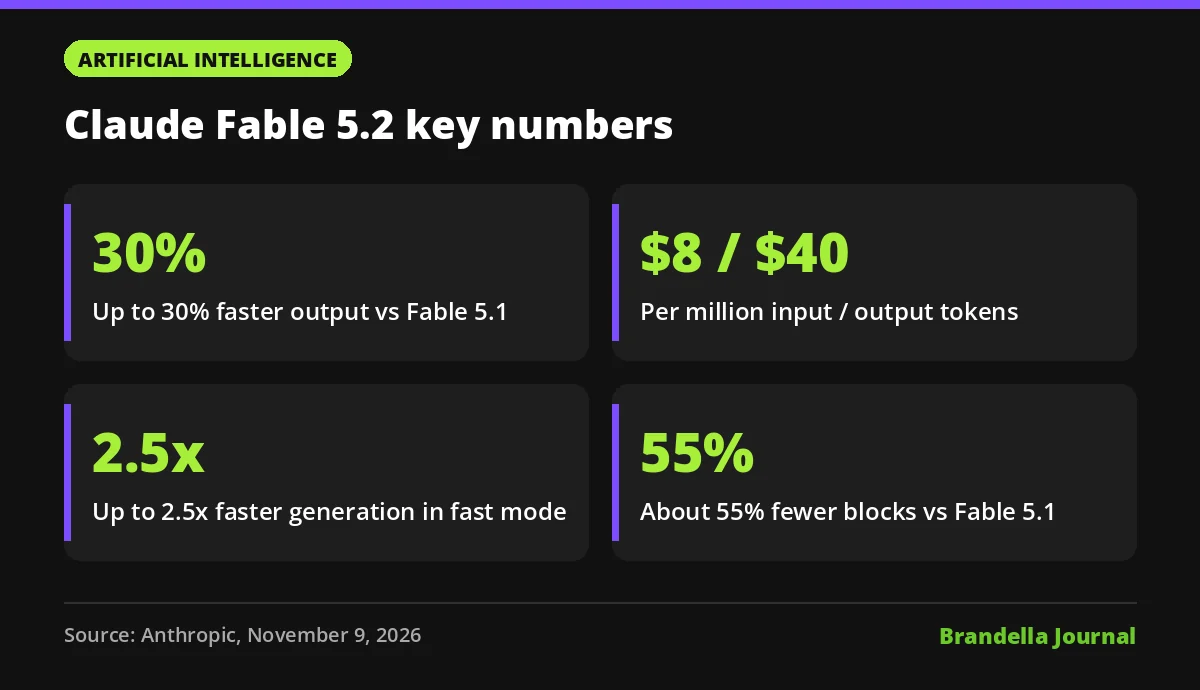
For marketers, the headline is not the cyber or science scores. It is that Fable 5.2 is faster, scores higher on Anthropic’s business workflow and knowledge work tests than Fable 5.1, and is now in the Claude apps, Claude Code and the API. Anthropic also says Fable 5.2 blocks about 55% fewer requests than Fable 5.1.
Here is what changed, what it costs, and how to decide whether it belongs in your marketing workflow.
What Anthropic released
Anthropic says Fable 5.2 and Mythos 5.2 improve on coding, reasoning and vision, and that testers found they communicate more clearly than the 5.1 versions. Standard output is up to 30% faster than Fable 5.1 and Mythos 5.1.
Fable 5.2 is available in the Claude apps and Claude Code, through the Claude Platform API with the model string claude-fable-5-2, and on Amazon Web Services, Google Cloud and Microsoft Azure. Medium effort is the default in the Claude apps and Claude Code.
Claude Fable 5.2 pricing and fast mode
API pricing is $8 per million input tokens and $40 per million output tokens. An optional fast mode speeds up token generation by up to 2.5 times and costs $16 per million input tokens and $80 per million output tokens. Fast mode is available in Claude Code and on some cloud platforms.
The Claude Fable 5.2 model overview adds more detail: a 1M token context window, up to 128K output tokens, and a 50% discount through the Batch API. Anthropic’s what’s new page for Fable 5.2 notes that these prices are lower than Fable 5.1, which cost $10 per million input tokens and $50 per million output tokens. A large context window matters for marketers because it lets you load long reports, transcripts or content libraries in one go.
For paid Claude plans, Anthropic says Fable is included for up to 50% of weekly usage limits on Pro plans and standard Team seats, and eligible paid plans get extra Fable usage at launch.
| Option | Input per million tokens | Output per million tokens |
|---|---|---|
| Fable 5.2 standard | $8 | $40 |
| Fable 5.2 fast mode | $16 | $80 |
Benchmarks that matter for marketing work
Anthropic publishes many benchmarks. These are the company’s own results, so treat them as a guide rather than independent proof. The ones closest to marketing and business tasks:
- AutomationBench (business workflows): 51.4%, up from 31.4% for Fable 5.1. Gemini 4 Carbon scored higher at 53.9% in Anthropic’s table.
- AA-Briefcase v1.1 (knowledge work, rubric): 66.1%, up from 61.5% for Fable 5.1.
- Chartography (reading charts, no tools): 73.4%, up from 44.8%.
- WANDR relaxed (agentic search): 82.1%, up from 68.7%.
One detail is easy to miss. On the AA-Briefcase Elo score, Fable 5.2 (1785) sits slightly below Claude Opus 5.5 (1800). Anthropic itself recommends Opus 5.5 for most coding and knowledge work, with Fable or Mythos for larger, more complex tasks.
Which marketing tasks suit Fable 5.2
Based on Anthropic’s description, Fable 5.2 fits big, multi step jobs rather than quick drafts. Anthropic says it can act as an Advisor to smaller models or as an Orchestrator that hands simpler tasks to cheaper models, which matches how many teams now build AI agents for marketing.
Good candidates, in our view, include long research tasks that pull from many sources, analysis of reports full of charts, and agent workflows that run across several tools. Everyday copywriting, social captions and short summaries are usually better done on a cheaper, faster model, since Anthropic positions Sonnet 5.5 and Haiku 5.5 as the step down.
If you are new to how these models differ, our guide to large language models explained covers the basics.
What marketers should do now
These steps are Brandella’s recommendations, not Anthropic guidance.
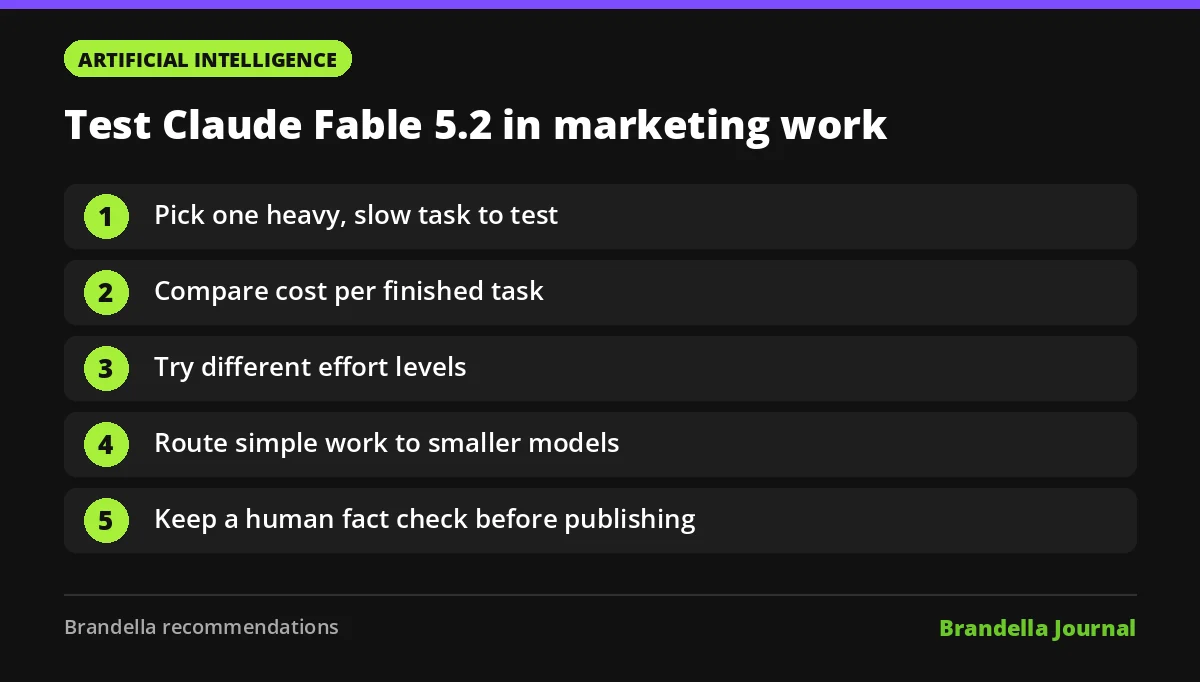
- Pick one heavy task to test. Choose something slow today, such as a competitor analysis or a monthly report with many charts, and run it on Fable 5.2 and on your current model.
- Compare cost per finished task. Fable output costs $40 per million tokens. Check whether faster, better results justify that for your use case.
- Try effort levels. Anthropic says Fable 5.2 at High effort roughly matches Opus 5.5 on one coding test at about half the cost per task, so effort settings can change the cost picture.
- Route simple work to smaller models. Use Fable as an orchestrator and let cheaper models handle drafts and formatting.
- Keep a human check. Better benchmarks do not remove errors. Fact check numbers, quotes and claims before anything is published.
How this fits the wider AI race
Fable 5.2 lands the same week Google pushed Gemini 4 Carbon into AI Mode, and Anthropic’s own table compares it with GPT-6 Astra and Gemini 4 Carbon. No single model wins every test, which is the main lesson for marketing teams: pick models per task, measure results, and review your choices each quarter.
If you want your brand to show up when people use Claude for research, our piece on how Claude AI selects trusted sources is a useful next read.