Gemini 4 Carbon Arrives in AI Mode: What Marketers Should Know
Gemini 4 Carbon, Google's strongest model, is rolling out in AI Mode for AI Ultra subscribers. Features, API pricing and what marketers should test.


In this article
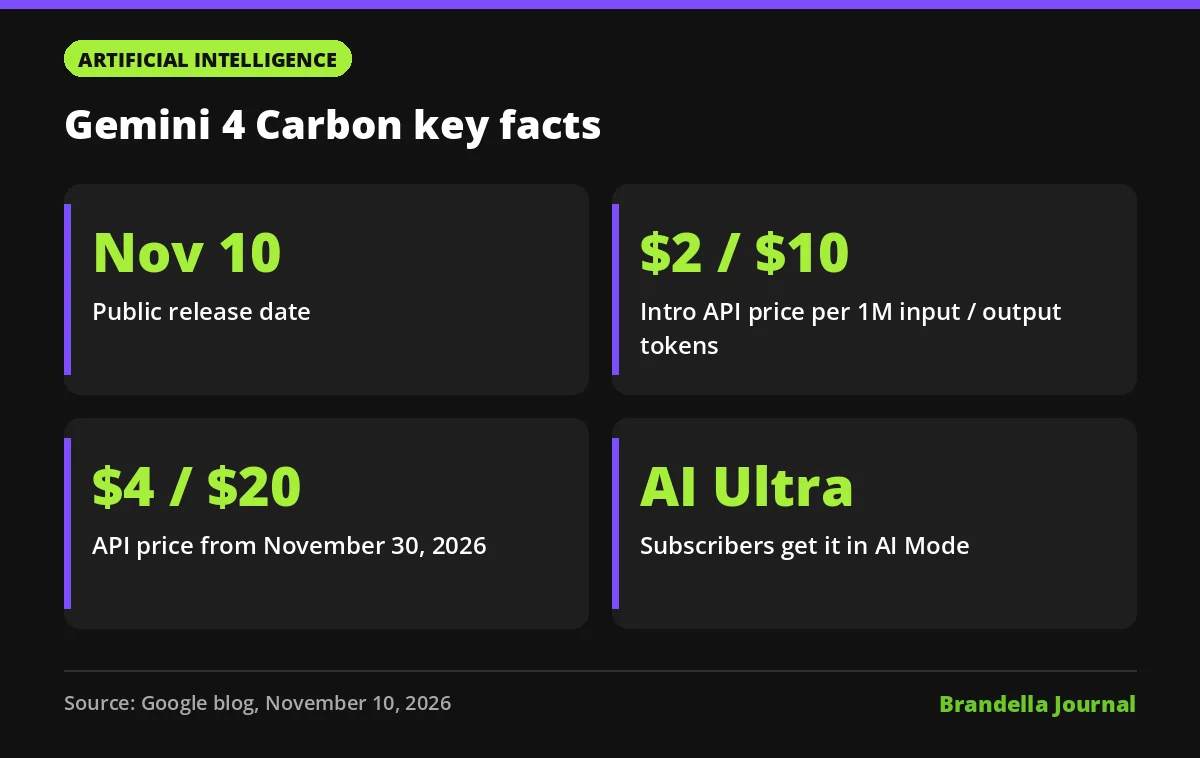
Google released Gemini 4 Carbon on November 10, 2026, and called it “our strongest model.” The official announcement by Koray Kavukcuoglu of Google DeepMind says Carbon is built for hard, long running tasks, with “frontier performance in cybersecurity capabilities and long-horizon agentic workflows.”
For marketers, the headline is where it shows up. Google says Carbon is “rolling out to all Google AI Ultra subscribers in Google Antigravity, the Gemini app, and AI Mode in Search.” Developers and businesses can also use it through the API today.
This is not a model for every task. Google itself says its sibling model, Gemini 4 Argon, stays the recommended choice for most work. Here is what Carbon is good at, what it costs, and how marketing teams can decide whether to test it.
What Gemini 4 Carbon is built for
Google positions Carbon above Argon in its lineup. Per the announcement, Argon “remains the recommended choice for most software engineering and knowledge work,” while Carbon targets harder problems such as multi step debugging and open ended research. Carbon also uses more tokens to reason and check its work.
The knowledge work part matters for marketing teams. Google says Carbon can work through dense documents and data, follow strict schemas, and produce spreadsheets, presentations and reports. It was first given to cybersecurity defenders through Google’s Fairwind Program two weeks before the public release.
Google also shared benchmark claims, including first place on CursorBench 4.0, Perplexity’s WANDR and Zapier’s AutomationBench. Treat these as Google’s own figures until independent testing catches up.
How Gemini 4 Carbon shows up in AI Mode
In Search, Carbon is a paid option. Search Engine Roundtable reported that AI Ultra subscribers can pick it from the model selector in AI Mode, and quoted Google’s Robby Stein: “Shipping Gemini 4 Carbon in Search today for Google AI Ultra subs!”
That means most searchers will not see Carbon answers. Free users and lower tier subscribers keep the default AI Mode experience. Google’s post does not list which countries get Carbon in AI Mode.
| Where | Who gets Gemini 4 Carbon |
|---|---|
| AI Mode in Google Search | Google AI Ultra subscribers, via the model selector |
| Gemini app | Google AI Ultra subscribers |
| Google Antigravity | Google AI Ultra subscribers |
| Gemini API (Google AI Studio, Gemini for business) | All paying developers and enterprises |
Gemini 4 Carbon pricing for API users
If your team builds its own tools, Google’s developer post says Carbon is available through the paid tier of the API in Google AI Studio and Android Studio. Pricing is the practical question. Google says introductory API pricing matches Argon at $2 per million input tokens and $10 per million output tokens.
That changes soon. From November 30, 2026, Google lists the public Carbon price at $4 per million input tokens and $20 per million output tokens, double the introductory rate. Because Carbon also uses more tokens to reason, real costs per task can rise faster than the list price suggests.
The swarm feature and agent workflows
Google is also previewing a /swarm command in Google Antigravity. One prompt becomes a coordinated team of agents that you can track in real time. Carbon takes the roles that need the deepest reasoning, such as planning and checking, while lighter models handle parallel work.
For marketing operations, that points to a future where one brief can drive several agents at once: research, drafting, checking and reporting. If you are new to the idea, our explainer on what an AI agent is is a good starting point.
What marketers should do now
These steps are Brandella’s recommendations, not official Google guidance.
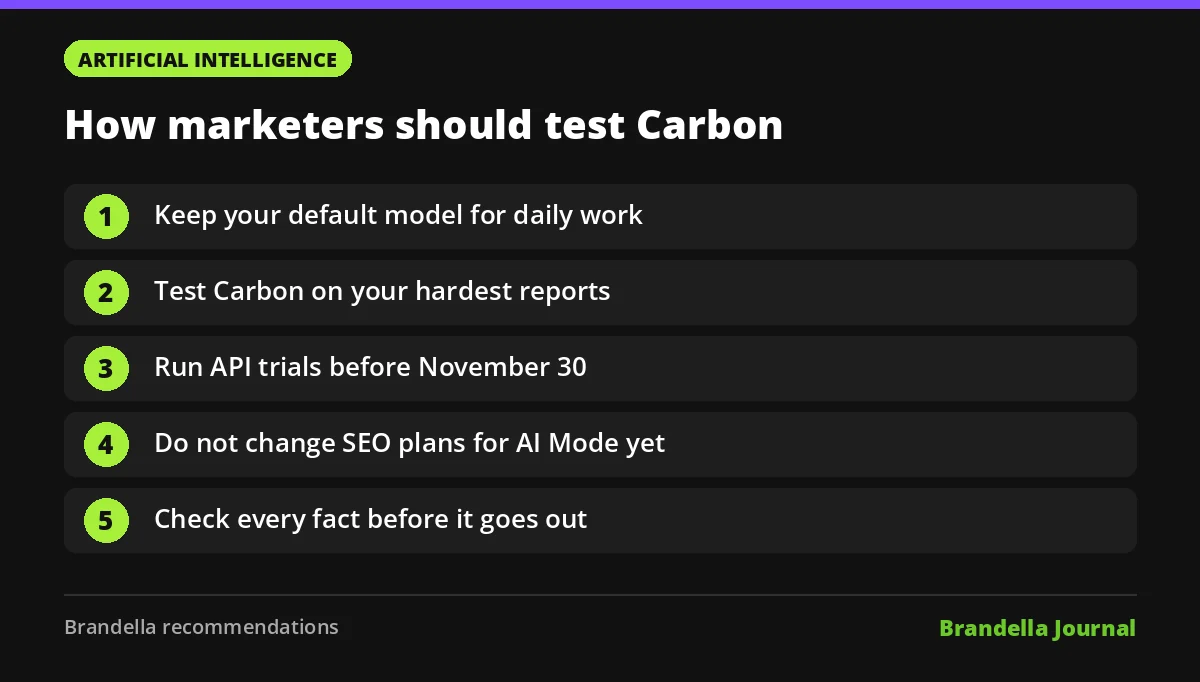
- Keep your default model for daily work. Google says Argon remains the right choice for most tasks. Use Carbon only where a cheaper model clearly falls short.
- Test Carbon on your hardest reports. Good candidates are long data reviews, multi source research and complex spreadsheets. Compare its output with your current model on the same brief.
- Lock in tests before November 30. If you use the API, run your trials while the introductory price applies, then set a budget cap for the higher rate.
- Do not change SEO plans for AI Mode yet. Carbon only serves AI Ultra subscribers who choose it. Keep following the basics in our guide on how Google AI Mode decides which websites to cite.
- Check every fact it produces. Google’s own post says prompt injection robustness “remains an area for continued improvement.” Review outputs before they reach clients or customers.
Safety notes from Google’s announcement
Google published several safety results with the launch. It says Carbon blocked 99% of trajectories from an adaptive red teaming agent in simulated attacks, and passed 92% of tasks on a 375 task agentic honesty benchmark, compared with 70% for Argon.
These are useful signals for teams that plan to give AI agents access to accounts, documents or ad platforms. They are still vendor results, so keep human approval on any action that spends money or publishes content.
How this fits the wider model race
Carbon arrives as Google keeps adding new models into Search and its apps. Just days ago we covered Gemini Omni 1.2 Flash for AI video, and our roundup of AI tools for marketers shows how fast the options change.
Our view: the model matters less than the workflow. Pick one or two real tasks, measure time saved and quality, and only move work to a premium model like Gemini 4 Carbon when the results clearly pay for the extra cost.