Moving to a CDN: Google Explains Crawl Spikes and Overblocking
Moving to a CDN can trigger a Googlebot crawl spike and tempt teams to block bots. Google's new guidance on cold caches, pre-warming and safe throttling.


In this article
Moving to a CDN is supposed to make a website faster and protect the origin server. Google now warns that the first days after the switch can do the opposite: Googlebot may crawl much harder, the origin may take a heavy load, and a panicked bot rule can quietly push pages out of Search.
The advice comes from a Google Search Central blog post by Cherry Prommawin and Gary Illyes, Moving to a CDN without overwhelming your origin (or blocking Googlebot), published on November 11, 2026. It is the closing piece of their Non-Canonical Cabinet video series, and Search Engine Roundtable noted it the same day.
This matters to anyone planning a hosting change, a Cloudflare or Akamai rollout, or a site migration before the holiday season. The risk is not the CDN itself. It is the mix of a sudden crawl increase and the wrong reaction to it.
Why Googlebot crawls more after moving to a CDN
Google’s crawlers watch how quickly and reliably a server responds. Slow answers make them back off. Fast, stable answers let the crawl capacity limit rise, as long as Google also has crawl demand for the site.
When DNS starts pointing to a fast edge network, connection and response times drop. To Google’s systems that looks like a major infrastructure upgrade, so they raise the request rate. A site that has been crawled gently for years can suddenly see far more Googlebot hits than usual.
If you have read our guide to crawl budget, this is the same mechanism working in reverse. Speed is not only a user experience signal. It is also an invitation to crawl more.
Cold caches: why the origin still takes the hit
A new CDN starts with an empty cache. Google explains that the first request for any URL is a cache miss that goes back to the origin, and only later requests for that same URL are served from the edge.
Human visitors usually cluster on a small set of popular pages, so those warm up fast. Crawlers behave differently. They walk through the full URL inventory, including old articles, filtered category pages and deep product URLs that nobody has requested since the switch. Each one is a cold miss.
Google adds that CDNs often include connection pacing that smooths some of the spike, but the origin still does most of the work until the caches fill. In short, the CDN protects you on the second visit, not the first.
The overblocking trap
This is the part that can hurt rankings. When admins see a wave of unexpected automated traffic, the easy reaction is to switch on blanket bot protection at the CDN or web application firewall.
Google’s post explains why that backfires. Blanket rules treat all automated clients the same, including verified search crawlers. A CAPTCHA or JavaScript challenge makes Googlebot fail, because it cannot solve it, and it ends up fetching error or challenge pages. If the blocking continues, Google’s crawlers back off and pages can start dropping out of Search. The authors list “your pages, shopping listings, and your chicken pictures” as the things at risk.
We covered a related problem recently in how to verify Googlebot properly. The goal is the same here: block bad bots precisely, never all bots at once.
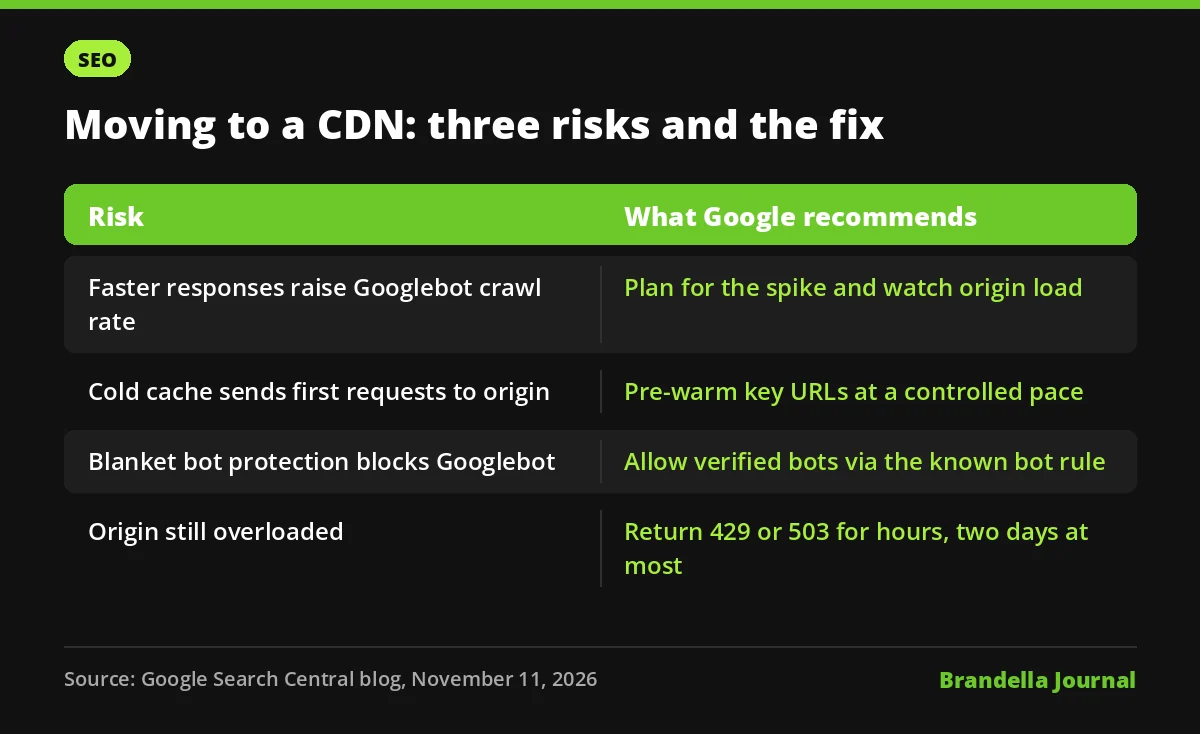
| Situation | Risky reaction | What Google recommends |
|---|---|---|
| Crawl rate jumps after the switch | Turn on blanket bot protection | Allow verified bots through the CDN or WAF known bot rule |
| Origin slows on uncached URLs | Wait and hope | Pre-warm the cache before full cutover |
| Origin is still overloaded | Serve challenges to Googlebot | Return 429 or 503 for a short window only |
| Specific scrapers cause load | Block every automated client | Target those bots with robots.txt or specific rules |
What Google recommends when moving to a CDN
The post gives three concrete recommendations.
- Allow verified bots. Use the CDN or WAF built in toggle or managed rule for known bots, and check Google’s crawlers against the published Google IP ranges. If specific unwanted bots are the problem, target them through robots.txt or individual rules.
- Pre-warm caches. Before routing all traffic through the CDN, fetch high traffic pages, pages that will soon get peak traffic such as promotions or seasonal launches, and frequently crawled URLs, at a controlled pace.
- Throttle temporarily if needed. If crawling still strains the origin, return a 429 (Too Many Requests) or 503 (Service Unavailable) status for a short window. Google describes that window as a few hours or one to two days at most, and links its guide to reducing the Google crawl rate.
The short version from Google: faster responses mean faster crawling, caches only shield you on the second visit, and verified crawlers should be exempt from challenges.
Your CDN migration checklist
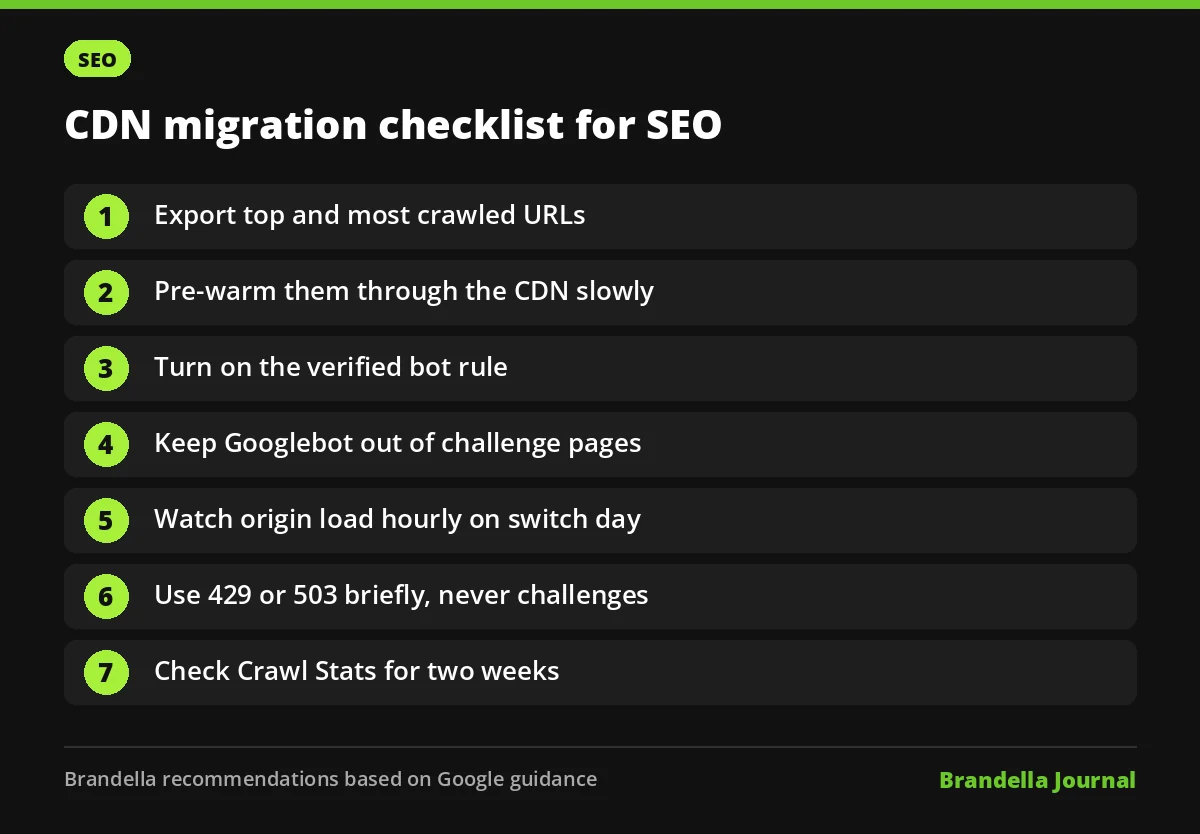
The steps below are Brandella recommendations built on Google’s guidance. Use them before, during and after the switch.
Before the switch
- Export your top URLs from Search Console and analytics, plus the URLs Googlebot requests most often in your server logs. Our Python log file analysis guide shows how to pull that list.
- Script a slow, rate limited fetch of those URLs through the CDN so they are cached before real traffic arrives.
- Confirm the CDN’s verified bot or known bot rule is on and that Googlebot is excluded from any challenge page.
On switch day
- Watch origin CPU, response times and error rates hourly, not daily.
- If the origin struggles, use a short 429 or 503 window instead of a challenge page. Remove it as soon as the load settles, because Google says to keep it to one or two days at most.
In the first two weeks
- Check the Crawl Stats report in Search Console for spikes in requests, response time and any rise in 4xx or 5xx responses.
- Spot check key pages with the URL Inspection tool to confirm Googlebot sees real content, not a challenge page.
- Review WAF logs for blocked requests from Google’s published IP ranges and fix any rule that caught them.
Who should pay attention
Large ecommerce sites, publishers with deep archives and any site with many filtered or parameter URLs are the most exposed, because crawlers will reach far more uncached pages than humans do. Small sites will usually feel a milder version, but the overblocking risk applies to everyone.
The timing also matters. With the November 2026 core update still rolling out and holiday traffic building, a week of Googlebot hitting challenge pages is the last thing an online store needs. If a CDN move is on your roadmap, plan the pre-warm and the bot rules first, then flip the DNS.