Gootloader SEO Poisoning: What the FBI Alert Means for Sites
Gootloader SEO poisoning hit over 1,000 WordPress sites, says a new FBI alert. How the scheme works and the security and Search Console checks to run now.


In this article
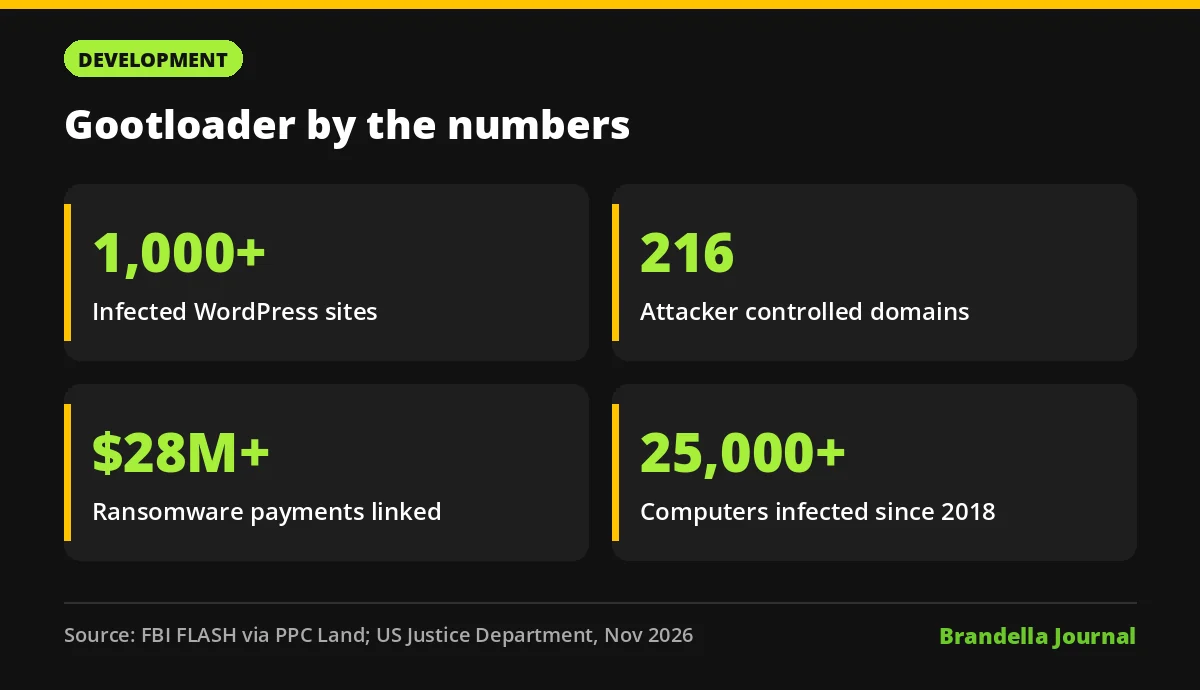
Gootloader SEO poisoning is now the subject of a public FBI warning. On November 16, 2026, the FBI released a FLASH alert titled “Gootloader Malware Using SEO Poisoning and Compromised Websites to Gain Initial Access” (PDF on IC3). According to PPC Land’s summary of the alert, the FBI had found more than 1,000 infected WordPress sites and 216 domains run by the Gootloader administrator as of October 2026.
The alert came days after the US Justice Department announced a takedown on November 12, 2026. It said the malware was removed from more than 100 servers, including compromised WordPress sites, and that Gootloader has infected at least 25,000 computers worldwide since 2018.
Why should marketers and developers care? Because the attack works through search rankings. Hacked, ordinary looking websites are the delivery system, and their owners often do not know.
How Gootloader SEO poisoning works
The scheme turns normal SEO tactics into a trap. Per the FBI alert as summarized by PPC Land and by SafeBreach on Security Boulevard, it runs like this:
- Pick easy keywords. Attackers targeted low competition, jurisdiction specific legal phrases. Sample lures included “Zoning Government Definition” and “When did Sports Betting Become Legal in Virginia”.
- Hack real sites. They broke into WordPress sites, injected posts and pages, and added hidden keyword links and arranged backlinks to push those pages up.
- Filter visitors. A traffic distribution system checked country, referrer, cookie or IP address, so only chosen visitors saw the malicious version.
- Deliver the payload. The victim downloaded an archive containing malicious JavaScript. Operators then sold access, and ransomware groups often followed.
Activity in 2025 and 2026 focused on US legal professionals, according to PPC Land. But any site that can be hacked can be used as a host.
The numbers behind the warning
The two official sources give slightly different loss figures because they count different things.
| Source | Date | Key figures |
|---|---|---|
| Justice Department release | November 12, 2026 | 100+ servers cleaned, 25,000+ computers infected since 2018, 44+ US ransomware victims, about $28.8 million in losses |
| FBI FLASH alert | November 16, 2026 | 1,000+ infected WordPress sites, 216 attacker domains, more than $28 million in ransomware payments |
The Justice Department said the action was coordinated with Operation Endgame, a multinational effort against malware services. It also credited the Shadowserver Foundation with helping to identify infected systems and notify victims.
How attackers got into WordPress sites
According to the alert summaries, the Gootloader administrator scanned for the xmlrpc.php file, used stolen credentials and exploited vulnerable plugins and themes. SafeBreach’s summary adds that attackers modified REST routes and JavaScript once inside.
None of these are exotic. They are the same weak spots behind most site hacks: old plugins, reused passwords and features left on that nobody uses. Upload folders are another classic risk, which we explain in our guide to PHP file upload security.
The SEO warning signs to look for
This is where the FBI advice overlaps with everyday SEO work. The alert asks owners to review Search Console and webmaster tools for “unrelated legal or business queries,” sudden indexed pages, manual actions and security warnings, as PPC Land reports.
In practice, open your Search Console performance report and sort queries by impressions. A recipe blog suddenly ranking for court or zoning terms is a red flag. A jump in crawled pages in the Crawl Stats report that you did not publish is another.
What site owners should do now
These steps follow the FBI’s WordPress guidance as summarized by PPC Land and SafeBreach. The order and wording are Brandella’s recommendation.

- Update everything. Patch WordPress core, plugins and themes. Remove unused plugins, themes, user accounts and old staging sites.
- Lock down logins. Require strong multi factor authentication, preferably phishing resistant, for admins and hosting access.
- Close XML-RPC. Disable xmlrpc.php if you do not need it, or rate limit it and allow only the methods you use.
- Block PHP in uploads. Deny PHP execution under wp-content/uploads and make core files read only where practical.
- Watch for changes. Compare core files against official checksums and alert on edits to plugins, themes, mu-plugins, JavaScript, .htaccess and index files.
- Check Search Console weekly. Look for odd queries, unexpected indexed pages, manual actions and security issues.
If you think your site is infected, the alert advice is to restrict public access while keeping a forensic copy, reset every credential from a clean device, and restore only from a clean backup after the entry point is closed. In the US, suspected intrusions can be reported to a local FBI field office or at ic3.gov.
FAQ about Gootloader SEO poisoning
What is SEO poisoning?
It is when attackers push malicious pages up in search results for chosen keywords. Gootloader used hacked WordPress sites and niche legal phrases so victims would find the bad pages through normal searches.
Is my site at risk if I do not work in law?
Yes. The searchers targeted were mostly legal professionals, but the hacked host sites can be on any topic. Weak logins and outdated plugins are the real risk factors.
How can I tell if my WordPress site was used?
Look for queries and indexed pages that have nothing to do with your business, unknown posts or users, and recent file changes you did not make. A security scan from your host is a good next step.
Did the FBI publish a list of infected sites?
According to PPC Land, the alert publishes no indicators of compromise for the 216 domains. Check your own site rather than waiting for a list.