AdSense for Search Policies Merge on January 17, 2027
Google will merge its AdSense for Search policies and Search ads policies into one set on January 17, 2027. What is new and what publishers should check.


In this article
Google is rewriting the AdSense for Search policies. According to the AdSense policy change log, on January 17, 2027 Google will merge the current AFS policies and the Search ads policies “into a single, unified policy set for AdSense for Search publishers.”
This affects publishers that show Google search ads on their own site search results pages, and anyone who uses AFS through Programmable Search Engine. Display ads on content pages under AdSense for Content are a different product, but the new text covers how the two can share a page.
Search Engine Roundtable reported the change on November 19, 2026. It quotes Google’s stated aim: to “simplify our policy structure, modernize requirements to reflect the current business landscape.”
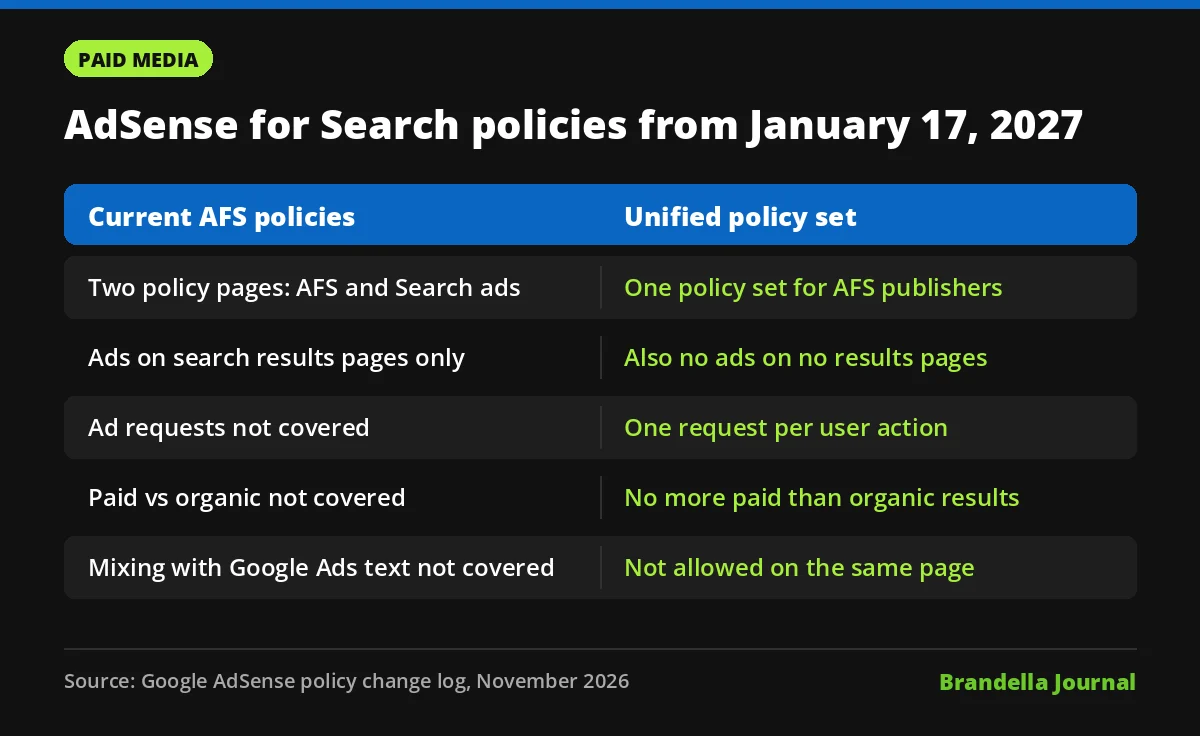
What changes in the AdSense for Search policies
The change log entry includes the full text of the new policy. It opens by saying that “AFS is only supported in web-based environments.” It also defines “Search ads” as AFS ads served through the Custom Search Ads protocol.
Content requirements
Pages must follow the Google Publisher Policies. AFS ads can only appear on search results pages. They cannot appear on results pages that mainly show videos, images, people, music or content from outside Programmable Search, such as results pulled from the YouTube API. Pages with no results, placeholder text or gibberish cannot show AFS ads either.
User intent and traffic quality
Every search needs clear user intent. Publishers may send one ad request per user action, and each AFS ad can be shown only once unless Google approves otherwise in writing. No interstitial content may appear before or between AFS ads and their landing pages. Ads cannot be modified, framed, hidden or reordered, and they must sit in one continuous block rather than mixed into results.
Ad implementation and placement
A page can carry no more than two Google search boxes. Ads and paid promotions must be clearly labeled, and a page cannot show more paid promotion than organic results.
Other Google advertising demand
AFS ads cannot appear on a page that also shows Google Ads text demand in other ad slots. A single AFS slot also cannot be backfilled or alternated with AdSense for Content or Ad Manager, though other slots on the page are fine.
The policy ends with a line saying publishers must follow the technical protocols and specifications Google provides from time to time.
Old rules vs the new AdSense for Search policy set
Some rules carry over with new wording. Query modification becomes the clear search intent rule, and the search box limit and the search results pages only rule stay.
| Topic | Current AFS policies | Unified policy from January 17, 2027 |
|---|---|---|
| Where ads can show | Search results pages only | Same, plus no ads on no results or mostly image or video results pages |
| Search boxes | Limit on boxes per page | No more than two Google search boxes |
| Ad requests | Not covered | One request per user action, each ad shown once |
| Paid vs organic | Not covered | No more paid promotion than organic results |
| Mixing with Google Ads text demand | Not covered | Not allowed on the same page |
The current AFS page also has rules on the Google logo, toolbars and browser extensions, searchable content, incentivized searches and a yearly query limit of 5 billion queries per account. Those do not appear in the new text. Google has not said whether they are dropped, moved elsewhere or still enforced through other policies, so do not assume they are gone. The new text links to the AdSense Program policies, Google Publisher Policies, Google Publisher Restrictions, the AFS Product-Integrated Feature policies and the Alternative Search Query policies, so some of those rules may live there.
Who should pay attention
Our view: sites with large on site search, such as directories, comparison sites, classifieds and content portals, have the most to check. So do publishers that send paid traffic to search results pages, since the rules on clear intent, single ad requests and interstitials apply directly to that traffic.
Publishers that mix AFS with other Google demand on the same page need to check their setup too. The section on other Google advertising demand is the most likely to force layout changes.
What AdSense publishers should do now
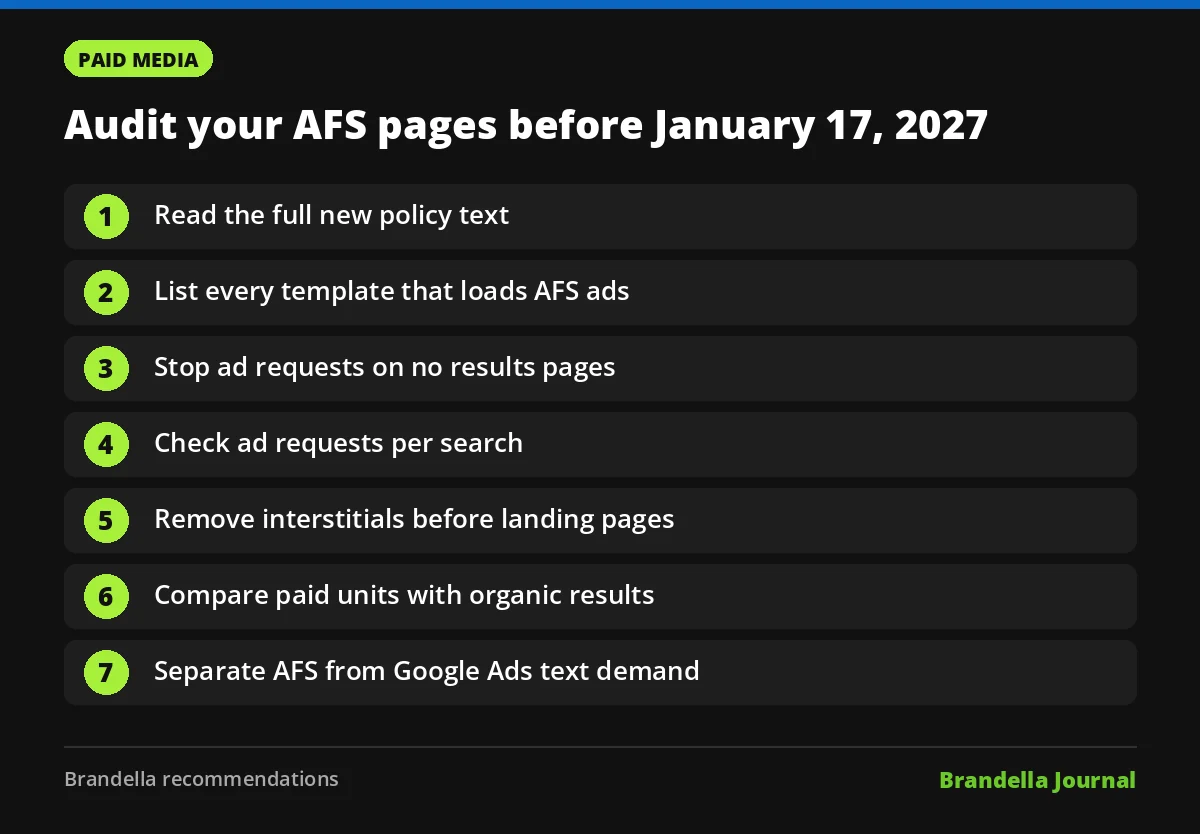
Google’s entry does not list specific steps. The checklist below is Brandella’s recommendation based on the new text.
- Read the full new policy text in the change log, not just this summary.
- List every page template where AFS ads load, on desktop and mobile web.
- Check how your no results pages behave. If they still request ads, change that before January 17.
- Count ad requests per search. Infinite scroll, auto refresh and filter changes can trigger extra requests.
- Remove any interstitial, countdown or redirect page between the search, the ads and the advertiser’s landing page.
- Compare the number of paid units with organic results on each page, especially for short result sets.
- If any page shows Google Ads text demand in another slot next to AFS, plan a new layout.
- Make sure every paid placement carries a clear label.
For the advertiser side of traffic quality, see our post on the Google Ads invalid traffic overview card.
If you also run AdSense on content pages, review the recent change on Global Privacy Control in AdSense while you are in the account. Publishers watching search traffic change should also read why publishers expect search traffic to fall as AI answers grow.
FAQ about the AdSense for Search policies
When do the new AdSense for Search policies take effect?
January 17, 2027. Google posted the notice in its AdSense policy change log in November 2026.
Are the old AFS policy pages being deleted?
Google says the existing pages “will be updated when the changes take effect.” It does not say they will be removed or redirected.
Does this change apply to AdSense for Content?
The policy is for AdSense for Search publishers. It does say that an AFS slot cannot be backfilled or alternated with AdSense for Content or Ad Manager.
Is the 5 billion query limit gone?
The limit is not in the new text, but Google has not said it is removed. Treat it as unclear until Google confirms.