Google Ads Surcharges Rise to 3% in France and Italy in 2027
Google Ads surcharges rise to 3% in France and Italy and fall in Turkey from January 1, 2027. Who pays, how they are billed and how to check your exposure.


In this article
Google Ads surcharges in France and Italy will rise to 3% on January 1, 2027. Google’s jurisdiction specific surcharges help page now lists France’s Regulatory Operating Cost moving from 2% to 3% and Italy’s from 2.5% to 3%, while Turkey’s falls from 4.5% to 2.25% on the same date.
This affects any advertiser whose ads are shown to people in those countries, wherever the business is based. Search Engine Journal reported that advertisers received notification emails in November, and pointed out that even local US advertisers can be billed through default location settings.
Why it matters: a one point rise sounds small, but surcharges are added on top of your budget. If you sell into France or Italy, your real cost per conversion goes up from the first day of 2027 unless you plan for it.
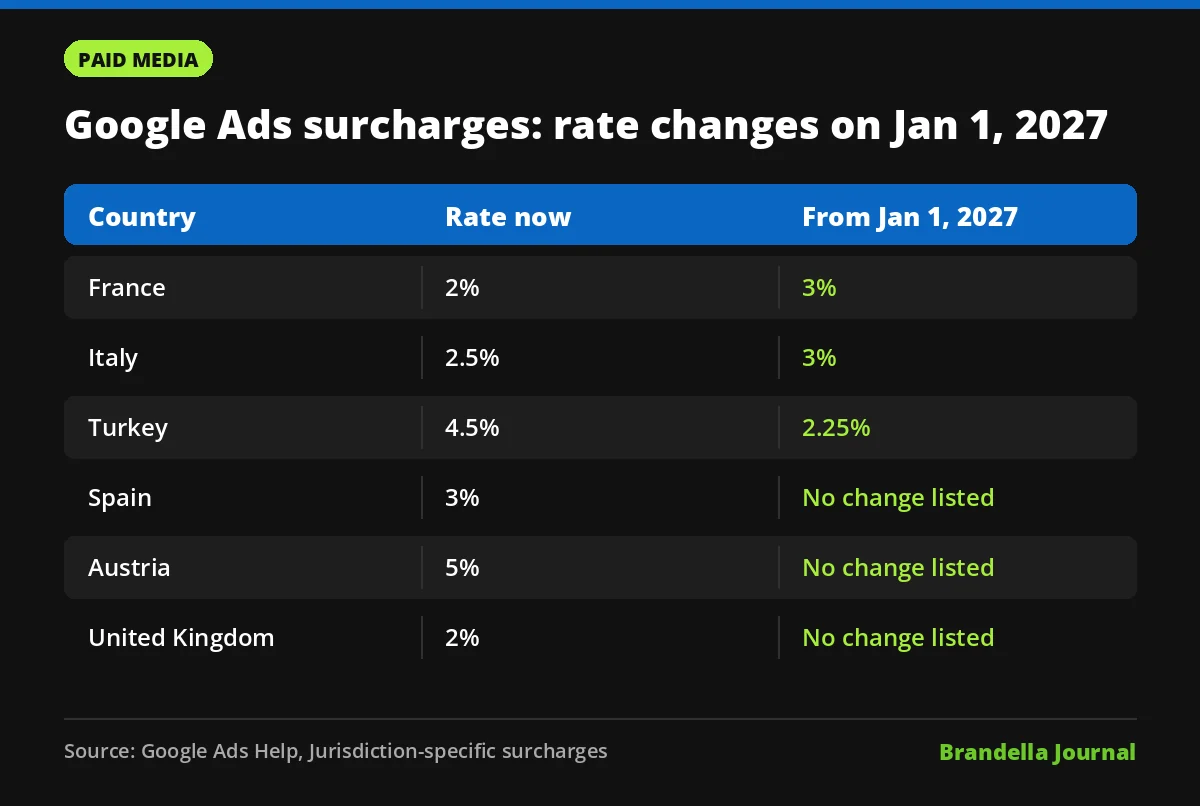
Google Ads surcharges: the full country list
Here is how the rates stand on Google’s help page as of this week.
| Country | Surcharge name | Rate now | From January 1, 2027 |
|---|---|---|---|
| France | Regulatory Operating Cost | 2% | 3% |
| Italy | Regulatory Operating Cost | 2.5% | 3% |
| Turkey | Regulatory Operating Cost | 4.5% | 2.25% |
| Spain | Regulatory Operating Cost | 3% (since July 1, 2024) | No change listed |
| Austria | DST Fee | 5% | No change listed |
| United Kingdom | DST Fee | 2% | No change listed |
| India | Regulatory Operating Cost | No longer applies since September 1, 2024 | No change |
| Canada | DST Fee | Removed | No change |
Google says the fees cover the cost of doing business in these places, including complying with Digital Services Tax laws and, for Turkey and India, rising regulatory complexity.
How surcharges are calculated and billed
Google bases each surcharge on the impressions or clicks served in that jurisdiction. The help page is clear that they apply “regardless of where your business is located.” An Indian or US business showing ads to users in Italy pays the Italian surcharge on that Italian traffic.
Billing details matter for finance teams:
- Monthly invoicing and postpay: surcharges are added once at the end of the month and paid with your next charge.
- Prepay: surcharges can be deducted after your prepaid balance is used, leaving an open balance taken from your next payment.
- On top of budget: Google’s example is a 100 euro budget plus 5 euro in Austria DST fees, billed as 105 euro before tax.
- Taxes are extra: VAT, GST or sales tax still apply on top.
- Separate line items: each country appears as its own line on the invoice and under Billing, then Transactions.
YouTube placements bought on a reservation basis also get surcharges added to placement costs at month end. Google also states it will not refund surcharges that come from legitimate traffic served according to your targeting.
Why local advertisers can be charged too
This is the part many small advertisers miss. Google’s advanced location options page says “Presence or Interest” is the default and recommended setting. It reaches people in your target area and also people who have shown interest in it.
So a Mumbai hotel or a Chicago dentist can still get clicks from someone researching from Paris or Rome. Google’s surcharge page says it is “the advertiser’s responsibility” to keep targeting correct, and that campaigns that do not target a country can still serve there through location of interest.
If you only want people physically in your area, Google offers a “Presence” option instead. Google notes most campaigns see fewer impressions after moving away from the default, so make the change on purpose, not by reflex.
What advertisers should do now
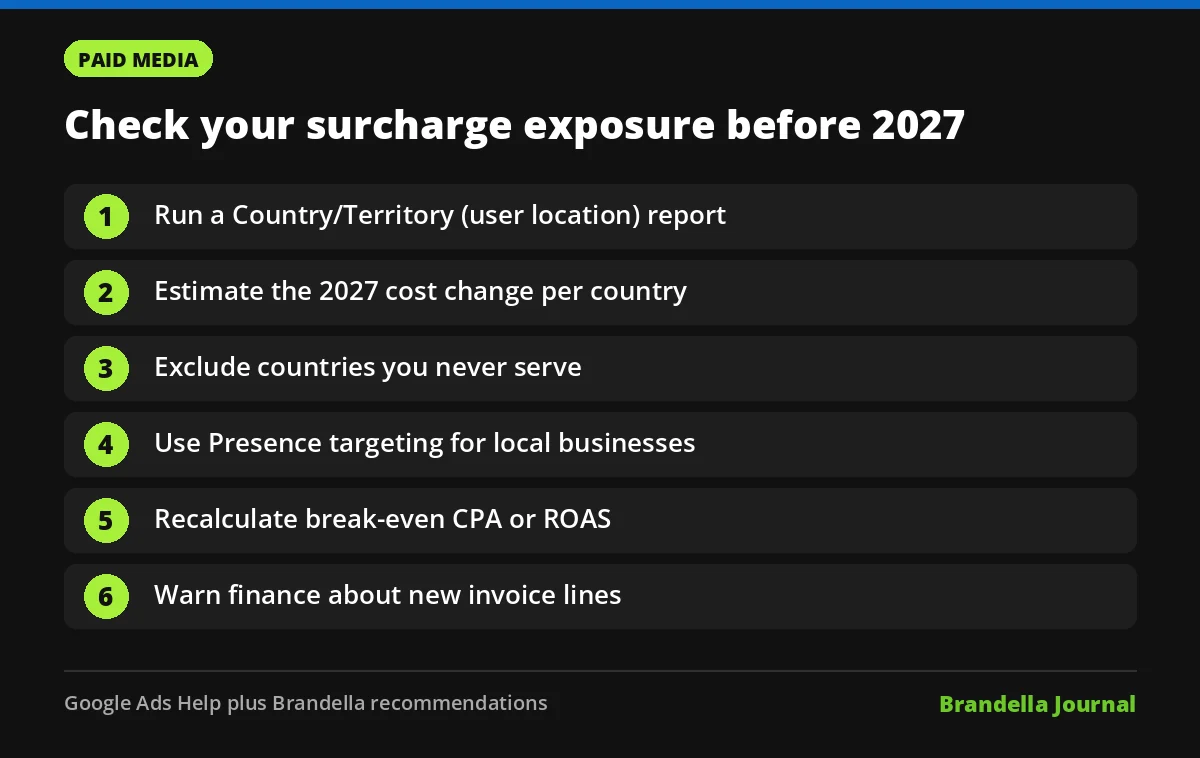
Use December to prepare. These steps mix Google’s own guidance with Brandella recommendations.
- Run a user location report. Google suggests building a Distance report in Report editor with a “Country/Territory (user location)” row. This shows exactly where clicks and impressions came from.
- Size your France, Italy and Turkey spend. Our recommendation: multiply last quarter’s spend in each country by the rate change to estimate the 2027 difference.
- Exclude countries you never serve. If traffic from France or Italy has no business value, exclude those locations at campaign level.
- Switch to Presence where it fits. Local service businesses and stores that only serve nearby customers are good candidates. Watch volume for two weeks after the change.
- Adjust targets for markets you keep. Our recommendation: recalculate your break-even CPA or ROAS for French and Italian campaigns with the 3% surcharge included, then set bid targets from that new number. The Google Ads budget pacing changes are worth reviewing at the same time.
- Tell finance. Surcharges show as separate invoice lines, so flag them before the January invoice arrives.
For a wider account health check, see our 25 Google Ads optimization tips and our note on how language targeting was removed from Search, which also changes who sees your ads.
The bigger trend on ad platform fees
Google is not alone in passing country costs to advertisers. Platforms keep adding fees, credits and line items that make the invoice harder to read than the bid. We saw a similar debate over hidden costs in the Amazon Ads FTC lawsuit on auction surcharges.
The practical lesson is the same: check the invoice, not just the campaign dashboard, when you calculate return on ad spend.
FAQ about Google Ads surcharges
When do the new Google Ads surcharges start?
The new rates for France, Italy and Turkey take effect on January 1, 2027, according to Google’s help page.
Do Google Ads surcharges count toward my budget?
No. Google says surcharges are added on top of your account budget, and taxes are charged in addition.
My business is not in France or Italy. Can I still pay?
Yes. Surcharges depend on where ads are served. If people in those countries see or click your ads, the surcharge applies to that traffic.
Will Google refund surcharges from unwanted countries?
Google says it will not refund surcharges caused by legitimate impressions and clicks served according to your targeting, so fix settings before the date.