AI Assistant Usage Hits 76 Billion Monthly Sessions: Key Data
AI assistant usage reached 76 billion monthly sessions in September 2026, a new Graphite report says. What changed and what it means for your traffic plans.

In this article
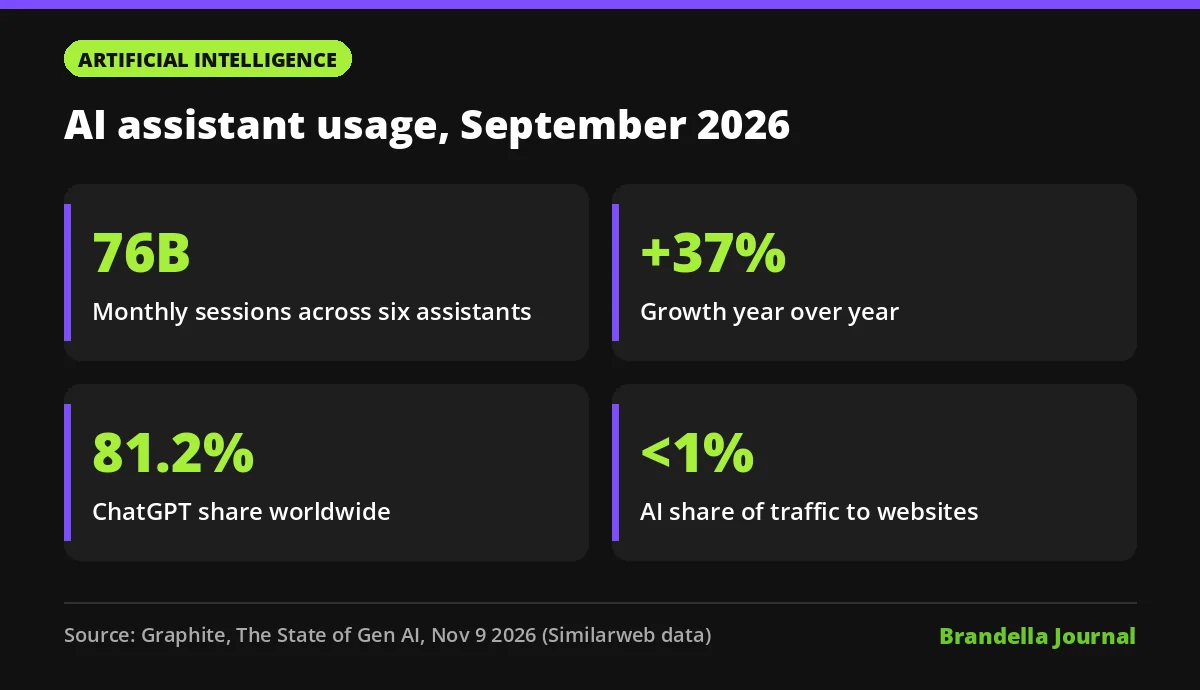
AI assistant usage keeps growing, but not evenly. A new report from Graphite, The State of Gen AI, published on November 9, 2026, estimates that six AI assistants had 76 billion sessions worldwide in September 2026. That is up 37% from September 2025, based on Similarweb data.
The report covers ChatGPT, Gemini, Claude, Grok, Perplexity and DeepSeek. It updates Graphite’s March 2026 study, and it makes one notable change: it no longer compares AI usage with search engine usage.
For marketers, the useful parts are not the headline total. They are the shifts in which assistants are growing, how little traffic AI still sends to websites, and why that referral number probably understates AI’s real influence.
AI assistant usage by the numbers
Graphite, an agency that sells SEO and AI search services, wrote the report with Similarweb estimates. The authors are Ethan Smith and José Luis Paredes. Here are the main figures for September 2026.
| Measure | Figure |
|---|---|
| Worldwide sessions, six assistants | 76 billion, up 37% year over year |
| US sessions | 6.6 billion, up 45% year over year |
| ChatGPT share worldwide | 81.2% |
| ChatGPT share in the US | 80.7% |
| AI share of traffic to websites | Under 1% on average |
| AI referral traffic growth | Up 92% worldwide, 75% in the US |
Growth was not a straight line. Graphite says usage plateaued from July to December 2025, then rebounded 19% from January to September 2026.
Which assistants are growing and which are shrinking
ChatGPT still dominates, with sessions up 24% year over year. No competitor has more than 10% share. But the growth story has spread out.
- Claude: sessions up 1,901% worldwide year over year, and 26% of worldwide growth.
- Gemini: up 182% worldwide year over year, now third by share.
- Grok: up 123% year over year, but down 24% from its March 2026 peak of 1.82 billion sessions to 1.38 billion in September.
- Perplexity: down 27% year over year, and down 38% from its October 2025 peak.
Forbes, which covered the same study, focused on ChatGPT regaining share. Graphite says ChatGPT lost about one percentage point of share per month from January to June 2026, then recovered about 0.27 points per month from July to September.
Why the search engine comparison was dropped
The March edition compared AI assistants with search engines. This one does not. Graphite says Google’s Android app is used for many tasks besides search, and it has no reliable way to separate search sessions from the rest. In its words: “we can no longer reliably compare the relative size of AI for search vs. search engines.”
That is worth remembering the next time you see a claim that AI has overtaken search. The report itself says that comparison cannot be made reliably with this data.
Graphite does give two Google figures. It says AI Overviews appeared in 23% of US searches in September 2025 and 64% by August 2026, and that Google AI Mode had 491 million US web visits in August 2026, compared with 360 million for Gemini.
AI referral traffic is small but undercounted
AI sends less than 1% of traffic to websites on average, according to the report, based on a sample of 43,000 US domains. Worldwide, ChatGPT accounts for 60% of AI referrals, Gemini 14% and Claude 10%.
Graphite argues this number understates AI’s impact, because people who discover a brand in an AI answer often arrive later as direct or branded search visitors. The report also notes that desktop app usage is not measured, so desktop share is likely undercounted. Most measured usage is on phones: 89% worldwide in Q3 2026, with 86% happening inside apps.
What marketers should do with this data now
These are Brandella’s recommendations, based on the report’s findings.
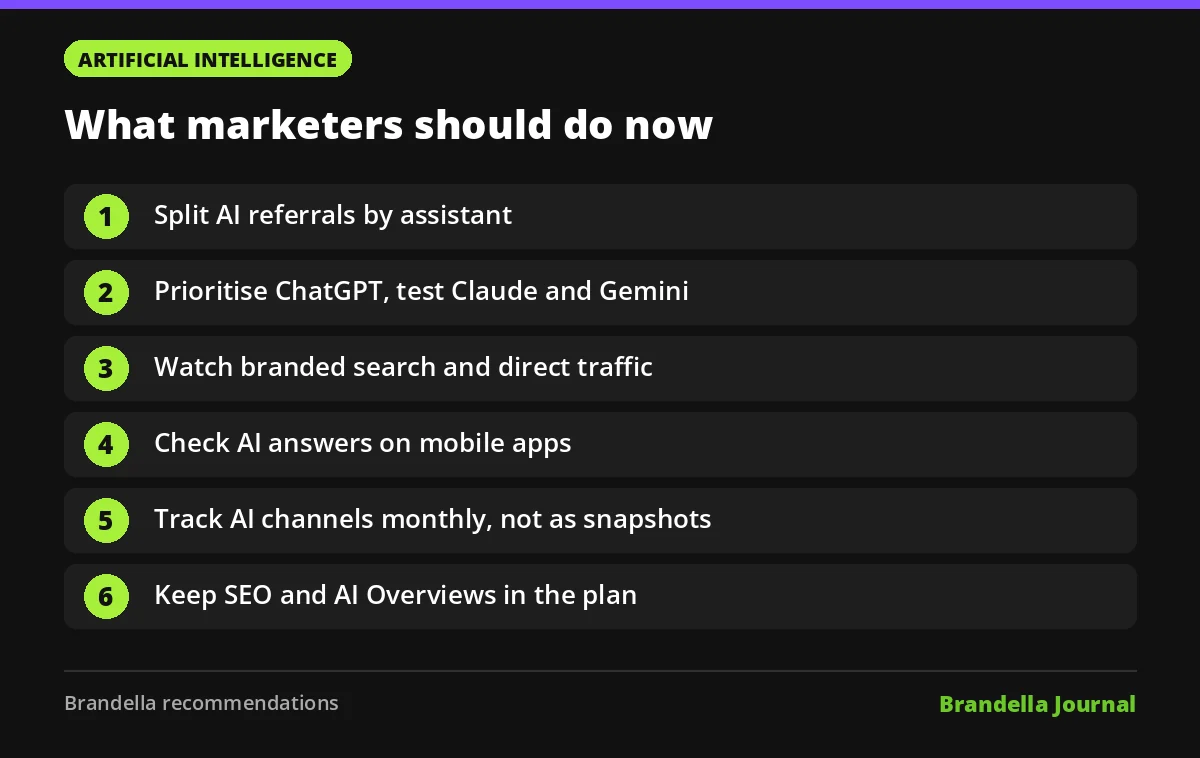
- Split AI referrals by assistant. In your analytics, create a channel group for ChatGPT, Gemini, Claude and Perplexity. Check which ones actually send you visits, rather than assuming.
- Prioritise ChatGPT, but test Claude and Gemini. ChatGPT has the bulk of usage and referrals. Claude and Gemini are growing much faster in percentage terms, so ask each one the questions your customers ask and see if you are mentioned. Our guides on how ChatGPT chooses websites and how Claude selects trusted sources explain what each looks for.
- Watch branded search and direct traffic. If AI influence shows up as direct or branded visits, a rise there may be your clearest signal. Review your attribution model so AI discovery is not invisible.
- Check answers on mobile. With most usage on phones and in apps, test your brand’s AI visibility in the mobile apps, not only on desktop.
- Do not overreact to one assistant’s spike. Perplexity, Grok and DeepSeek have all risen and fallen sharply. Track AI channels monthly and look at trends, not snapshots.
- Keep SEO in the plan. With AI Overviews on most US searches in the report’s data, being cited inside Google’s AI answers matters as much as ranking. Our AI friendly website setup guide is a good starting point.
How to read reports like this
Session estimates from panel data are useful for direction, not precision. Graphite itself lists limits: desktop apps are not measured, and company user numbers are not deduplicated. It gives the example of Similarweb estimating 476 million weekly ChatGPT users against OpenAI’s claim of more than 900 million.
So use the report to decide where to test and what to measure, then trust your own analytics for decisions about budget and content.