
Now Reading: PPC Ad Copy Testing: 7 Proven Tips to Boost CTR
-
01
PPC Ad Copy Testing: 7 Proven Tips to Boost CTR

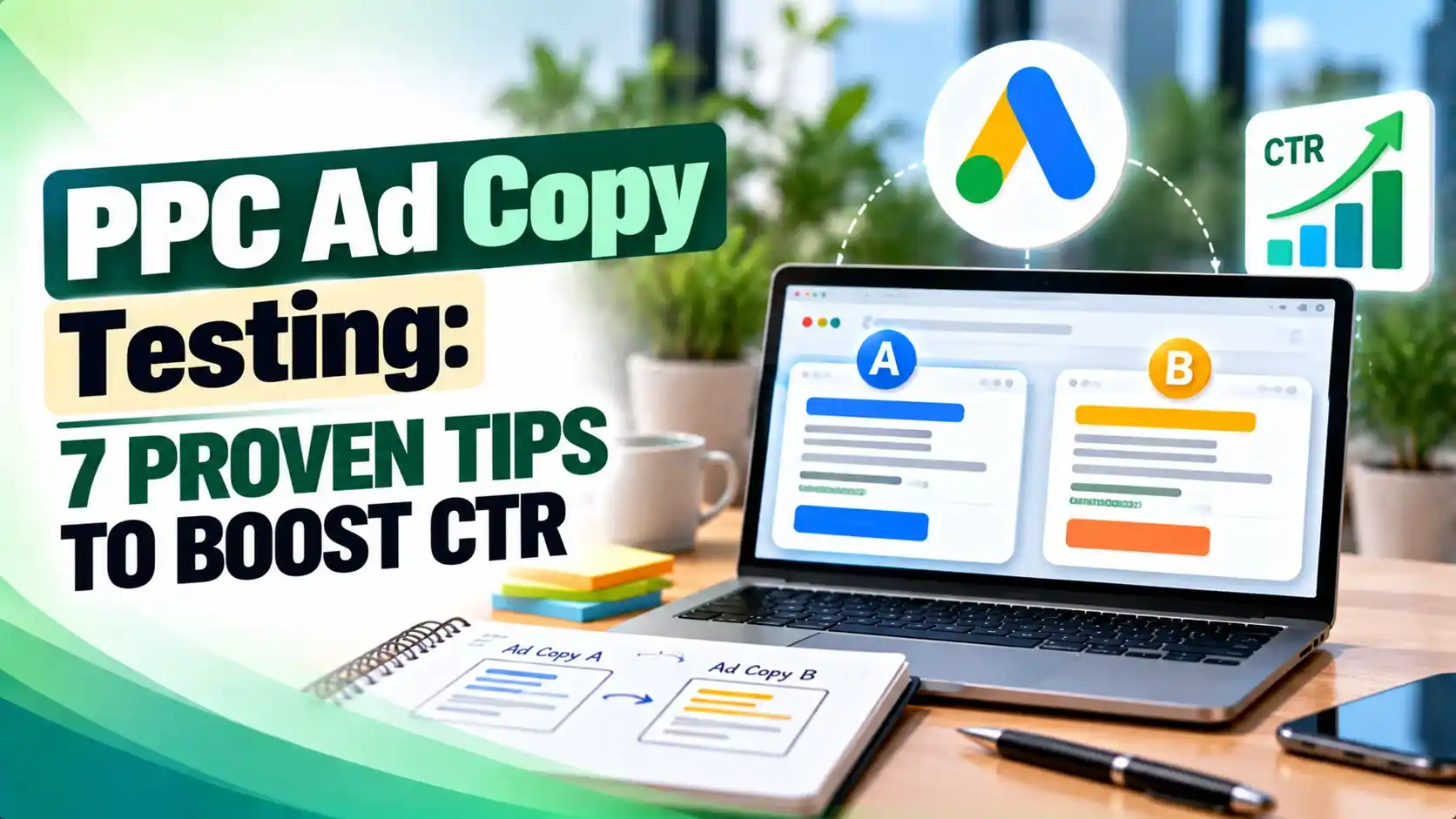
Responsive Search Ads don't test themselves the way most advertisers assume. This guide breaks down what Google's asset-level reporting and Ad Strength actually show versus a true ad variations experiment, plus the statistical significance basics and common mistakes that quietly wreck most PPC ad copy testing efforts.
Hey! If you have ever launched a fresh batch of Google Ads headlines, watched the numbers trickle in for a few days, and then wondered whether you actually learned anything useful from them, this one is for you.
Picture this: your dashboard flags one headline as the top performer, so you pause the rest and move on with your week. But is that a real result, or just noise that will flip again tomorrow? Proper PPC ad copy testing is what tells the two apart, and that is exactly what we are unpacking today.
Why PPC Ad Copy Testing Looks Different in 2026
Google Ads does not run your ads exactly the way you wrote them anymore. Responsive Search Ads mix and match the headlines and descriptions you supply, so the "ad" a shopper actually sees is a live combination the system assembled for that specific auction.
That shift changed what PPC ad copy testing really means day to day. You are no longer comparing Ad A against Ad B in isolation, you are comparing two different pools of assets and how the system chooses to combine them.
The good news is the fundamentals have not changed at all. You still need a clear hypothesis, a clean way to measure results, and enough patience to let the data mature before acting on it, the same habits that run through most account level optimization work in general.
How Responsive Search Ads Report on Your Assets
Inside a responsive search ad, asset level reporting shows impressions, clicks, CTR, cost, average position, and conversions for every individual headline and description you have added, broken out by where each one is used across your ad groups.
Google attaches a real caveat to that report. Metrics like CTR are described as something that "should be used as directional indicators only," because each asset's numbers are attributed per instance it was served inside a combination, not as a standalone ad with its own audience. Google Ads Help spells this out directly for anyone pulling the report.
Ad Strength sits next to that report as a separate signal entirely. It runs on a scale of Incomplete, Poor, Average, Good, or Excellent, based mostly on how closely your assets match your ad group's keywords and how varied your overall asset mix is. Google's own documentation is explicit that the rating does not calculate Ad Rank or Quality Score, and it does not decide whether an ad is even eligible to serve.
An Excellent Ad Strength score is only an indicator of potential effectiveness, not a performance guarantee, confirmed in Google Ads Help's own explanation of how the rating is built and what it deliberately leaves out.
Running a True A/B Test With Ad Variations
For an actual head to head test, Google Ads offers a feature called ad variations, found on the Experiments page that used to be called Drafts and Experiments. It lets you change a headline, a description, or a landing page URL across a campaign and run the edited version against your original on a set share of traffic. Google Ads Help covers the full setup flow.
Google splits the audience using cookies so the same visitor keeps seeing one version consistently, which keeps the comparison cleaner than letting the responsive search ad algorithm rotate assets on its own inside one ad.
Google's guidance for the Experiments page recommends letting a test run for at least four to six weeks to collect enough data before you evaluate it. If no clear recommendation appears after that window, you adjust the budget split or extend the run, you do not call it early, the same patience that shapes how bidding plays out inside the auction itself.
Tip
Before you launch an ad variations test, write down the one change you expect to help and why. PPC ad copy testing without a stated hypothesis just produces numbers nobody on the team can act on with confidence.
Statistical Significance Basics Every Marketer Should Know
An ad with one click out of one impression shows a 100% CTR, and that number tells you nothing yet. It is practically the first lesson anyone running real PPC ad copy testing learns the hard way, as PPC Hero's testing breakdown points out with a real landing page example that flipped after a few more days of data.
Most practitioners aim for a 95% confidence level before declaring a winner, running clicks, impressions, and conversions through a free significance calculator rather than eyeballing the dashboard. Cypress North's walkthrough treats anything below that threshold as inconclusive, not a result worth acting on.
Sample size matters just as much as confidence level. one PPC Hero case study describes a test with 188 clicks over roughly two weeks that still failed to reach significance, which simply meant more data was needed, not that the test had failed.
Resist the urge to check results daily and call a winner the moment one variant edges ahead. That peeking habit is how teams end up acting on what Search Engine Journal calls a result that looks decisive early and then quietly reverses once the sample grows.
What Is Actually Worth Testing in Your Ad Copy
When it comes to PPC ad copy testing, headlines carry the most weight because they are what a shopper reads first, so testing a different value proposition, a different number format, or a different opening verb in your call to action tends to move results more than smaller wording tweaks.
Descriptions, calls to action, and even punctuation are worth isolating too. Search Engine Journal's testing guide found that abbreviated numbers compared against full figures, and different closing punctuation marks, both produced measurable shifts in click through rate for real accounts.
Extensions and assets like sitelinks, callouts, and structured snippets deserve the same attention as headlines. Google counts sitelinks toward your overall ad quality signals and recommends at least six per campaign or ad group for a stronger Ad Strength rating.
Keep each individual test focused on one element at a time. Clix Marketing's testing checklist narrows this down to four swappable pieces, the headline, description line one, description line two, or the display URL, changed one at a time so you know exactly what caused any shift in performance.
Real Limitations of RSA Testing You Should Expect
This is exactly where PPC ad copy testing gets tricky. Asset level reporting inside a responsive search ad is not the same thing as a true split test, and Google's own help documentation never frames it as an A/B testing tool, it is a performance breakdown of assets that are already being combined and rotated automatically within one ad.
Pinning a headline or description can actually lower your Ad Strength score, because pinning limits how many combinations the system is free to try. It is a real tradeoff between creative control and the breadth of data you get back from that rating.
Full performance statistics inside the asset level report are only available from June 5, 2025 onward, per Google Ads Help, so pulling a longer historical comparison inside that specific report has a hard cutoff.
Optmyzr's optimization guidance adds a practical point: comparing assets fairly means grouping ad groups with similar impression volume, otherwise a strong headline in a busy ad group can look artificially better than an equally good one sitting in a quiet one.
Google explicitly recommends running an ad variations experiment for at least four to six weeks before evaluating the result, confirmed on the Experiments help page, which is longer than most advertisers assume.
Common Mistakes That Undermine PPC Ad Copy Testing
Most failed tests do not fail because of bad creative, they fail because of how the test itself was run. The mistakes below show up constantly in real accounts, and most of them tie back to the same basic discipline that drives account success in general.
None of this requires exotic tools. It just requires treating PPC ad copy testing as a repeatable process with a clear deadline, an agreed confidence threshold, and a written hypothesis you can share with the rest of your team, the same approach that keeps automated bidding and AI driven features from making decisions nobody on the account ever actually validated.
| Testing Approach | What It Actually Tells You | Best Used For |
|---|---|---|
| Asset level reporting | Directional performance per headline or description inside live combinations | Spotting weak assets to refresh |
| Ad Strength rating | Asset variety and keyword match quality, not predicted CTR | Checking asset diversity while writing an ad |
| Ad variations experiment | A controlled comparison with a defined control and variant group | Validating one specific copy change |
It means evaluating which headlines, descriptions, and assets perform best within the combinations Google's system assembles, using both the asset level report for directional signals and a true ad variations experiment when you need a defined winner.
Google recommends at least four to six weeks for an ad variations experiment, and most independent PPC sources suggest a minimum of two to four weeks for text ad tests, long enough to cover normal weekly traffic cycles and reach statistical significance.
Not in the strict sense. A single RSA automatically rotates and combines its own assets, so for a controlled comparison with a separate control and variant group you need the ad variations feature on the Experiments page instead.
It measures how well your assets match your ad group's keywords and how varied your asset mix is. Google states directly that it does not calculate Ad Rank, Quality Score, or ad serving eligibility, so it is not a performance prediction.
Stopping a test before it reaches statistical significance. A result that looks like a clear winner after a few days can reverse completely once a full, representative sample of clicks and conversions comes in.
Learn Today
Ad Strength
Google's rating of asset variety and keyword match quality, from Incomplete to Excellent.
Asset level reporting
Per asset performance data for every headline and description inside an RSA.
Ad variations
Google's controlled testing tool for comparing an edited ad against the original.
Statistical significance
Confidence that a test result reflects a real difference rather than random chance.
Responsive Search Ads
Search ads built from multiple headlines and descriptions that Google combines automatically.
Sample size
The amount of click and conversion data needed before a test result can be trusted.
Ready to Run Smarter PPC Ad Copy Tests?
Explore more Brandella Journal guides on SEO and digital marketing.