

- Home
- SEODiscover the latest updates from across the United States, including politics, culture, economy, and trending stories. Stay informed on the key events shaping the nation and the topics everyone’s talking about.
- Technical SEOLearn technical SEO concepts including crawling, indexing, XML sitemaps, robots.txt, canonical tags, site architecture, and website performance.
- Local SEOOptimize your business for local seo with Google Business Profile, local citations, reviews, maps, and location-based SEO.
- Mobile SEOImprove your website’s mobile seo performance with responsive design, mobile-first indexing, usability, and page speed optimization.
- On-Page SEOExplore on-page seo optimization techniques such as title tags, meta descriptions, headings, URLs, internal linking, and content optimization.
- Off-Page SEODiscover off-page SEO strategies such as backlinks, digital PR, brand mentions, outreach, and authority building.
- SEO ToolsExplore the best SEO tools for keyword research, technical audits, backlink analysis, rank tracking, and website optimization.
- Core Web VitalsLearn how to improve Core Web Vitals including LCP, INP, CLS, page speed, and overall user experience for better rankings.
- Keyword ResearchLearn how to find profitable keywords, analyze search intent, evaluate competition, and build effective keyword strategies.
- Link BuildingMaster ethical link building techniques, backlink analysis, outreach methods, guest posting, and authority growth strategies.
- Google Search ConsoleLearn how to use Google Search Console to monitor indexing, fix errors, analyze search performance, and improve SEO.
- SEO BasicsLearn the fundamentals of search engine optimization (SEO Basics), including how search engines work, SEO terminology, and beginner-friendly best practices.
- Paid Media
- Display AdvertisingLearn display advertising strategies, banner ads, audience targeting, remarketing, Google Display campaigns, and optimization techniques.
- Google AdsLearn Google Ads strategies, campaign setup, bidding, keywords, Performance Max, Search Ads, and optimization techniques.
- LinkedIn AdsLearn LinkedIn Ads strategies for B2B marketing, lead generation, audience targeting, campaign optimization, and paid social advertising.
- Meta AdsLearn Meta Ads strategies for Facebook and Instagram, including campaign setup, targeting, retargeting, and performance optimization.
- Paid Media AnalyticsLearn paid media analytics, including CPC, CTR, CPA, ROAS, conversion tracking, attribution, reporting, and campaign performance analysis.
- PPC StrategyLearn effective PPC strategies, campaign planning, bidding, keyword targeting, landing pages, conversion optimization, and more.
- ContentTransform your living spaces with inspiration, tips, and trends in interior design. From minimalist decor to bold statements, find ideas for every style and budget.
- Social
- Digital MarketingExplore stories and advice on living your best life. From personal growth to entertainment, dive into the latest in lifestyle trends and inspiration.
- Artificial IntelligenceStay informed about health and wellness with expert advice, fitness tips, and the latest medical breakthroughs. Your guide to a healthier and happier life.
- DevelopmentYou will find development related educational articles
- GTMLearn Google Tag Manager (GTM) with practical guides for tags, triggers, variables, tracking, conversions, and website analytics implementation.
- HTMLLearn HTML with simple tutorials, examples, tags, elements, attributes, and best practices for building modern web pages.
- HTML CSSLearn HTML CSS together with practical tutorials, examples, layouts, styling techniques, responsive design, and modern web development practices.
- HTML JSLearn HTML JS – JavaScript with practical tutorials and examples for adding interactivity, dynamic content, events, and functionality to web pages.
- JavaScriptExplore JavaScript tutorials, examples, concepts, and practical techniques for creating interactive and dynamic websites and web applications.
- PHPLearn PHP programming with practical tutorials, examples, functions, syntax, and web development techniques for beginners and developers.
- PythonLearn Python programming with practical tutorials, examples, syntax, functions, automation techniques, and useful programming concepts.
- Home
- SEODiscover the latest updates from across the United States, including politics, culture, economy, and trending stories. Stay informed on the key events shaping the nation and the topics everyone’s talking about.
- Technical SEOLearn technical SEO concepts including crawling, indexing, XML sitemaps, robots.txt, canonical tags, site architecture, and website performance.
- Local SEOOptimize your business for local seo with Google Business Profile, local citations, reviews, maps, and location-based SEO.
- Mobile SEOImprove your website’s mobile seo performance with responsive design, mobile-first indexing, usability, and page speed optimization.
- On-Page SEOExplore on-page seo optimization techniques such as title tags, meta descriptions, headings, URLs, internal linking, and content optimization.
- Off-Page SEODiscover off-page SEO strategies such as backlinks, digital PR, brand mentions, outreach, and authority building.
- SEO ToolsExplore the best SEO tools for keyword research, technical audits, backlink analysis, rank tracking, and website optimization.
- Core Web VitalsLearn how to improve Core Web Vitals including LCP, INP, CLS, page speed, and overall user experience for better rankings.
- Keyword ResearchLearn how to find profitable keywords, analyze search intent, evaluate competition, and build effective keyword strategies.
- Link BuildingMaster ethical link building techniques, backlink analysis, outreach methods, guest posting, and authority growth strategies.
- Google Search ConsoleLearn how to use Google Search Console to monitor indexing, fix errors, analyze search performance, and improve SEO.
- SEO BasicsLearn the fundamentals of search engine optimization (SEO Basics), including how search engines work, SEO terminology, and beginner-friendly best practices.
- Paid Media
- Display AdvertisingLearn display advertising strategies, banner ads, audience targeting, remarketing, Google Display campaigns, and optimization techniques.
- Google AdsLearn Google Ads strategies, campaign setup, bidding, keywords, Performance Max, Search Ads, and optimization techniques.
- LinkedIn AdsLearn LinkedIn Ads strategies for B2B marketing, lead generation, audience targeting, campaign optimization, and paid social advertising.
- Meta AdsLearn Meta Ads strategies for Facebook and Instagram, including campaign setup, targeting, retargeting, and performance optimization.
- Paid Media AnalyticsLearn paid media analytics, including CPC, CTR, CPA, ROAS, conversion tracking, attribution, reporting, and campaign performance analysis.
- PPC StrategyLearn effective PPC strategies, campaign planning, bidding, keyword targeting, landing pages, conversion optimization, and more.
- ContentTransform your living spaces with inspiration, tips, and trends in interior design. From minimalist decor to bold statements, find ideas for every style and budget.
- Social
- Digital MarketingExplore stories and advice on living your best life. From personal growth to entertainment, dive into the latest in lifestyle trends and inspiration.
- Artificial IntelligenceStay informed about health and wellness with expert advice, fitness tips, and the latest medical breakthroughs. Your guide to a healthier and happier life.
- DevelopmentYou will find development related educational articles
- GTMLearn Google Tag Manager (GTM) with practical guides for tags, triggers, variables, tracking, conversions, and website analytics implementation.
- HTMLLearn HTML with simple tutorials, examples, tags, elements, attributes, and best practices for building modern web pages.
- HTML CSSLearn HTML CSS together with practical tutorials, examples, layouts, styling techniques, responsive design, and modern web development practices.
- HTML JSLearn HTML JS – JavaScript with practical tutorials and examples for adding interactivity, dynamic content, events, and functionality to web pages.
- JavaScriptExplore JavaScript tutorials, examples, concepts, and practical techniques for creating interactive and dynamic websites and web applications.
- PHPLearn PHP programming with practical tutorials, examples, functions, syntax, and web development techniques for beginners and developers.
- PythonLearn Python programming with practical tutorials, examples, syntax, functions, automation techniques, and useful programming concepts.
Now Reading: REST API in PHP Without a Framework: Build It in 6 Steps
-
01
REST API in PHP Without a Framework: Build It in 6 Steps
- Home//
- SEO//Discover the latest updates from across the United States, including politics, culture, economy, and trending stories. Stay informed on the key events shaping the nation and the topics everyone’s talking about.
- Technical SEO//Learn technical SEO concepts including crawling, indexing, XML sitemaps, robots.txt, canonical tags, site architecture, and website performance.
- Local SEO//Optimize your business for local seo with Google Business Profile, local citations, reviews, maps, and location-based SEO.
- Mobile SEO//Improve your website’s mobile seo performance with responsive design, mobile-first indexing, usability, and page speed optimization.
- On-Page SEO//Explore on-page seo optimization techniques such as title tags, meta descriptions, headings, URLs, internal linking, and content optimization.
- Off-Page SEO//Discover off-page SEO strategies such as backlinks, digital PR, brand mentions, outreach, and authority building.
- SEO Tools//Explore the best SEO tools for keyword research, technical audits, backlink analysis, rank tracking, and website optimization.
- Core Web Vitals//Learn how to improve Core Web Vitals including LCP, INP, CLS, page speed, and overall user experience for better rankings.
- Keyword Research//Learn how to find profitable keywords, analyze search intent, evaluate competition, and build effective keyword strategies.
- Link Building//Master ethical link building techniques, backlink analysis, outreach methods, guest posting, and authority growth strategies.
- Google Search Console//Learn how to use Google Search Console to monitor indexing, fix errors, analyze search performance, and improve SEO.
- SEO Basics//Learn the fundamentals of search engine optimization (SEO Basics), including how search engines work, SEO terminology, and beginner-friendly best practices.
- Paid Media//
- Display Advertising//Learn display advertising strategies, banner ads, audience targeting, remarketing, Google Display campaigns, and optimization techniques.
- Google Ads//Learn Google Ads strategies, campaign setup, bidding, keywords, Performance Max, Search Ads, and optimization techniques.
- LinkedIn Ads//Learn LinkedIn Ads strategies for B2B marketing, lead generation, audience targeting, campaign optimization, and paid social advertising.
- Meta Ads//Learn Meta Ads strategies for Facebook and Instagram, including campaign setup, targeting, retargeting, and performance optimization.
- Paid Media Analytics//Learn paid media analytics, including CPC, CTR, CPA, ROAS, conversion tracking, attribution, reporting, and campaign performance analysis.
- PPC Strategy//Learn effective PPC strategies, campaign planning, bidding, keyword targeting, landing pages, conversion optimization, and more.
- Content//Transform your living spaces with inspiration, tips, and trends in interior design. From minimalist decor to bold statements, find ideas for every style and budget.
- Social//
- Digital Marketing//Explore stories and advice on living your best life. From personal growth to entertainment, dive into the latest in lifestyle trends and inspiration.
- Artificial Intelligence//Stay informed about health and wellness with expert advice, fitness tips, and the latest medical breakthroughs. Your guide to a healthier and happier life.
- Development//You will find development related educational articles
- GTM//Learn Google Tag Manager (GTM) with practical guides for tags, triggers, variables, tracking, conversions, and website analytics implementation.
- HTML//Learn HTML with simple tutorials, examples, tags, elements, attributes, and best practices for building modern web pages.
- HTML CSS//Learn HTML CSS together with practical tutorials, examples, layouts, styling techniques, responsive design, and modern web development practices.
- HTML JS//Learn HTML JS – JavaScript with practical tutorials and examples for adding interactivity, dynamic content, events, and functionality to web pages.
- JavaScript//Explore JavaScript tutorials, examples, concepts, and practical techniques for creating interactive and dynamic websites and web applications.
- PHP//Learn PHP programming with practical tutorials, examples, functions, syntax, and web development techniques for beginners and developers.
- Python//Learn Python programming with practical tutorials, examples, syntax, functions, automation techniques, and useful programming concepts.
- Home
- Development
- PHP
- REST API in PHP Without a Framework: Build It in 6 Steps
REST API in PHP Without a Framework: Build It in 6 Steps

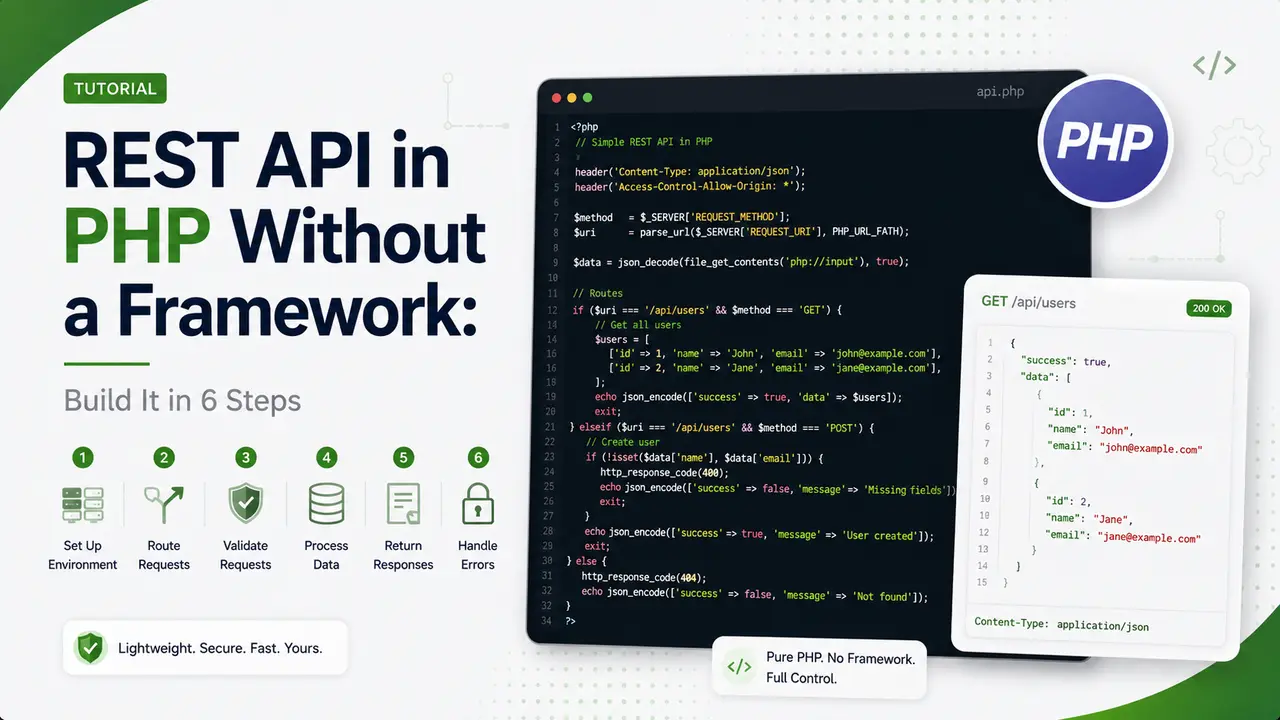
A practical guide to a rest api in php without a framework, covering routing, PDO backed models, bearer token authentication, and JSON error handling.
Table of Contents
ToggleInstalling a full framework to serve a handful of JSON endpoints is a lot of weight for a small job. A REST API in PHP without a framework needs only a router, a database connection, and a clear idea of what each HTTP verb should do.
Why Build a REST API in PHP Without a Framework
A framework earns its weight on a large application with dozens of routes, middleware, and moving parts. Roy Fielding's original REST dissertation never mentions a framework at all, since the architecture itself is just a set of constraints over plain HTTP.
A small internal tool, a mobile app backend with six endpoints, or a proof of concept rarely needs any of that structure.
Plain PHP with a thin routing layer starts in minutes and stays easy to read months later, since nothing hides behind a framework's own conventions.
Everything below is production usable code, not a toy example, built around the same HTTP rules a framework would enforce anyway.
Setting Up a Front Controller
Every request routes through a single PHP file, which keeps the routing logic in one place instead of scattered across separate files per endpoint.
RewriteEngine On
RewriteCond %{REQUEST_FILENAME} !-f
RewriteRule ^(.*)$ index.php [QSA,L]
Every request that does not point at a real file gets forwarded to index.php, which becomes the single entry point the router below reads from. mod_rewrite handles this on Apache, and Nginx uses an equivalent try_files directive in its own server block.
Building a Simple Router Class
A router just needs to match a method and a path pattern against the current request, then call the matching handler.
final class Router {
    private array $routes = [];

    public function add(string $method, string $pattern, callable $handler): void {
        $this->routes[] = ['method' => $method, 'pattern' => $pattern, 'handler' => $handler];
    }

    public function dispatch(string $method, string $path): void {
        foreach ($this->routes as $route) {
            if ($route['method'] !== $method) {
                continue;
            }
            $regex = '#^' . preg_replace('/\{(\w+)\}/', '(?P<$1>[^/]+)', $route['pattern']) . '$#';
            if (preg_match($regex, $path, $matches)) {
                $route['handler'](array_filter($matches, 'is_string', ARRAY_FILTER_USE_KEY));
                return;
            }
        }
        http_response_code(404);
        echo json_encode(['error' => 'Route not found']);
    }
}
Turning {id} style placeholders into a named regex group lets a single pattern like /posts/{id} match /posts/42 and hand back id already extracted.
Returning Proper JSON Responses and Status Codes
A REST API's status code carries real meaning, and a client integrating against it depends on that meaning being consistent. The full list of codes and what each one is meant to signal comes from MDN's HTTP status reference, which is worth keeping open while building any API.
function json_response(array $data, int $status = 200): void {
    http_response_code($status);
    header('Content-Type: application/json');
    echo json_encode($data, JSON_UNESCAPED_SLASHES);
    exit;
}| HTTP Method | Action | Typical Status Code |
|---|---|---|
| GET | Read one or many resources | 200 on success, 404 if missing |
| POST | Create a new resource | 201 on success |
| PUT | Replace an existing resource | 200 on success |
| DELETE | Remove a resource | 204 on success |
Handling GET, POST, PUT, and DELETE for a Resource
Registering routes for a single resource follows the same shape regardless of how many resources the API eventually grows to cover, and every response still follows the same JSON structure a client already expects.
$router = new Router();

$router->add('GET', '/posts', fn() => json_response(get_all_posts($pdo)));
$router->add('GET', '/posts/{id}', fn($p) => json_response(get_post($pdo, (int) $p['id'])));
$router->add('POST', '/posts', fn() => json_response(create_post($pdo, get_json_body()), 201));
$router->add('PUT', '/posts/{id}', fn($p) => json_response(update_post($pdo, (int) $p['id'], get_json_body())));
$router->add('DELETE', '/posts/{id}', fn($p) => json_response(delete_post($pdo, (int) $p['id']), 204));

$router->dispatch($_SERVER['REQUEST_METHOD'], parse_url($_SERVER['REQUEST_URI'], PHP_URL_PATH));
Five lines wire up a complete resource, and adding a second resource means five more lines rather than a new controller class and configuration file.
Connecting Routes to a PDO Backed Model
The handler functions referenced above stay small, since each one wraps a single PDO prepared statement.
function get_post(PDO $pdo, int $id): array {
    $stmt = $pdo->prepare('SELECT id, title, body FROM posts WHERE id = ?');
    $stmt->execute([$id]);
    $post = $stmt->fetch(PDO::FETCH_ASSOC);

    if (!$post) {
        json_response(['error' => 'Post not found'], 404);
    }
    return $post;
}
Calling json_response directly from inside the model and letting it exit keeps the missing resource case short, without an extra layer of exceptions just to bubble a 404 upward.
Authenticating Requests With a Bearer Token
A write endpoint left open to anyone is a real risk the moment the API is reachable from outside a local network. The Bearer scheme is a standard HTTP authentication pattern, not something specific to this guide.
function require_bearer_token(): void {
    $header = $_SERVER['HTTP_AUTHORIZATION'] ?? '';

    if (!preg_match('/^Bearer\s+(.+)$/', $header, $matches)) {
        json_response(['error' => 'Missing or malformed token'], 401);
    }
    if (!hash_equals(getenv('API_TOKEN'), $matches[1])) {
        json_response(['error' => 'Invalid token'], 403);
    }
}
hash_equals() compares strings in constant time, which matters here since a plain === comparison can leak timing information about how much of the token matched. RFC 6750 defines the Bearer token scheme this pattern follows.
Handling Errors With a Consistent JSON Format
A client integrating against the API should be able to parse every error the same way, regardless of which endpoint produced it.
set_exception_handler(function (Throwable $e) {
    json_response([
        'error' => 'Server error',
        'request_id' => bin2hex(random_bytes(8))
    ], 500);
});
Returning a random request_id instead of the raw exception message keeps internal details out of the response while still giving support a value to search server logs for.
- Validate the request body before touching the database: the JSON decoding and validation rules from earlier in this series apply directly here.
- Return the right status code, not just 200: a client relies on the code as much as the body to know what happened.
- Never echo a raw exception message: it can leak file paths, query fragments, or other internal details to a caller.
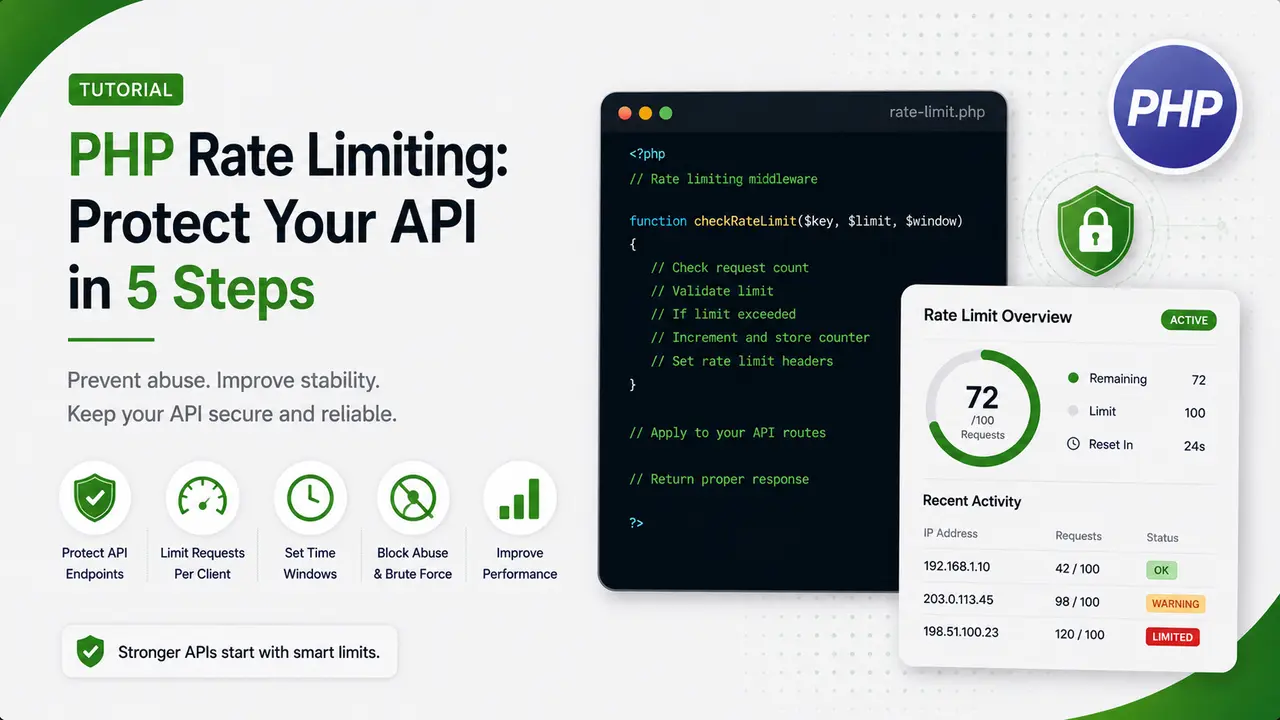
- Rate limit write endpoints: the same IP based limiter used for a contact form works just as well in front of a POST route.
- Check requests against the OWASP API Security Top 10: broken authentication and excessive data exposure are the two most common issues in a hand rolled API.
- Version the API in the URL path: a prefix like /v1/posts leaves room to change the response shape later without breaking existing clients.
Testing the API With curl
A quick command line request using curl confirms the whole chain works before any client application gets involved.
# create a post
curl -X POST https://api.example.com/posts \
  -H "Authorization: Bearer your_token_here" \
  -H "Content-Type: application/json" \
  -d '{"title":"Hello","body":"First post"}'
A successful call returns status 201 along with the newly created row, confirming the router, the model, and the authentication check all worked together correctly.
Watch: Building a PHP REST API From Scratch
Dave Hollingworth builds a working REST API using plain, object oriented PHP and MySQL, which follows a very similar shape to the router and model pattern in this guide.
Video credit: Dave Hollingworth.
Swapping the video's approach for the named route parameters and bearer token check in this guide is a natural next step once the base pattern feels familiar.
Related Articles
Frequently Asked Questions
For a small, focused API it often is. Once the number of resources and business rules grows large, the structure a framework provides usually becomes worth the added weight.
Faster setup, fewer dependencies to keep updated, and a codebase where every line of routing and request handling is visible instead of hidden behind configuration.
It is a reasonable baseline for a server to server integration, though a public facing API serving many users usually needs a fuller OAuth style flow eventually.
Yes. Always setting an explicit status code, even 200, avoids relying on PHP's default, which can vary depending on what already ran earlier in the request.
Add a new model file with its own functions and register a matching set of routes, following the exact same five line pattern used for posts in this guide.
What We Learn Today
A front controller centralizes routing
Every request passes through one file instead of many scattered endpoints.
Status codes carry real meaning
Clients depend on the code, not just the response body, to know what happened.
Route registration stays short
Five lines wire up a full resource without any generated boilerplate.
Bearer tokens need constant time checks
hash_equals prevents a timing attack a plain comparison would allow.
Errors should never leak internals
A request ID beats a raw exception message in every response.
curl confirms the whole chain
A single command line request tests routing, auth, and the model together.
Ready to Ship a Lightweight PHP API?
Pair a rest api in php without a framework with a wider development workflow to keep every endpoint fast, secure, and easy to extend.
Related Posts

Previous Post
Next Post
Previous Post
Next Post




- Artificial Intelligence
- Content
- Core Web Vitals
- Development
- Digital Marketing
- Display Advertising
- Google Ads
- Google Search Console
- GTM
- HTML
- HTML CSS
- JavaScript
- Keyword Research
- Link Building
- LinkedIn Ads
- Local SEO
- Meta Ads
- Mobile SEO
- Off-Page SEO
- On-Page SEO
- Paid Media
- Paid Media Analytics
- PHP
- PPC Strategy
- Python
- SEO
- SEO Basics
- SEO Tools
- Social
- Technical SEO