
- Home
- SEODiscover the latest updates from across the United States, including politics, culture, economy, and trending stories. Stay informed on the key events shaping the nation and the topics everyone’s talking about.
- Technical SEOLearn technical SEO concepts including crawling, indexing, XML sitemaps, robots.txt, canonical tags, site architecture, and website performance.
- Local SEOOptimize your business for local seo with Google Business Profile, local citations, reviews, maps, and location-based SEO.
- Mobile SEOImprove your website’s mobile seo performance with responsive design, mobile-first indexing, usability, and page speed optimization.
- On-Page SEOExplore on-page seo optimization techniques such as title tags, meta descriptions, headings, URLs, internal linking, and content optimization.
- Off-Page SEODiscover off-page SEO strategies such as backlinks, digital PR, brand mentions, outreach, and authority building.
- SEO ToolsExplore the best SEO tools for keyword research, technical audits, backlink analysis, rank tracking, and website optimization.
- Core Web VitalsLearn how to improve Core Web Vitals including LCP, INP, CLS, page speed, and overall user experience for better rankings.
- Keyword ResearchLearn how to find profitable keywords, analyze search intent, evaluate competition, and build effective keyword strategies.
- Link BuildingMaster ethical link building techniques, backlink analysis, outreach methods, guest posting, and authority growth strategies.
- Google Search ConsoleLearn how to use Google Search Console to monitor indexing, fix errors, analyze search performance, and improve SEO.
- SEO BasicsLearn the fundamentals of search engine optimization (SEO Basics), including how search engines work, SEO terminology, and beginner-friendly best practices.
- Paid Media
- Display AdvertisingLearn display advertising strategies, banner ads, audience targeting, remarketing, Google Display campaigns, and optimization techniques.
- Google AdsLearn Google Ads strategies, campaign setup, bidding, keywords, Performance Max, Search Ads, and optimization techniques.
- LinkedIn AdsLearn LinkedIn Ads strategies for B2B marketing, lead generation, audience targeting, campaign optimization, and paid social advertising.
- Meta AdsLearn Meta Ads strategies for Facebook and Instagram, including campaign setup, targeting, retargeting, and performance optimization.
- Paid Media AnalyticsLearn paid media analytics, including CPC, CTR, CPA, ROAS, conversion tracking, attribution, reporting, and campaign performance analysis.
- PPC StrategyLearn effective PPC strategies, campaign planning, bidding, keyword targeting, landing pages, conversion optimization, and more.
- ContentTransform your living spaces with inspiration, tips, and trends in interior design. From minimalist decor to bold statements, find ideas for every style and budget.
- Social
- Digital MarketingExplore stories and advice on living your best life. From personal growth to entertainment, dive into the latest in lifestyle trends and inspiration.
- Artificial IntelligenceStay informed about health and wellness with expert advice, fitness tips, and the latest medical breakthroughs. Your guide to a healthier and happier life.
- DevelopmentYou will find development related educational articles
- GTMLearn Google Tag Manager (GTM) with practical guides for tags, triggers, variables, tracking, conversions, and website analytics implementation.
- HTMLLearn HTML with simple tutorials, examples, tags, elements, attributes, and best practices for building modern web pages.
- HTML CSSLearn HTML CSS together with practical tutorials, examples, layouts, styling techniques, responsive design, and modern web development practices.
- HTML JSLearn HTML JS – JavaScript with practical tutorials and examples for adding interactivity, dynamic content, events, and functionality to web pages.
- JavaScriptExplore JavaScript tutorials, examples, concepts, and practical techniques for creating interactive and dynamic websites and web applications.
- PHPLearn PHP programming with practical tutorials, examples, functions, syntax, and web development techniques for beginners and developers.
- PythonLearn Python programming with practical tutorials, examples, syntax, functions, automation techniques, and useful programming concepts.
- Home
- SEODiscover the latest updates from across the United States, including politics, culture, economy, and trending stories. Stay informed on the key events shaping the nation and the topics everyone’s talking about.
- Technical SEOLearn technical SEO concepts including crawling, indexing, XML sitemaps, robots.txt, canonical tags, site architecture, and website performance.
- Local SEOOptimize your business for local seo with Google Business Profile, local citations, reviews, maps, and location-based SEO.
- Mobile SEOImprove your website’s mobile seo performance with responsive design, mobile-first indexing, usability, and page speed optimization.
- On-Page SEOExplore on-page seo optimization techniques such as title tags, meta descriptions, headings, URLs, internal linking, and content optimization.
- Off-Page SEODiscover off-page SEO strategies such as backlinks, digital PR, brand mentions, outreach, and authority building.
- SEO ToolsExplore the best SEO tools for keyword research, technical audits, backlink analysis, rank tracking, and website optimization.
- Core Web VitalsLearn how to improve Core Web Vitals including LCP, INP, CLS, page speed, and overall user experience for better rankings.
- Keyword ResearchLearn how to find profitable keywords, analyze search intent, evaluate competition, and build effective keyword strategies.
- Link BuildingMaster ethical link building techniques, backlink analysis, outreach methods, guest posting, and authority growth strategies.
- Google Search ConsoleLearn how to use Google Search Console to monitor indexing, fix errors, analyze search performance, and improve SEO.
- SEO BasicsLearn the fundamentals of search engine optimization (SEO Basics), including how search engines work, SEO terminology, and beginner-friendly best practices.
- Paid Media
- Display AdvertisingLearn display advertising strategies, banner ads, audience targeting, remarketing, Google Display campaigns, and optimization techniques.
- Google AdsLearn Google Ads strategies, campaign setup, bidding, keywords, Performance Max, Search Ads, and optimization techniques.
- LinkedIn AdsLearn LinkedIn Ads strategies for B2B marketing, lead generation, audience targeting, campaign optimization, and paid social advertising.
- Meta AdsLearn Meta Ads strategies for Facebook and Instagram, including campaign setup, targeting, retargeting, and performance optimization.
- Paid Media AnalyticsLearn paid media analytics, including CPC, CTR, CPA, ROAS, conversion tracking, attribution, reporting, and campaign performance analysis.
- PPC StrategyLearn effective PPC strategies, campaign planning, bidding, keyword targeting, landing pages, conversion optimization, and more.
- ContentTransform your living spaces with inspiration, tips, and trends in interior design. From minimalist decor to bold statements, find ideas for every style and budget.
- Social
- Digital MarketingExplore stories and advice on living your best life. From personal growth to entertainment, dive into the latest in lifestyle trends and inspiration.
- Artificial IntelligenceStay informed about health and wellness with expert advice, fitness tips, and the latest medical breakthroughs. Your guide to a healthier and happier life.
- DevelopmentYou will find development related educational articles
- GTMLearn Google Tag Manager (GTM) with practical guides for tags, triggers, variables, tracking, conversions, and website analytics implementation.
- HTMLLearn HTML with simple tutorials, examples, tags, elements, attributes, and best practices for building modern web pages.
- HTML CSSLearn HTML CSS together with practical tutorials, examples, layouts, styling techniques, responsive design, and modern web development practices.
- HTML JSLearn HTML JS – JavaScript with practical tutorials and examples for adding interactivity, dynamic content, events, and functionality to web pages.
- JavaScriptExplore JavaScript tutorials, examples, concepts, and practical techniques for creating interactive and dynamic websites and web applications.
- PHPLearn PHP programming with practical tutorials, examples, functions, syntax, and web development techniques for beginners and developers.
- PythonLearn Python programming with practical tutorials, examples, syntax, functions, automation techniques, and useful programming concepts.
Now Reading: Hreflang Tags Explained: 5 Essential Rules for Global SEO
-
01
Hreflang Tags Explained: 5 Essential Rules for Global SEO
- Home//
- SEO//Discover the latest updates from across the United States, including politics, culture, economy, and trending stories. Stay informed on the key events shaping the nation and the topics everyone’s talking about.
- Technical SEO//Learn technical SEO concepts including crawling, indexing, XML sitemaps, robots.txt, canonical tags, site architecture, and website performance.
- Local SEO//Optimize your business for local seo with Google Business Profile, local citations, reviews, maps, and location-based SEO.
- Mobile SEO//Improve your website’s mobile seo performance with responsive design, mobile-first indexing, usability, and page speed optimization.
- On-Page SEO//Explore on-page seo optimization techniques such as title tags, meta descriptions, headings, URLs, internal linking, and content optimization.
- Off-Page SEO//Discover off-page SEO strategies such as backlinks, digital PR, brand mentions, outreach, and authority building.
- SEO Tools//Explore the best SEO tools for keyword research, technical audits, backlink analysis, rank tracking, and website optimization.
- Core Web Vitals//Learn how to improve Core Web Vitals including LCP, INP, CLS, page speed, and overall user experience for better rankings.
- Keyword Research//Learn how to find profitable keywords, analyze search intent, evaluate competition, and build effective keyword strategies.
- Link Building//Master ethical link building techniques, backlink analysis, outreach methods, guest posting, and authority growth strategies.
- Google Search Console//Learn how to use Google Search Console to monitor indexing, fix errors, analyze search performance, and improve SEO.
- SEO Basics//Learn the fundamentals of search engine optimization (SEO Basics), including how search engines work, SEO terminology, and beginner-friendly best practices.
- Paid Media//
- Display Advertising//Learn display advertising strategies, banner ads, audience targeting, remarketing, Google Display campaigns, and optimization techniques.
- Google Ads//Learn Google Ads strategies, campaign setup, bidding, keywords, Performance Max, Search Ads, and optimization techniques.
- LinkedIn Ads//Learn LinkedIn Ads strategies for B2B marketing, lead generation, audience targeting, campaign optimization, and paid social advertising.
- Meta Ads//Learn Meta Ads strategies for Facebook and Instagram, including campaign setup, targeting, retargeting, and performance optimization.
- Paid Media Analytics//Learn paid media analytics, including CPC, CTR, CPA, ROAS, conversion tracking, attribution, reporting, and campaign performance analysis.
- PPC Strategy//Learn effective PPC strategies, campaign planning, bidding, keyword targeting, landing pages, conversion optimization, and more.
- Content//Transform your living spaces with inspiration, tips, and trends in interior design. From minimalist decor to bold statements, find ideas for every style and budget.
- Social//
- Digital Marketing//Explore stories and advice on living your best life. From personal growth to entertainment, dive into the latest in lifestyle trends and inspiration.
- Artificial Intelligence//Stay informed about health and wellness with expert advice, fitness tips, and the latest medical breakthroughs. Your guide to a healthier and happier life.
- Development//You will find development related educational articles
- GTM//Learn Google Tag Manager (GTM) with practical guides for tags, triggers, variables, tracking, conversions, and website analytics implementation.
- HTML//Learn HTML with simple tutorials, examples, tags, elements, attributes, and best practices for building modern web pages.
- HTML CSS//Learn HTML CSS together with practical tutorials, examples, layouts, styling techniques, responsive design, and modern web development practices.
- HTML JS//Learn HTML JS – JavaScript with practical tutorials and examples for adding interactivity, dynamic content, events, and functionality to web pages.
- JavaScript//Explore JavaScript tutorials, examples, concepts, and practical techniques for creating interactive and dynamic websites and web applications.
- PHP//Learn PHP programming with practical tutorials, examples, functions, syntax, and web development techniques for beginners and developers.
- Python//Learn Python programming with practical tutorials, examples, syntax, functions, automation techniques, and useful programming concepts.
- Home
- SEO
- Technical SEO
- Hreflang Tags Explained: 5 Essential Rules for Global SEO
Hreflang Tags Explained: 5 Essential Rules for Global SEO

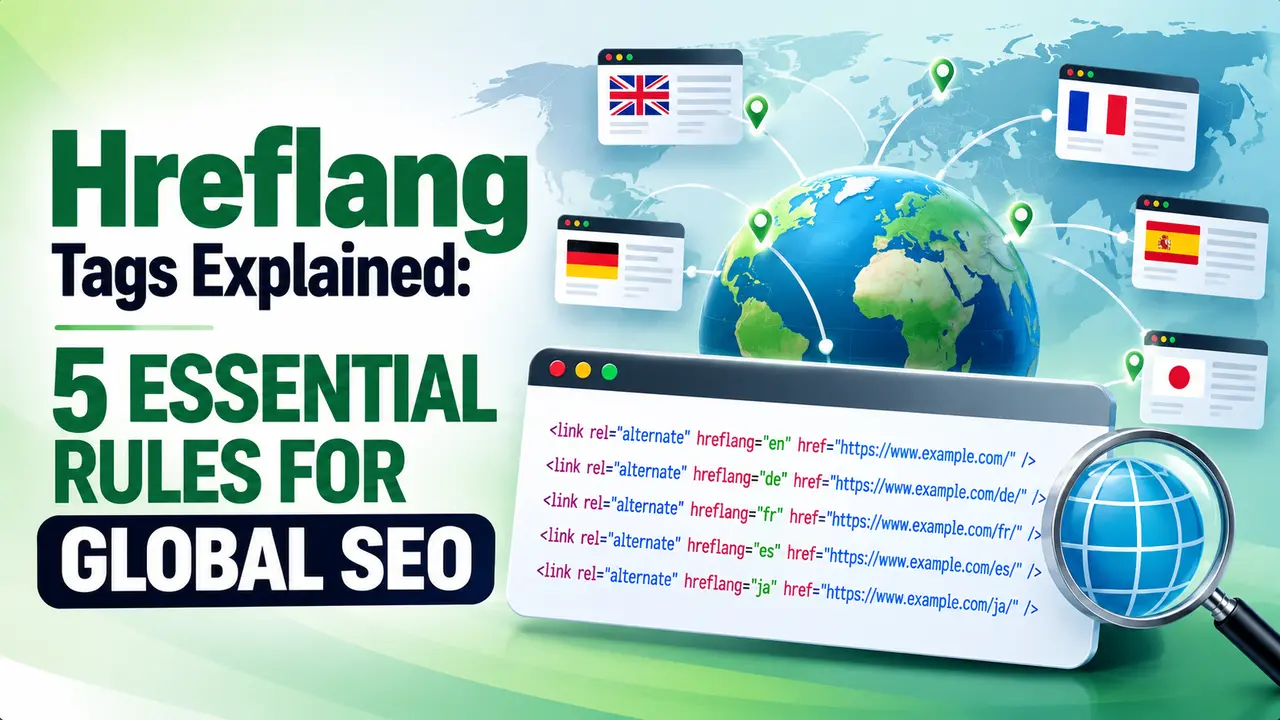
Hreflang tags are the quiet reason your French page can outrank your English one in the wrong country. This guide breaks down what hreflang tags actually do, the most common setup mistakes, and five rules that keep international SEO signals pointing at the right page every time.
Table of Contents
ToggleHey! If you run a site in more than one language or ship separate pages for different countries, you have probably typed a block of link tags into your head section and hoped for the best. This one is for you.
Picture this: your French page outranks your English page in France, except it is showing up for searchers in Canada instead, and your support inbox is full of confused messages. That mismatch is usually not a translation problem. It is a hreflang tags problem, and it is one of the most common ways international sites quietly lose traffic.
What Hreflang Tags Actually Do
Hreflang tags are a small piece of markup that tell search engines which language and which country a page is meant for. According to Google's own documentation, the annotation exists so Google can point a searcher in Tokyo to the Japanese version of a page and a searcher in Madrid to the Spanish one, even when both pages are technically duplicates of each other.
Without hreflang tags, search engines are left guessing. They might index only one language, show the wrong country version in search results, or treat your localized pages as duplicate content competing against each other. That last outcome is the quiet killer, because it dilutes ranking signals across pages that should be working together.
Per Wikipedia's overview of the attribute, hreflang covers three real world scenarios: the same country with different languages, different countries with the same language, and different countries with different languages. Most sites only plan for one of these and miss the other two.
The scale of the problem is bigger than most teams expect. An audit of 374,756 domains found that 67 percent of sites using hreflang tags carried at least one unresolved error, meaning broken international targeting is closer to the norm than the exception. If your site has never been audited for this specifically, assume there is at least one mismatched pair somewhere in your clusters.
Tip
Before you touch this setup, make sure your canonical tags are already correct for every locale. Hreflang built on top of a broken canonical setup just scales the confusion.
The Rule Nobody Reads Twice: Return Tags Must Confirm
This is the part of international SEO that trips up even experienced teams. Google states it plainly: if page A points to page B as an alternate, page B must point back to page A, or the whole pair is ignored. One direction is not enough.
Ahrefs compares this to confirming a relationship status, a declaration only counts once both sides agree. A page that lists five language versions but is not listed back on all five is effectively invisible to the system, even though the markup looks complete on the page you are staring at.
This return tag requirement is also why mismatches are so easy to create at scale. Add a new regional page, forget to update the other four, and you have broken a cluster that was working fine yesterday.
What the x default Value Is For (and Isn't)
Alongside language and country codes, hreflang tags support one special value: x-default. Google describes it as the version shown when none of your other annotations match a visitor's browser settings, think of a language picker page or a global homepage that serves everyone before they choose a locale.
x-default is not meant for your biggest market's homepage or your most heavily optimized page. It is meant for the fallback a visitor sees when nothing else fits, which is a narrower job than most teams assign it.
An audit of over 374,000 domains by Ahrefs found that 56.3 percent of sites using hreflang tags were missing an x-default fallback entirely, making it the single most common gap in real world implementations.
Three Ways to Add Hreflang
There are three accepted places to declare hreflang tags, and Google treats them as functionally equal. You pick based on your site's shape, not based on which one ranks better.
The first is a link element inside the HTML head of each page, the most common choice for small to mid sized sites because it is easy to template. The second is an HTTP header, which matters for files that have no head section at all, like PDFs. The third is an XML sitemap entry, which Screaming Frog recommends for large multilingual catalogs, since one sitemap file can describe hundreds of language clusters without bloating every page's markup.
If your site already maintains a sitemap for crawling, our guide on the difference between an HTML sitemap and an XML sitemap is a useful companion read before you decide where this annotation should live.
Tip
Pick one method and stick to it. Google explicitly says there is no ranking benefit to declaring hreflang tags in the sitemap and the HTML head at the same time, you just double your chances of the two copies drifting out of sync.
5 Mistakes That Break International SEO
Now the part you came for. These five mistakes show up again and again in audits, and they are the reason this markup has a reputation for being fragile.
A study of 20,000 multilingual sites by Semrush found that 58 percent had hreflang conflicts somewhere in their source code, and missing self references showed up in 96 percent of the sites that had any source code conflict at all. These are not rare edge cases, they are the default state of most multilingual sites that have never been audited.
en-UK when the correct region code is GB, or reverse the order and write the country before the language. Codes must follow the BCP 47 language tag standard, language first, region second.x-default fallback. Visitors whose language does not match any listed version land on whatever the server guesses, often the wrong country entirely.As Helen Pollitt, Head of SEO at Getty Images, put it in a Search Engine Journal interview, getting hreflang tags right matters because "search engines being confused over which version of a page to show" is exactly the outcome you are trying to avoid.
Auditing Your Hreflang Setup Without Guessing
You cannot eyeball every pair across a hundred pages and trust what you see. A crawler is the only realistic way to confirm every pair actually links back correctly.
Tools built for this job flag the same handful of problems every time: broken or redirected targets, missing reciprocal links, duplicate language codes pointing at more than one URL, and annotations that contradict a noindex directive on the target page. Run that check after every content migration, not just once at launch, since a single URL change can quietly snap a whole cluster.
It also helps to confirm your overall international site structure before you fix individual tags, since this annotation layered on top of an inconsistent folder or subdomain structure tend to break again the next time someone reorganizes the site.
Keeping Your Hreflang Setup Healthy Long Term
Hreflang tags are not a set it and forget it task. Every new locale, every page rename, and every migration is a chance to break a reciprocal link that was fine the week before.
Build a habit of treating language clusters as a single unit. When one page in the group moves or redirects, update every other member of that cluster in the same change, not as a follow up ticket that might get skipped.
Keep a simple reference sheet of your valid language and region codes so nobody on the team has to remember whether it is pt-BR or br-PT. Small clerical slips are the most common reason these tags fail, far more often than anything structurally complicated.
Tip
Re run a full hreflang tags audit on a schedule, quarterly at minimum, and immediately after any domain or URL structure change.
Hreflang tags tell search engines which language and country a page targets, so the right localized version shows up for each searcher instead of search engines guessing or treating translated pages as duplicates.
Yes. Google's documentation states that if two pages do not both point to each other, the annotation is ignored entirely. Every page in a language cluster must list every other page, and vice versa.
Visitors whose browser language does not match any of your listed hreflang tags get routed based on the server's own guess, which often lands them on the wrong country version. Ahrefs found over half of sites studied skip this fallback entirely.
Either works, Google treats them as equal. Small sites usually find HTML head tags easier to maintain, while large multilingual catalogs often prefer sitemap entries so one file can cover many pages without bloating every page's source code.
Usually because a related page in the cluster moved, redirected, or changed its canonical tag without every other version being updated at the same time. Treat the whole cluster as one unit whenever any page in it changes.
Learn Today
Hreflang
An HTML annotation that tells search engines the language and region a page targets.
X Default
A fallback hreflang value shown when no listed language or region matches the visitor.
Return Tag
The reciprocal hreflang link that a target page must send back to confirm a pairing.
BCP 47
The standard combining ISO language and region codes used to format hreflang values correctly.
Language Cluster
The full set of localized versions of one page that must all reference each other.
Canonical Conflict
When a hreflang target is not the canonical version of a page, causing the signal to be ignored.
Related Articles
Get Your International Site Speaking the Right Language to Google
Explore more Brandella Journal guides on SEO and digital marketing.
Related Posts


Previous Post
Next Post
Previous Post

Next Post




- Artificial Intelligence
- Content
- Core Web Vitals
- Development
- Digital Marketing
- Display Advertising
- Google Ads
- Google Search Console
- GTM
- HTML
- HTML CSS
- JavaScript
- Keyword Research
- Link Building
- LinkedIn Ads
- Local SEO
- Meta Ads
- Mobile SEO
- Off-Page SEO
- On-Page SEO
- Paid Media
- Paid Media Analytics
- PHP
- PPC Strategy
- Python
- SEO
- SEO Basics
- SEO Tools
- Social
- Technical SEO