
- Home
- SEODiscover the latest updates from across the United States, including politics, culture, economy, and trending stories. Stay informed on the key events shaping the nation and the topics everyone’s talking about.
- Technical SEOLearn technical SEO concepts including crawling, indexing, XML sitemaps, robots.txt, canonical tags, site architecture, and website performance.
- Local SEOOptimize your business for local seo with Google Business Profile, local citations, reviews, maps, and location-based SEO.
- Mobile SEOImprove your website’s mobile seo performance with responsive design, mobile-first indexing, usability, and page speed optimization.
- On-Page SEOExplore on-page seo optimization techniques such as title tags, meta descriptions, headings, URLs, internal linking, and content optimization.
- Off-Page SEODiscover off-page SEO strategies such as backlinks, digital PR, brand mentions, outreach, and authority building.
- SEO ToolsExplore the best SEO tools for keyword research, technical audits, backlink analysis, rank tracking, and website optimization.
- Core Web VitalsLearn how to improve Core Web Vitals including LCP, INP, CLS, page speed, and overall user experience for better rankings.
- Keyword ResearchLearn how to find profitable keywords, analyze search intent, evaluate competition, and build effective keyword strategies.
- Link BuildingMaster ethical link building techniques, backlink analysis, outreach methods, guest posting, and authority growth strategies.
- Google Search ConsoleLearn how to use Google Search Console to monitor indexing, fix errors, analyze search performance, and improve SEO.
- SEO BasicsLearn the fundamentals of search engine optimization (SEO Basics), including how search engines work, SEO terminology, and beginner-friendly best practices.
- Paid Media
- Display AdvertisingLearn display advertising strategies, banner ads, audience targeting, remarketing, Google Display campaigns, and optimization techniques.
- Google AdsLearn Google Ads strategies, campaign setup, bidding, keywords, Performance Max, Search Ads, and optimization techniques.
- LinkedIn AdsLearn LinkedIn Ads strategies for B2B marketing, lead generation, audience targeting, campaign optimization, and paid social advertising.
- Meta AdsLearn Meta Ads strategies for Facebook and Instagram, including campaign setup, targeting, retargeting, and performance optimization.
- Paid Media AnalyticsLearn paid media analytics, including CPC, CTR, CPA, ROAS, conversion tracking, attribution, reporting, and campaign performance analysis.
- PPC StrategyLearn effective PPC strategies, campaign planning, bidding, keyword targeting, landing pages, conversion optimization, and more.
- ContentTransform your living spaces with inspiration, tips, and trends in interior design. From minimalist decor to bold statements, find ideas for every style and budget.
- Social
- Digital MarketingExplore stories and advice on living your best life. From personal growth to entertainment, dive into the latest in lifestyle trends and inspiration.
- Artificial IntelligenceStay informed about health and wellness with expert advice, fitness tips, and the latest medical breakthroughs. Your guide to a healthier and happier life.
- DevelopmentYou will find development related educational articles
- GTMLearn Google Tag Manager (GTM) with practical guides for tags, triggers, variables, tracking, conversions, and website analytics implementation.
- HTMLLearn HTML with simple tutorials, examples, tags, elements, attributes, and best practices for building modern web pages.
- HTML CSSLearn HTML CSS together with practical tutorials, examples, layouts, styling techniques, responsive design, and modern web development practices.
- HTML JSLearn HTML JS – JavaScript with practical tutorials and examples for adding interactivity, dynamic content, events, and functionality to web pages.
- JavaScriptExplore JavaScript tutorials, examples, concepts, and practical techniques for creating interactive and dynamic websites and web applications.
- PHPLearn PHP programming with practical tutorials, examples, functions, syntax, and web development techniques for beginners and developers.
- PythonLearn Python programming with practical tutorials, examples, syntax, functions, automation techniques, and useful programming concepts.
- Home
- SEODiscover the latest updates from across the United States, including politics, culture, economy, and trending stories. Stay informed on the key events shaping the nation and the topics everyone’s talking about.
- Technical SEOLearn technical SEO concepts including crawling, indexing, XML sitemaps, robots.txt, canonical tags, site architecture, and website performance.
- Local SEOOptimize your business for local seo with Google Business Profile, local citations, reviews, maps, and location-based SEO.
- Mobile SEOImprove your website’s mobile seo performance with responsive design, mobile-first indexing, usability, and page speed optimization.
- On-Page SEOExplore on-page seo optimization techniques such as title tags, meta descriptions, headings, URLs, internal linking, and content optimization.
- Off-Page SEODiscover off-page SEO strategies such as backlinks, digital PR, brand mentions, outreach, and authority building.
- SEO ToolsExplore the best SEO tools for keyword research, technical audits, backlink analysis, rank tracking, and website optimization.
- Core Web VitalsLearn how to improve Core Web Vitals including LCP, INP, CLS, page speed, and overall user experience for better rankings.
- Keyword ResearchLearn how to find profitable keywords, analyze search intent, evaluate competition, and build effective keyword strategies.
- Link BuildingMaster ethical link building techniques, backlink analysis, outreach methods, guest posting, and authority growth strategies.
- Google Search ConsoleLearn how to use Google Search Console to monitor indexing, fix errors, analyze search performance, and improve SEO.
- SEO BasicsLearn the fundamentals of search engine optimization (SEO Basics), including how search engines work, SEO terminology, and beginner-friendly best practices.
- Paid Media
- Display AdvertisingLearn display advertising strategies, banner ads, audience targeting, remarketing, Google Display campaigns, and optimization techniques.
- Google AdsLearn Google Ads strategies, campaign setup, bidding, keywords, Performance Max, Search Ads, and optimization techniques.
- LinkedIn AdsLearn LinkedIn Ads strategies for B2B marketing, lead generation, audience targeting, campaign optimization, and paid social advertising.
- Meta AdsLearn Meta Ads strategies for Facebook and Instagram, including campaign setup, targeting, retargeting, and performance optimization.
- Paid Media AnalyticsLearn paid media analytics, including CPC, CTR, CPA, ROAS, conversion tracking, attribution, reporting, and campaign performance analysis.
- PPC StrategyLearn effective PPC strategies, campaign planning, bidding, keyword targeting, landing pages, conversion optimization, and more.
- ContentTransform your living spaces with inspiration, tips, and trends in interior design. From minimalist decor to bold statements, find ideas for every style and budget.
- Social
- Digital MarketingExplore stories and advice on living your best life. From personal growth to entertainment, dive into the latest in lifestyle trends and inspiration.
- Artificial IntelligenceStay informed about health and wellness with expert advice, fitness tips, and the latest medical breakthroughs. Your guide to a healthier and happier life.
- DevelopmentYou will find development related educational articles
- GTMLearn Google Tag Manager (GTM) with practical guides for tags, triggers, variables, tracking, conversions, and website analytics implementation.
- HTMLLearn HTML with simple tutorials, examples, tags, elements, attributes, and best practices for building modern web pages.
- HTML CSSLearn HTML CSS together with practical tutorials, examples, layouts, styling techniques, responsive design, and modern web development practices.
- HTML JSLearn HTML JS – JavaScript with practical tutorials and examples for adding interactivity, dynamic content, events, and functionality to web pages.
- JavaScriptExplore JavaScript tutorials, examples, concepts, and practical techniques for creating interactive and dynamic websites and web applications.
- PHPLearn PHP programming with practical tutorials, examples, functions, syntax, and web development techniques for beginners and developers.
- PythonLearn Python programming with practical tutorials, examples, syntax, functions, automation techniques, and useful programming concepts.
Now Reading: AI Memory vs Context Window: What’s the Difference?
-
01
AI Memory vs Context Window: What’s the Difference?
- Home//
- SEO//Discover the latest updates from across the United States, including politics, culture, economy, and trending stories. Stay informed on the key events shaping the nation and the topics everyone’s talking about.
- Technical SEO//Learn technical SEO concepts including crawling, indexing, XML sitemaps, robots.txt, canonical tags, site architecture, and website performance.
- Local SEO//Optimize your business for local seo with Google Business Profile, local citations, reviews, maps, and location-based SEO.
- Mobile SEO//Improve your website’s mobile seo performance with responsive design, mobile-first indexing, usability, and page speed optimization.
- On-Page SEO//Explore on-page seo optimization techniques such as title tags, meta descriptions, headings, URLs, internal linking, and content optimization.
- Off-Page SEO//Discover off-page SEO strategies such as backlinks, digital PR, brand mentions, outreach, and authority building.
- SEO Tools//Explore the best SEO tools for keyword research, technical audits, backlink analysis, rank tracking, and website optimization.
- Core Web Vitals//Learn how to improve Core Web Vitals including LCP, INP, CLS, page speed, and overall user experience for better rankings.
- Keyword Research//Learn how to find profitable keywords, analyze search intent, evaluate competition, and build effective keyword strategies.
- Link Building//Master ethical link building techniques, backlink analysis, outreach methods, guest posting, and authority growth strategies.
- Google Search Console//Learn how to use Google Search Console to monitor indexing, fix errors, analyze search performance, and improve SEO.
- SEO Basics//Learn the fundamentals of search engine optimization (SEO Basics), including how search engines work, SEO terminology, and beginner-friendly best practices.
- Paid Media//
- Display Advertising//Learn display advertising strategies, banner ads, audience targeting, remarketing, Google Display campaigns, and optimization techniques.
- Google Ads//Learn Google Ads strategies, campaign setup, bidding, keywords, Performance Max, Search Ads, and optimization techniques.
- LinkedIn Ads//Learn LinkedIn Ads strategies for B2B marketing, lead generation, audience targeting, campaign optimization, and paid social advertising.
- Meta Ads//Learn Meta Ads strategies for Facebook and Instagram, including campaign setup, targeting, retargeting, and performance optimization.
- Paid Media Analytics//Learn paid media analytics, including CPC, CTR, CPA, ROAS, conversion tracking, attribution, reporting, and campaign performance analysis.
- PPC Strategy//Learn effective PPC strategies, campaign planning, bidding, keyword targeting, landing pages, conversion optimization, and more.
- Content//Transform your living spaces with inspiration, tips, and trends in interior design. From minimalist decor to bold statements, find ideas for every style and budget.
- Social//
- Digital Marketing//Explore stories and advice on living your best life. From personal growth to entertainment, dive into the latest in lifestyle trends and inspiration.
- Artificial Intelligence//Stay informed about health and wellness with expert advice, fitness tips, and the latest medical breakthroughs. Your guide to a healthier and happier life.
- Development//You will find development related educational articles
- GTM//Learn Google Tag Manager (GTM) with practical guides for tags, triggers, variables, tracking, conversions, and website analytics implementation.
- HTML//Learn HTML with simple tutorials, examples, tags, elements, attributes, and best practices for building modern web pages.
- HTML CSS//Learn HTML CSS together with practical tutorials, examples, layouts, styling techniques, responsive design, and modern web development practices.
- HTML JS//Learn HTML JS – JavaScript with practical tutorials and examples for adding interactivity, dynamic content, events, and functionality to web pages.
- JavaScript//Explore JavaScript tutorials, examples, concepts, and practical techniques for creating interactive and dynamic websites and web applications.
- PHP//Learn PHP programming with practical tutorials, examples, functions, syntax, and web development techniques for beginners and developers.
- Python//Learn Python programming with practical tutorials, examples, syntax, functions, automation techniques, and useful programming concepts.
AI Memory vs Context Window: What’s the Difference?

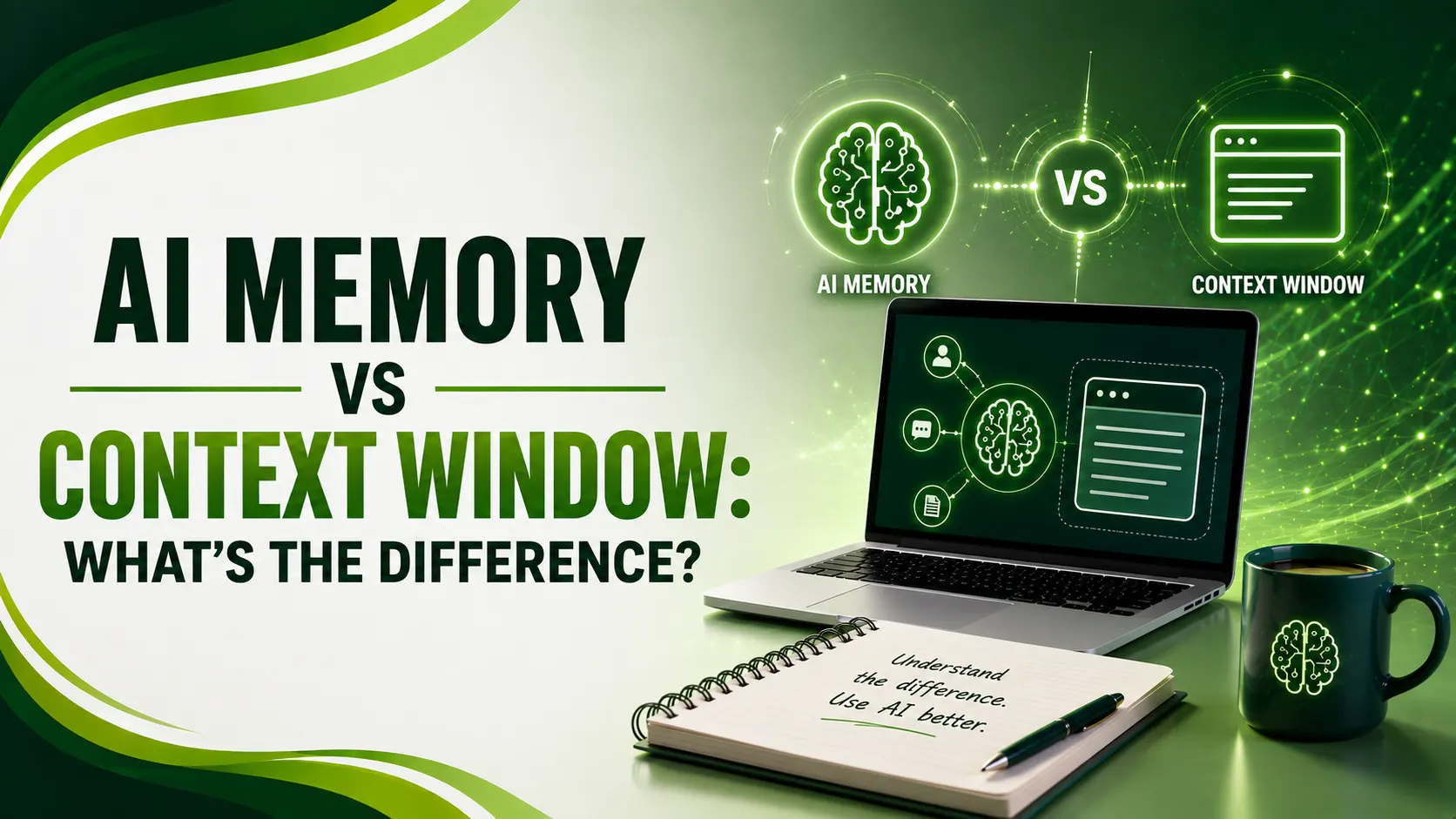
AI memory vs context window is one of the most confused pairs in AI — a huge context window still forgets everything the moment the session ends.
Table of Contents
ToggleAI memory vs context window is one of the most common confusions in AI chat, and vendors don't always help clear it up. "Our model holds a million tokens" sounds like it solves the forgetting problem, and the marketing benefits from that ambiguity. But they're genuinely not the same feature.
A context window is the model's working memory for the current request. Memory is what persists after that request ends, across sessions, days, and weeks. Confusing the two is why people get surprised when a chatbot "forgets" something despite a huge advertised context size.
Here's the real distinction, why bigger context windows don't solve the memory problem, and what the current benchmark data actually shows.
01AI Memory vs Context Window: The Core Distinction
Mem0's guide states it in one clean line: a large context window handles within-session coherence. Persistent memory handles everything else, continuity across sessions, cost control at scale, and reliable retrieval of the facts that actually matter. The two are not alternatives, they're different layers of the same architecture.
HowAIWorks' guide adds the practical consequence of confusing them: the context window is temporary and per-conversation, memory is durable and spans sessions. Confusing them leads to wrong expectations about what a model actually retains.
02What a Context Window Actually Is
ShieldBase's guide offers the analogy that sticks: in computing terms, the context window functions like RAM, fast but temporary. Memory architecture is more like a database and long-term storage combined, enabling actual persistence.
MachineLearningMastery's guide extends the analogy further: treating a huge context window as memory is like buying a 25-foot-wide office desk because you're reluctant to acquire a filing cabinet. You can spread everything out, but nothing gets filed anywhere once you walk away from the desk.
IBM's documentation confirms context windows have grown dramatically: some 2026 models reach up to 10 million tokens. But Atlan's analysis found real-world effective capacity runs at only 60-70% of advertised limits, the reasons are structural, not incidental, tied to how transformer attention actually works.
03AI Memory vs Context Window: What Memory Actually Is
Sentx's guide gives the clearest test for telling the two apart: open a new chat and ask the assistant something it should only know from a prior session. If it answers correctly, the tool has memory. If it has no idea, it only has a context window, and everything was lost the moment the first chat ended.
Supermemory's guide adds why memory needs its own retrieval logic entirely separate from the context window: memory systems use contextual signals like user identity, project scope, and timing to narrow the search space, the same way an exam room or a crime scene helps a witness recall details more accurately.
04The "Lost in the Middle" Problem
FreeAcademy's guide names a specific, well-documented failure mode: models are best at recalling information from the beginning and end of their context window, and worst at recalling material buried in the middle, regardless of how large the window technically is.
Mem0's guide, referenced above, cites a specific 2026 study on why this matters for agents specifically: research across 4,416 trials found that if an agent violates a constraint it followed correctly 10 turns earlier, the model itself didn't change, the attention weight on that constraint simply dropped below the threshold needed to enforce it.
05Why Bigger Context Windows Don't Fix This
Redis' guide is direct about the tempting but wrong shortcut: bigger context windows alone won't get a system to production reliably. You still need infrastructure that handles caching, retrieval, and memory management on top of raw window size.
IBM's documentation, referenced above, adds the cost dimension driving this: transformer attention cost scales quadratically with token length, so doubling input length roughly quadruples compute cost. A massive context window filled with unstructured content becomes economically impractical for high-volume production use, not just technically limited.
06What the Benchmark Data Actually Shows
Mem0's guide, referenced above, shares concrete 2026 LoCoMo benchmark results worth knowing. Full-context baseline: 72.9% accuracy, over 26,000 tokens used, with 17.12 second latency at the 95th percentile. Their selective memory approach hit 91.6% accuracy using under 7,000 tokens on average, with latency around 1.44 seconds.
That's an 18.7 percentage point accuracy improvement while using roughly a quarter of the tokens and a fraction of the response time, evidence that smarter retrieval beats simply dumping more raw context into the window.
07AI Memory vs Context Window Sizes in 2026
A quick reference for how far advertised context windows have grown across major models.
| Model | Advertised Context Window | Persistent Memory? |
|---|---|---|
| GPT-4o | 128,000 tokens | Separate memory feature, not the window itself |
| GPT-4.1 | 1,000,000 tokens | Separate memory feature, not the window itself |
| Claude Sonnet 4 | 200,000 tokens (1M in enterprise beta) | Separate memory feature, not the window itself |
| Gemini 2.5 Pro | 1,000,000 tokens | Separate memory feature, not the window itself |
| Gemini 3 Pro | Up to 10,000,000 tokens | Separate memory feature, not the window itself |
08Designing Around Both Layers
A short list for anyone building or evaluating AI tools with this distinction in mind.
Don't confuse a big context window with real memory, they solve genuinely different problems.
Expect roughly 60-70% effective capacity, not the full advertised token count, in real-world use.
Watch for the "lost in the middle" effect, put critical information near the start or end of long inputs.
Use selective retrieval over raw context stuffing, benchmark data shows it's both faster and more accurate.
Treat memory as core system design, not an optional add-on, if your agent needs to function beyond one session.
09Does Your AI Setup Need a Memory Layer?
Answer a few quick questions to check whether context window alone is sufficient for your use case.
Do You Need a Memory Layer?
Select the option that matches your use case
10Common Questions
No. A larger window means more can fit into a single request, but nothing is retained once that session ends unless a separate memory system is in place.
This is the "lost in the middle" effect. Models pay less attention to information buried in the middle of a long context window, even though it's technically still there.
Benchmark data favors selective retrieval. One 2026 test found selective memory reached 91.6% accuracy using a quarter of the tokens compared to dumping the full context, which only reached 72.9%.
Start a new chat and ask about something from a previous session. If the assistant knows it without you re-explaining, that's memory. If it has no idea, it's only a context window.
No. Even massive windows reset once a session ends, and the quadratic cost of attention makes filling them with unstructured content economically impractical at scale.
Related Articles
What We Learn Today
Context window is RAM-like, temporary and per-session
Memory is durable and spans across sessions entirely
Real-world context capacity runs at 60-70% of advertised limits
Models recall the middle of a long context worse than the edges
Selective memory retrieval outperformed full-context stuffing in benchmarks
Attention cost scales quadratically, making huge windows expensive at scale
Build a Complete Understanding of Agent Infrastructure
Memory architecture connects directly to how MCP and agentic workflows are designed. Explore both guides next.
Related Posts

Previous Post
Next Post
Previous Post
Next Post





- Artificial Intelligence
- Content
- Core Web Vitals
- Development
- Digital Marketing
- Display Advertising
- Google Ads
- Google Search Console
- GTM
- HTML
- HTML CSS
- JavaScript
- Keyword Research
- Link Building
- LinkedIn Ads
- Local SEO
- Meta Ads
- Mobile SEO
- Off-Page SEO
- On-Page SEO
- Paid Media
- Paid Media Analytics
- PHP
- PPC Strategy
- Python
- SEO
- SEO Basics
- SEO Tools
- Social
- Technical SEO