
- Home
- SEODiscover the latest updates from across the United States, including politics, culture, economy, and trending stories. Stay informed on the key events shaping the nation and the topics everyone’s talking about.
- Technical SEOLearn technical SEO concepts including crawling, indexing, XML sitemaps, robots.txt, canonical tags, site architecture, and website performance.
- Local SEOOptimize your business for local seo with Google Business Profile, local citations, reviews, maps, and location-based SEO.
- Mobile SEOImprove your website’s mobile seo performance with responsive design, mobile-first indexing, usability, and page speed optimization.
- On-Page SEOExplore on-page seo optimization techniques such as title tags, meta descriptions, headings, URLs, internal linking, and content optimization.
- Off-Page SEODiscover off-page SEO strategies such as backlinks, digital PR, brand mentions, outreach, and authority building.
- SEO ToolsExplore the best SEO tools for keyword research, technical audits, backlink analysis, rank tracking, and website optimization.
- Core Web VitalsLearn how to improve Core Web Vitals including LCP, INP, CLS, page speed, and overall user experience for better rankings.
- Keyword ResearchLearn how to find profitable keywords, analyze search intent, evaluate competition, and build effective keyword strategies.
- Link BuildingMaster ethical link building techniques, backlink analysis, outreach methods, guest posting, and authority growth strategies.
- Google Search ConsoleLearn how to use Google Search Console to monitor indexing, fix errors, analyze search performance, and improve SEO.
- SEO BasicsLearn the fundamentals of search engine optimization (SEO Basics), including how search engines work, SEO terminology, and beginner-friendly best practices.
- Paid Media
- Display AdvertisingLearn display advertising strategies, banner ads, audience targeting, remarketing, Google Display campaigns, and optimization techniques.
- Google AdsLearn Google Ads strategies, campaign setup, bidding, keywords, Performance Max, Search Ads, and optimization techniques.
- LinkedIn AdsLearn LinkedIn Ads strategies for B2B marketing, lead generation, audience targeting, campaign optimization, and paid social advertising.
- Meta AdsLearn Meta Ads strategies for Facebook and Instagram, including campaign setup, targeting, retargeting, and performance optimization.
- Paid Media AnalyticsLearn paid media analytics, including CPC, CTR, CPA, ROAS, conversion tracking, attribution, reporting, and campaign performance analysis.
- PPC StrategyLearn effective PPC strategies, campaign planning, bidding, keyword targeting, landing pages, conversion optimization, and more.
- ContentTransform your living spaces with inspiration, tips, and trends in interior design. From minimalist decor to bold statements, find ideas for every style and budget.
- Social
- Digital MarketingExplore stories and advice on living your best life. From personal growth to entertainment, dive into the latest in lifestyle trends and inspiration.
- Artificial IntelligenceStay informed about health and wellness with expert advice, fitness tips, and the latest medical breakthroughs. Your guide to a healthier and happier life.
- DevelopmentYou will find development related educational articles
- GTMLearn Google Tag Manager (GTM) with practical guides for tags, triggers, variables, tracking, conversions, and website analytics implementation.
- HTMLLearn HTML with simple tutorials, examples, tags, elements, attributes, and best practices for building modern web pages.
- HTML CSSLearn HTML CSS together with practical tutorials, examples, layouts, styling techniques, responsive design, and modern web development practices.
- HTML JSLearn HTML JS – JavaScript with practical tutorials and examples for adding interactivity, dynamic content, events, and functionality to web pages.
- JavaScriptExplore JavaScript tutorials, examples, concepts, and practical techniques for creating interactive and dynamic websites and web applications.
- PHPLearn PHP programming with practical tutorials, examples, functions, syntax, and web development techniques for beginners and developers.
- PythonLearn Python programming with practical tutorials, examples, syntax, functions, automation techniques, and useful programming concepts.
- Home
- SEODiscover the latest updates from across the United States, including politics, culture, economy, and trending stories. Stay informed on the key events shaping the nation and the topics everyone’s talking about.
- Technical SEOLearn technical SEO concepts including crawling, indexing, XML sitemaps, robots.txt, canonical tags, site architecture, and website performance.
- Local SEOOptimize your business for local seo with Google Business Profile, local citations, reviews, maps, and location-based SEO.
- Mobile SEOImprove your website’s mobile seo performance with responsive design, mobile-first indexing, usability, and page speed optimization.
- On-Page SEOExplore on-page seo optimization techniques such as title tags, meta descriptions, headings, URLs, internal linking, and content optimization.
- Off-Page SEODiscover off-page SEO strategies such as backlinks, digital PR, brand mentions, outreach, and authority building.
- SEO ToolsExplore the best SEO tools for keyword research, technical audits, backlink analysis, rank tracking, and website optimization.
- Core Web VitalsLearn how to improve Core Web Vitals including LCP, INP, CLS, page speed, and overall user experience for better rankings.
- Keyword ResearchLearn how to find profitable keywords, analyze search intent, evaluate competition, and build effective keyword strategies.
- Link BuildingMaster ethical link building techniques, backlink analysis, outreach methods, guest posting, and authority growth strategies.
- Google Search ConsoleLearn how to use Google Search Console to monitor indexing, fix errors, analyze search performance, and improve SEO.
- SEO BasicsLearn the fundamentals of search engine optimization (SEO Basics), including how search engines work, SEO terminology, and beginner-friendly best practices.
- Paid Media
- Display AdvertisingLearn display advertising strategies, banner ads, audience targeting, remarketing, Google Display campaigns, and optimization techniques.
- Google AdsLearn Google Ads strategies, campaign setup, bidding, keywords, Performance Max, Search Ads, and optimization techniques.
- LinkedIn AdsLearn LinkedIn Ads strategies for B2B marketing, lead generation, audience targeting, campaign optimization, and paid social advertising.
- Meta AdsLearn Meta Ads strategies for Facebook and Instagram, including campaign setup, targeting, retargeting, and performance optimization.
- Paid Media AnalyticsLearn paid media analytics, including CPC, CTR, CPA, ROAS, conversion tracking, attribution, reporting, and campaign performance analysis.
- PPC StrategyLearn effective PPC strategies, campaign planning, bidding, keyword targeting, landing pages, conversion optimization, and more.
- ContentTransform your living spaces with inspiration, tips, and trends in interior design. From minimalist decor to bold statements, find ideas for every style and budget.
- Social
- Digital MarketingExplore stories and advice on living your best life. From personal growth to entertainment, dive into the latest in lifestyle trends and inspiration.
- Artificial IntelligenceStay informed about health and wellness with expert advice, fitness tips, and the latest medical breakthroughs. Your guide to a healthier and happier life.
- DevelopmentYou will find development related educational articles
- GTMLearn Google Tag Manager (GTM) with practical guides for tags, triggers, variables, tracking, conversions, and website analytics implementation.
- HTMLLearn HTML with simple tutorials, examples, tags, elements, attributes, and best practices for building modern web pages.
- HTML CSSLearn HTML CSS together with practical tutorials, examples, layouts, styling techniques, responsive design, and modern web development practices.
- HTML JSLearn HTML JS – JavaScript with practical tutorials and examples for adding interactivity, dynamic content, events, and functionality to web pages.
- JavaScriptExplore JavaScript tutorials, examples, concepts, and practical techniques for creating interactive and dynamic websites and web applications.
- PHPLearn PHP programming with practical tutorials, examples, functions, syntax, and web development techniques for beginners and developers.
- PythonLearn Python programming with practical tutorials, examples, syntax, functions, automation techniques, and useful programming concepts.
Now Reading: Search Campaign vs Performance Max: Which Should You Choose?
-
01
Search Campaign vs Performance Max: Which Should You Choose?
- Home//
- SEO//Discover the latest updates from across the United States, including politics, culture, economy, and trending stories. Stay informed on the key events shaping the nation and the topics everyone’s talking about.
- Technical SEO//Learn technical SEO concepts including crawling, indexing, XML sitemaps, robots.txt, canonical tags, site architecture, and website performance.
- Local SEO//Optimize your business for local seo with Google Business Profile, local citations, reviews, maps, and location-based SEO.
- Mobile SEO//Improve your website’s mobile seo performance with responsive design, mobile-first indexing, usability, and page speed optimization.
- On-Page SEO//Explore on-page seo optimization techniques such as title tags, meta descriptions, headings, URLs, internal linking, and content optimization.
- Off-Page SEO//Discover off-page SEO strategies such as backlinks, digital PR, brand mentions, outreach, and authority building.
- SEO Tools//Explore the best SEO tools for keyword research, technical audits, backlink analysis, rank tracking, and website optimization.
- Core Web Vitals//Learn how to improve Core Web Vitals including LCP, INP, CLS, page speed, and overall user experience for better rankings.
- Keyword Research//Learn how to find profitable keywords, analyze search intent, evaluate competition, and build effective keyword strategies.
- Link Building//Master ethical link building techniques, backlink analysis, outreach methods, guest posting, and authority growth strategies.
- Google Search Console//Learn how to use Google Search Console to monitor indexing, fix errors, analyze search performance, and improve SEO.
- SEO Basics//Learn the fundamentals of search engine optimization (SEO Basics), including how search engines work, SEO terminology, and beginner-friendly best practices.
- Paid Media//
- Display Advertising//Learn display advertising strategies, banner ads, audience targeting, remarketing, Google Display campaigns, and optimization techniques.
- Google Ads//Learn Google Ads strategies, campaign setup, bidding, keywords, Performance Max, Search Ads, and optimization techniques.
- LinkedIn Ads//Learn LinkedIn Ads strategies for B2B marketing, lead generation, audience targeting, campaign optimization, and paid social advertising.
- Meta Ads//Learn Meta Ads strategies for Facebook and Instagram, including campaign setup, targeting, retargeting, and performance optimization.
- Paid Media Analytics//Learn paid media analytics, including CPC, CTR, CPA, ROAS, conversion tracking, attribution, reporting, and campaign performance analysis.
- PPC Strategy//Learn effective PPC strategies, campaign planning, bidding, keyword targeting, landing pages, conversion optimization, and more.
- Content//Transform your living spaces with inspiration, tips, and trends in interior design. From minimalist decor to bold statements, find ideas for every style and budget.
- Social//
- Digital Marketing//Explore stories and advice on living your best life. From personal growth to entertainment, dive into the latest in lifestyle trends and inspiration.
- Artificial Intelligence//Stay informed about health and wellness with expert advice, fitness tips, and the latest medical breakthroughs. Your guide to a healthier and happier life.
- Development//You will find development related educational articles
- GTM//Learn Google Tag Manager (GTM) with practical guides for tags, triggers, variables, tracking, conversions, and website analytics implementation.
- HTML//Learn HTML with simple tutorials, examples, tags, elements, attributes, and best practices for building modern web pages.
- HTML CSS//Learn HTML CSS together with practical tutorials, examples, layouts, styling techniques, responsive design, and modern web development practices.
- HTML JS//Learn HTML JS – JavaScript with practical tutorials and examples for adding interactivity, dynamic content, events, and functionality to web pages.
- JavaScript//Explore JavaScript tutorials, examples, concepts, and practical techniques for creating interactive and dynamic websites and web applications.
- PHP//Learn PHP programming with practical tutorials, examples, functions, syntax, and web development techniques for beginners and developers.
- Python//Learn Python programming with practical tutorials, examples, syntax, functions, automation techniques, and useful programming concepts.
- Home
- Paid Media
- Google Ads
- Search Campaign vs Performance Max: Which Should You Choose?
Search Campaign vs Performance Max: Which Should You Choose?

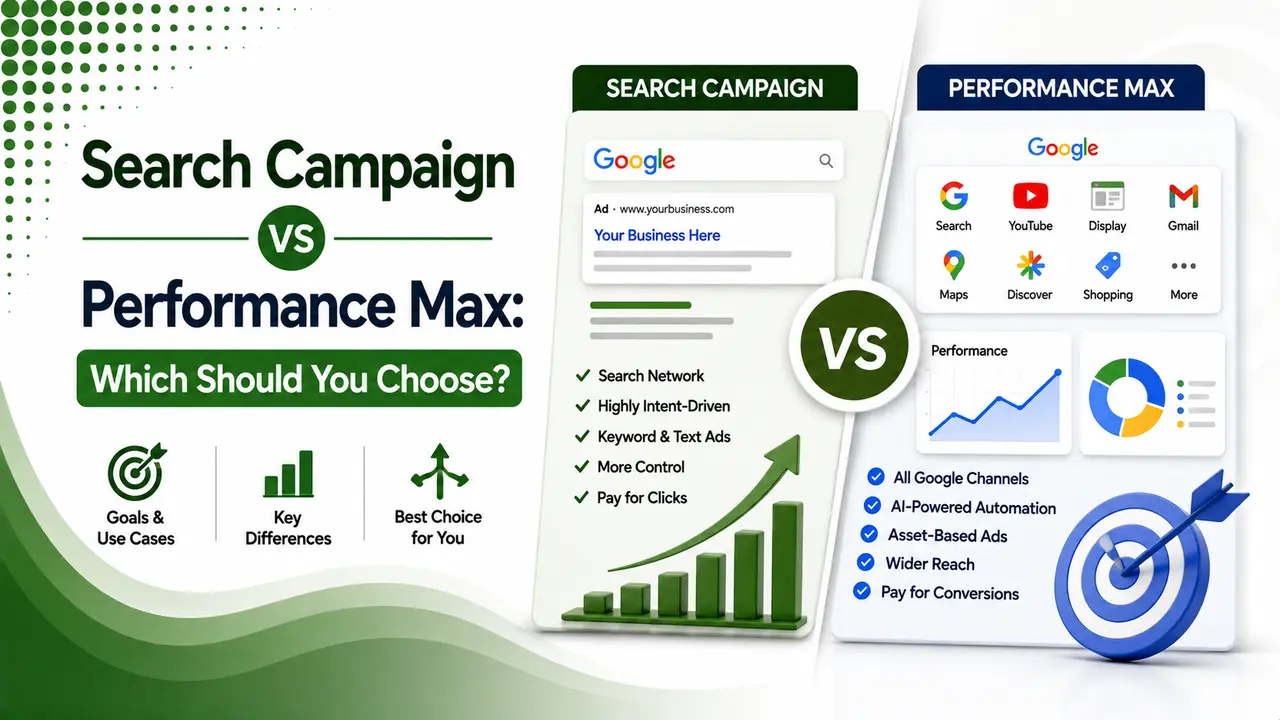
Search campaign vs Performance Max isn't a rivalry, it's two tools for two jobs. Here's when each wins, and the "Power Pack" strategy for running both.
Table of Contents
ToggleSearch campaign vs Performance Max isn't really a fight between two rivals, it's a question of what job you need done. Search campaigns capture demand that already exists. Performance Max goes looking for demand you didn't know was there. Most accounts that scale in 2026 run both, deliberately, with a clear line between them.
PMax now accounts for roughly 45% of Google Ads conversions industry-wide, and 82% of PMax advertisers still run Search campaigns alongside it. That single stat tells you most of what you need to know: PMax isn't replacing Search, it's expanding what Search alone couldn't reach.
The real decision isn't "which one." It's how much control you need, how much data you have, and which parts of the funnel each one should own.
01Search Campaign vs Performance Max: The Core Difference
StackMatix's 2026 breakdown states it in one sentence: Search campaigns give you explicit control over the queries that trigger your ads. Performance Max hands that control to Google's algorithm instead. You define keywords in Search; you provide creative assets and audience signals in PMax and let the AI decide where, when, and to whom your ads show.
Google's own Help Center describes PMax as complementary by design, built to find more converting customers across YouTube, Display, Search, Discover, Gmail, and Maps, alongside your existing keyword-based Search campaigns rather than replacing them.
02Who Wins When Both Target the Same Query?
This is the detail most comparisons skip. Google's Help Center confirms it directly: if a search query matches an exact match keyword in your Search campaign, Google Ads prioritizes the Search campaign over Performance Max every time. Search themes inside PMax carry the same priority as phrase and broad match keywords, meaning true exact match still wins.
Google's documentation adds a caveat worth knowing: your PMax campaign may still show for branded keywords, even exact-match ones in your Search campaign, if your Search campaign has a limited budget or overly strict targeting. Exclude brand terms from PMax explicitly if you want full control over that traffic.
03What the Performance Data Actually Shows
AdNabu's 2026 analysis of Shopify merchant data found Search campaigns averaging 3.2x ROAS compared to PMax's 2.8x for stores spending under $3,000 a month. Search Atlas' data adds a cost angle: PMax's average CPC runs around $0.68, lower than the Google Ads-wide average of $0.85, with a conversion rate close to but slightly under the platform average.
MarlinSEM's take, drawn from managing mostly small business accounts, is blunter: most small businesses see better results and conversion rates from Search campaigns specifically, and PMax makes more sense once a business has already maxed out available search volume and has budget left to reach people who aren't actively searching yet.
04When Search Campaigns Are the Right Call
Groas' 2026 framework is consistent with most other sources here: Search campaigns remain the better choice for high-intent lead generation, tight budgets, and businesses that need keyword-level, query-level reporting they can act on immediately.
You have a limited budget and need every dollar going toward people actively searching for what you offer.
You run a local service business depending on specific, high-intent search queries.
You need query-level transparency, exact search terms, keyword performance, and match-type breakdowns.
Lead quality matters more than volume, since Search delivers users already in a buying mindset.
05When Performance Max Is the Right Call
StackMatix's guide, referenced above, flags a specific trigger point: once Search campaigns hit an efficiency ceiling, high impression share, competitive CPCs, PMax opens YouTube, Display, and Discovery inventory that Search alone can't reach. It also notes PMax needs real data density, ideally 50+ monthly conversions, to optimize cross-channel allocation meaningfully.
You run e-commerce with a product feed, PMax effectively replaces and extends Standard Shopping.
Your Search campaigns have plateaued on available search volume with budget left over.
You want new-audience discovery, reaching people who don't know your brand exists yet.
You have enough conversion volume for Google's AI to actually learn from, roughly 50+ conversions a month.
06The "Power Pack" Strategy: Running Both Together
Uconic's 2026 guide references what it calls Google's own recommended approach for the year: pairing Performance Max for broad, cross-channel reach with Search campaigns for targeted coverage of high-intent keywords, so PMax builds awareness while Search captures the resulting branded searches.
ClickGuard's practical structure for making this work: exclude branded keywords from PMax so your Search campaign retains full control over direct brand searches, feed PMax clear audience signals, and keep landing pages tightly matched to each asset group to maintain relevance across both.
07Search Campaign vs Performance Max at a Glance
A side-by-side view of where each campaign type actually differs.
| Factor | Search Campaign | Performance Max |
|---|---|---|
| Targeting method | Keywords you choose directly | AI-driven, based on assets and audience signals |
| Channels covered | Search results only (plus partners) | Search, Display, YouTube, Gmail, Discover, Maps |
| Reporting depth | Full search term and keyword-level data | Limited channel-level visibility |
| Best for | High-intent lead gen, tight budgets | E-commerce, broad reach, brand discovery |
| Data needed to perform well | Works from day one | Ideally 50+ conversions/month for AI to learn |
| Query priority | Wins exact-match ties over PMax | Search themes rank like phrase/broad match |
08Which Should You Run First?
Answer a few quick questions about your account to see where to start.
Which Should You Run First?
Select the option that matches your situation
09FAQs on Search Campaign vs Performance Max
No. Google designed PMax to complement Search campaigns, not replace them. 82% of PMax advertisers still run Search campaigns alongside it.
Search campaigns win exact-match ties. If a query matches an exact match keyword in your Search campaign, Google prioritizes that over Performance Max.
Average CPC tends to be lower for PMax, but conversion rate and ROAS often favor Search campaigns for smaller budgets, especially under $3,000/month.
Roughly 50+ conversions per month gives Google's AI enough data density to meaningfully optimize cross-channel budget allocation.
Yes, if you want full control over brand search traffic. PMax can still show on branded terms if your Search campaign has a limited budget or narrow targeting.
Related Articles
What We Learn Today
PMax now drives 45% of Google Ads conversions industry-wide
82% of PMax advertisers still run Search campaigns too
Exact-match Search keywords beat PMax in query ties
Search wins on ROAS and control for smaller budgets
PMax needs ~50+ monthly conversions to optimize well
The "Power Pack" combo covers the full customer journey
Build a Complete Paid Media Strategy
Search and PMax work best alongside strong organic signals. Explore our brand authority and link building guides next.
Related Posts
Previous Post
Next Post
Previous Post
Next Post

- Artificial Intelligence
- Content
- Core Web Vitals
- Development
- Digital Marketing
- Display Advertising
- Google Ads
- Google Search Console
- GTM
- HTML
- HTML CSS
- JavaScript
- Keyword Research
- Link Building
- LinkedIn Ads
- Local SEO
- Meta Ads
- Mobile SEO
- Off-Page SEO
- On-Page SEO
- Paid Media
- Paid Media Analytics
- PHP
- PPC Strategy
- Python
- SEO
- SEO Basics
- SEO Tools
- Social
- Technical SEO