
Now Reading: Email Marketing Strategy: 7 Proven Tips for 2026
-
01
Email Marketing Strategy: 7 Proven Tips for 2026
Email Marketing Strategy: 7 Proven Tips for 2026

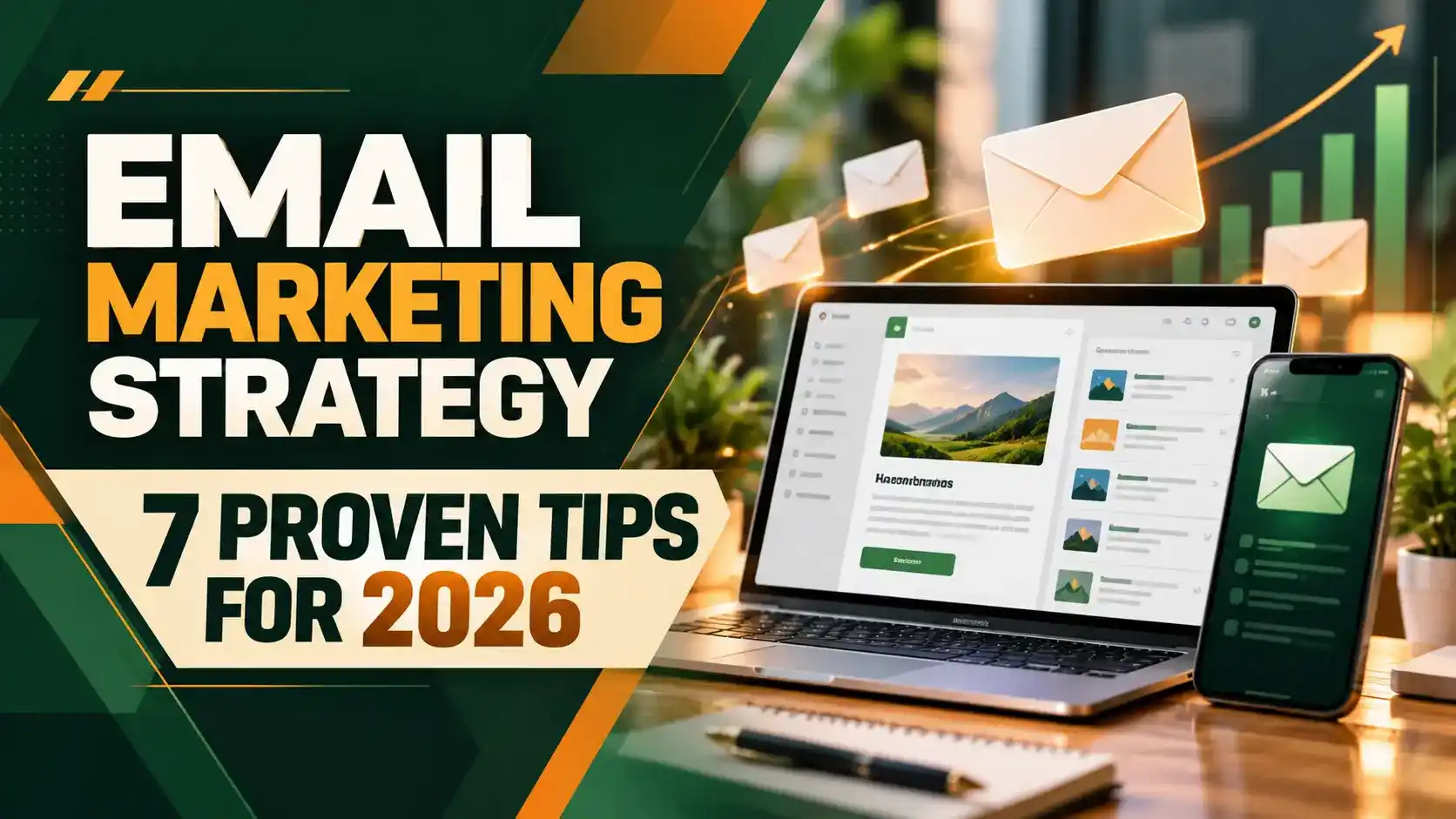
A modern email marketing strategy needs more than a newsletter template, it needs clean segmentation, solid deliverability, and automation that adapts to behavior. This guide walks through list building, SPF/DKIM/DMARC basics, drip automation, personalization, and A/B testing with real platform guidance from Google, Klaviyo, Mailchimp, HubSpot, and ActiveCampaign.
Hey! If your inbox campaigns feel like they are shouting into a void lately, you are not imagining it. This one's for you if you want a plan that actually gets opened, clicked, and acted on in 2026.
Ever stared at a campaign report where opens look fine but revenue barely moved? That gap is exactly why a sharp email marketing strategy matters more now than it did a few years ago, when a plain newsletter and a big list were enough to win.
What a Real Email Marketing Strategy Looks Like in 2026
A working email marketing strategy is no longer just a send schedule and a template. Mailbox providers now use AI to rank messages by relevance before a human ever sees the subject line, so the old habit of blasting one email to everyone has stopped paying off.
Litmus, the email testing and analytics company, told attendees at its 2026 Litmus Live event that engagement signals now carry more weight than raw opens, partly because Apple's Mail Privacy Protection has made open tracking unreliable since 2021 and bot scanners keep inflating click counts. Litmus recommends weighing site visits, replies, and actual conversions instead of chasing open rate alone.
That shift is also why so many brands are rebuilding their digital marketing playbooks around permission based lists and real behavioral data rather than purchased contacts. The seven moves below build a full email marketing strategy covering list building, deliverability, automation, personalization, testing, and the mistakes that quietly sink otherwise solid campaigns.
Email open tracking has been unreliable since Apple rolled out Mail Privacy Protection in 2021, and panelists at Litmus Live 2026 noted that bot activity and security scanners now inflate click numbers too. Litmus suggests time to click analysis and honeypot links to spot the fake activity.
Build Your List, Then Segment It Properly
Every email marketing strategy starts with a clean list, but the distinction between a list and a segment trips up a lot of teams. Klaviyo's own help documentation explains that a list is a fixed collection of people who joined through a form or a manual add, while a Klaviyo segment is built from live conditions, such as recent purchases or email engagement, so membership updates automatically as behavior changes.
That difference matters because segments draw from your entire account, not just people who opted into email, so you still need to narrow a segment to your actual subscriber list before you send a campaign to it. Use segments to trigger automated flows, to carve out people who opened your last few sends, or to quietly drop subscribers who have ignored your last twenty emails.
Mailchimp leans on the same idea with its predictive segmentation feature, which uses machine learning to score contacts by estimated lifetime value and label them high, moderate, or low value, so you can route your best offers to the people most likely to act on them, according to Mailchimp.
Tip
Before you obsess over segmentation rules, make sure your acquisition sources are actually bringing in people who want to hear from you. Our guide on generating high quality leads covers the forms and offers that keep your list healthy from day one.
Get Your Deliverability Basics Right
No email marketing strategy survives a spam folder, and deliverability is stricter now than it was even two years ago. Google's own sender guidelines say that anyone sending more than 5,000 messages a day to Gmail accounts must authenticate with SPF and DKIM and must publish a DMARC record for their sending domain, according to Google's support documentation.
The same guidelines ask senders to keep their reported spam rate under 0.30 percent, with 0.10 percent as the safer target, and to use a DKIM key of at least 1,024 bits, though 2,048 bits is recommended where it is supported. Marketing messages also need one click unsubscribe headers, not just a link buried in the footer.
| Record | What It Does | Where It Lives |
|---|---|---|
| SPF | Lists which mail servers are allowed to send on your domain's behalf | A DNS TXT record |
| DKIM | Signs outgoing mail with a key so inboxes can verify it was not altered | A DNS TXT record |
| DMARC | Tells inboxes what to do when SPF or DKIM checks fail | A DNS TXT record with a policy of none, quarantine, or reject |
Litmus points out that a DMARC policy set to p=none only monitors traffic and takes no action, so panelists at Litmus Live 2026 expect senders to keep moving toward p=quarantine or p=reject as mailbox providers tighten enforcement, per Litmus. Pair that authentication work with clean consent practices, which is also where first party data habits start paying off, since a list built on real permission almost always sends cleaner and complains less.
Automate the Journey With Smart Drip Sequences
Automation is where an email marketing strategy stops being a series of one off sends and starts behaving like a real program. ActiveCampaign's own help documentation walks through building an automation from a blank canvas: pick a trigger such as "Subscribes to a list," set it to run once per contact, then chain a Send an Email action with a Wait step that holds until a condition is met, like a click, according to ActiveCampaign.
From there an If/Else branch splits contacts by behavior, tagging the people who clicked differently from the people who only opened or did neither, and those tags can kick off a follow up automation on their own. ActiveCampaign's guidance also recommends varying the content in each follow up message rather than repeating the same email, and stopping outreach after two or three attempts with no response so deliverability stays healthy.
Ready made recipes like a seven day drip series exist in ActiveCampaign's marketplace for teams that want a starting template rather than building a sequence from nothing. Whichever platform you use, the logic is the same: welcome, educate, offer, and then quiet down for anyone who stops engaging.
Tip
Treat automation as a living system, not a set and forget project. If you are already layering AI into other parts of your stack, our piece on AI automation workflows covers how teams keep these flows updated without constant manual rebuilding.
Personalize Beyond a First Name Tag
Dropping a first name into a subject line used to count as personalization. A modern email marketing strategy goes further by using the behavioral and purchase data sitting inside your platform already.
Mailchimp's segmentation tools build contact profiles from real time behavior, interests, and purchase activity, then apply that predictive lifetime value score mentioned earlier so your highest value contacts see different offers than a brand new subscriber, per Mailchimp. The same data that powers personalization also feeds customer journey mapping, since both rely on knowing where a contact actually is in their relationship with your brand.
Keep personalization proportional to what you actually know. A subscriber who bought once deserves a different message than a repeat customer, but guessing at details you have not earned the right to know tends to feel invasive rather than thoughtful, and it shows up in complaint rates fast.
Test Everything With A/B Testing
You cannot refine an email marketing strategy on guesswork, which is why A/B testing belongs in every send cycle, not just big campaigns. HubSpot's own knowledge base lists the elements worth testing: offer format, copy style, sender address, images, and subject line length or personalization, with only one changed at a time so you know what actually moved the result, according to HubSpot.
HubSpot recommends sending a test to at least 1,000 contacts for a meaningful read. You choose what share of the list enters the test, pick a winning metric such as open rate, click rate, or click through rate, set a test window measured in hours, and select a fallback version in case the results stay inconclusive when that window closes.
Run one variable at a time, every time. Testing a new subject line and a new sender address in the same send tells you almost nothing useful, because you will not know which change actually caused the difference.
Common Email Marketing Strategy Mistakes to Avoid
Most weak email programs fail in a handful of predictable ways, and a good email marketing strategy is often just the old one with these mistakes removed.
None of this requires a bigger budget. A stronger email marketing strategy mostly requires picking one or two fixes from that list and actually finishing them before adding another tactic on top.
Start with one clean list, a welcome automation, and a monthly newsletter. Add segmentation and A/B testing once those three basics are running reliably, rather than launching everything at once.
There is no universal number. Watch unsubscribe and spam complaint rates as your real signal, and pull back frequency the moment either one climbs, rather than following a fixed weekly rule.
SPF lists approved sending servers, DKIM signs messages so they cannot be altered in transit, and DMARC tells inboxes what to do when either check fails. All three live as DNS TXT records on your sending domain.
Focus less on open rate alone, since tracking has been unreliable since Apple's privacy changes, and more on list hygiene, relevant segmentation, and subject lines tested against a real sample before a full send.
Klaviyo and Mailchimp fit ecommerce brands that want deep purchase based segmentation, HubSpot suits teams already using its CRM, and ActiveCampaign leans toward flexible, branching automation. Match the platform to the workflow you already run, not the other way around.
Learn Today
Segmentation
Grouping contacts by live behavior or traits so each group gets a relevant message.
Drip Sequence
A scheduled series of automated emails that nurtures a contact over time.
SPF
A DNS record listing which servers may send email on behalf of your domain.
DKIM
A signature added to outgoing mail that proves it was not altered in transit.
DMARC
A policy record telling inboxes what to do when SPF or DKIM checks fail.
Sender Reputation
A score mailbox providers assign your domain based on complaints, engagement, and authentication history.
Put This Email Marketing Strategy to Work This Quarter
Explore more Brandella Journal guides on SEO and digital marketing.