
- Home
- SEODiscover the latest updates from across the United States, including politics, culture, economy, and trending stories. Stay informed on the key events shaping the nation and the topics everyone’s talking about.
- Technical SEOLearn technical SEO concepts including crawling, indexing, XML sitemaps, robots.txt, canonical tags, site architecture, and website performance.
- Local SEOOptimize your business for local seo with Google Business Profile, local citations, reviews, maps, and location-based SEO.
- Mobile SEOImprove your website’s mobile seo performance with responsive design, mobile-first indexing, usability, and page speed optimization.
- On-Page SEOExplore on-page seo optimization techniques such as title tags, meta descriptions, headings, URLs, internal linking, and content optimization.
- Off-Page SEODiscover off-page SEO strategies such as backlinks, digital PR, brand mentions, outreach, and authority building.
- SEO ToolsExplore the best SEO tools for keyword research, technical audits, backlink analysis, rank tracking, and website optimization.
- Core Web VitalsLearn how to improve Core Web Vitals including LCP, INP, CLS, page speed, and overall user experience for better rankings.
- Keyword ResearchLearn how to find profitable keywords, analyze search intent, evaluate competition, and build effective keyword strategies.
- Link BuildingMaster ethical link building techniques, backlink analysis, outreach methods, guest posting, and authority growth strategies.
- Google Search ConsoleLearn how to use Google Search Console to monitor indexing, fix errors, analyze search performance, and improve SEO.
- SEO BasicsLearn the fundamentals of search engine optimization (SEO Basics), including how search engines work, SEO terminology, and beginner-friendly best practices.
- Paid Media
- Display AdvertisingLearn display advertising strategies, banner ads, audience targeting, remarketing, Google Display campaigns, and optimization techniques.
- Google AdsLearn Google Ads strategies, campaign setup, bidding, keywords, Performance Max, Search Ads, and optimization techniques.
- LinkedIn AdsLearn LinkedIn Ads strategies for B2B marketing, lead generation, audience targeting, campaign optimization, and paid social advertising.
- Meta AdsLearn Meta Ads strategies for Facebook and Instagram, including campaign setup, targeting, retargeting, and performance optimization.
- Paid Media AnalyticsLearn paid media analytics, including CPC, CTR, CPA, ROAS, conversion tracking, attribution, reporting, and campaign performance analysis.
- PPC StrategyLearn effective PPC strategies, campaign planning, bidding, keyword targeting, landing pages, conversion optimization, and more.
- ContentTransform your living spaces with inspiration, tips, and trends in interior design. From minimalist decor to bold statements, find ideas for every style and budget.
- Social
- Digital MarketingExplore stories and advice on living your best life. From personal growth to entertainment, dive into the latest in lifestyle trends and inspiration.
- Artificial IntelligenceStay informed about health and wellness with expert advice, fitness tips, and the latest medical breakthroughs. Your guide to a healthier and happier life.
- DevelopmentYou will find development related educational articles
- GTMLearn Google Tag Manager (GTM) with practical guides for tags, triggers, variables, tracking, conversions, and website analytics implementation.
- HTMLLearn HTML with simple tutorials, examples, tags, elements, attributes, and best practices for building modern web pages.
- HTML CSSLearn HTML CSS together with practical tutorials, examples, layouts, styling techniques, responsive design, and modern web development practices.
- HTML JSLearn HTML JS – JavaScript with practical tutorials and examples for adding interactivity, dynamic content, events, and functionality to web pages.
- JavaScriptExplore JavaScript tutorials, examples, concepts, and practical techniques for creating interactive and dynamic websites and web applications.
- PHPLearn PHP programming with practical tutorials, examples, functions, syntax, and web development techniques for beginners and developers.
- PythonLearn Python programming with practical tutorials, examples, syntax, functions, automation techniques, and useful programming concepts.
- Home
- SEODiscover the latest updates from across the United States, including politics, culture, economy, and trending stories. Stay informed on the key events shaping the nation and the topics everyone’s talking about.
- Technical SEOLearn technical SEO concepts including crawling, indexing, XML sitemaps, robots.txt, canonical tags, site architecture, and website performance.
- Local SEOOptimize your business for local seo with Google Business Profile, local citations, reviews, maps, and location-based SEO.
- Mobile SEOImprove your website’s mobile seo performance with responsive design, mobile-first indexing, usability, and page speed optimization.
- On-Page SEOExplore on-page seo optimization techniques such as title tags, meta descriptions, headings, URLs, internal linking, and content optimization.
- Off-Page SEODiscover off-page SEO strategies such as backlinks, digital PR, brand mentions, outreach, and authority building.
- SEO ToolsExplore the best SEO tools for keyword research, technical audits, backlink analysis, rank tracking, and website optimization.
- Core Web VitalsLearn how to improve Core Web Vitals including LCP, INP, CLS, page speed, and overall user experience for better rankings.
- Keyword ResearchLearn how to find profitable keywords, analyze search intent, evaluate competition, and build effective keyword strategies.
- Link BuildingMaster ethical link building techniques, backlink analysis, outreach methods, guest posting, and authority growth strategies.
- Google Search ConsoleLearn how to use Google Search Console to monitor indexing, fix errors, analyze search performance, and improve SEO.
- SEO BasicsLearn the fundamentals of search engine optimization (SEO Basics), including how search engines work, SEO terminology, and beginner-friendly best practices.
- Paid Media
- Display AdvertisingLearn display advertising strategies, banner ads, audience targeting, remarketing, Google Display campaigns, and optimization techniques.
- Google AdsLearn Google Ads strategies, campaign setup, bidding, keywords, Performance Max, Search Ads, and optimization techniques.
- LinkedIn AdsLearn LinkedIn Ads strategies for B2B marketing, lead generation, audience targeting, campaign optimization, and paid social advertising.
- Meta AdsLearn Meta Ads strategies for Facebook and Instagram, including campaign setup, targeting, retargeting, and performance optimization.
- Paid Media AnalyticsLearn paid media analytics, including CPC, CTR, CPA, ROAS, conversion tracking, attribution, reporting, and campaign performance analysis.
- PPC StrategyLearn effective PPC strategies, campaign planning, bidding, keyword targeting, landing pages, conversion optimization, and more.
- ContentTransform your living spaces with inspiration, tips, and trends in interior design. From minimalist decor to bold statements, find ideas for every style and budget.
- Social
- Digital MarketingExplore stories and advice on living your best life. From personal growth to entertainment, dive into the latest in lifestyle trends and inspiration.
- Artificial IntelligenceStay informed about health and wellness with expert advice, fitness tips, and the latest medical breakthroughs. Your guide to a healthier and happier life.
- DevelopmentYou will find development related educational articles
- GTMLearn Google Tag Manager (GTM) with practical guides for tags, triggers, variables, tracking, conversions, and website analytics implementation.
- HTMLLearn HTML with simple tutorials, examples, tags, elements, attributes, and best practices for building modern web pages.
- HTML CSSLearn HTML CSS together with practical tutorials, examples, layouts, styling techniques, responsive design, and modern web development practices.
- HTML JSLearn HTML JS – JavaScript with practical tutorials and examples for adding interactivity, dynamic content, events, and functionality to web pages.
- JavaScriptExplore JavaScript tutorials, examples, concepts, and practical techniques for creating interactive and dynamic websites and web applications.
- PHPLearn PHP programming with practical tutorials, examples, functions, syntax, and web development techniques for beginners and developers.
- PythonLearn Python programming with practical tutorials, examples, syntax, functions, automation techniques, and useful programming concepts.
Now Reading: How to Create Dynamic Meta Tags in PHP: A Security-First Guide
-
01
How to Create Dynamic Meta Tags in PHP: A Security-First Guide
- Home//
- SEO//Discover the latest updates from across the United States, including politics, culture, economy, and trending stories. Stay informed on the key events shaping the nation and the topics everyone’s talking about.
- Technical SEO//Learn technical SEO concepts including crawling, indexing, XML sitemaps, robots.txt, canonical tags, site architecture, and website performance.
- Local SEO//Optimize your business for local seo with Google Business Profile, local citations, reviews, maps, and location-based SEO.
- Mobile SEO//Improve your website’s mobile seo performance with responsive design, mobile-first indexing, usability, and page speed optimization.
- On-Page SEO//Explore on-page seo optimization techniques such as title tags, meta descriptions, headings, URLs, internal linking, and content optimization.
- Off-Page SEO//Discover off-page SEO strategies such as backlinks, digital PR, brand mentions, outreach, and authority building.
- SEO Tools//Explore the best SEO tools for keyword research, technical audits, backlink analysis, rank tracking, and website optimization.
- Core Web Vitals//Learn how to improve Core Web Vitals including LCP, INP, CLS, page speed, and overall user experience for better rankings.
- Keyword Research//Learn how to find profitable keywords, analyze search intent, evaluate competition, and build effective keyword strategies.
- Link Building//Master ethical link building techniques, backlink analysis, outreach methods, guest posting, and authority growth strategies.
- Google Search Console//Learn how to use Google Search Console to monitor indexing, fix errors, analyze search performance, and improve SEO.
- SEO Basics//Learn the fundamentals of search engine optimization (SEO Basics), including how search engines work, SEO terminology, and beginner-friendly best practices.
- Paid Media//
- Display Advertising//Learn display advertising strategies, banner ads, audience targeting, remarketing, Google Display campaigns, and optimization techniques.
- Google Ads//Learn Google Ads strategies, campaign setup, bidding, keywords, Performance Max, Search Ads, and optimization techniques.
- LinkedIn Ads//Learn LinkedIn Ads strategies for B2B marketing, lead generation, audience targeting, campaign optimization, and paid social advertising.
- Meta Ads//Learn Meta Ads strategies for Facebook and Instagram, including campaign setup, targeting, retargeting, and performance optimization.
- Paid Media Analytics//Learn paid media analytics, including CPC, CTR, CPA, ROAS, conversion tracking, attribution, reporting, and campaign performance analysis.
- PPC Strategy//Learn effective PPC strategies, campaign planning, bidding, keyword targeting, landing pages, conversion optimization, and more.
- Content//Transform your living spaces with inspiration, tips, and trends in interior design. From minimalist decor to bold statements, find ideas for every style and budget.
- Social//
- Digital Marketing//Explore stories and advice on living your best life. From personal growth to entertainment, dive into the latest in lifestyle trends and inspiration.
- Artificial Intelligence//Stay informed about health and wellness with expert advice, fitness tips, and the latest medical breakthroughs. Your guide to a healthier and happier life.
- Development//You will find development related educational articles
- GTM//Learn Google Tag Manager (GTM) with practical guides for tags, triggers, variables, tracking, conversions, and website analytics implementation.
- HTML//Learn HTML with simple tutorials, examples, tags, elements, attributes, and best practices for building modern web pages.
- HTML CSS//Learn HTML CSS together with practical tutorials, examples, layouts, styling techniques, responsive design, and modern web development practices.
- HTML JS//Learn HTML JS – JavaScript with practical tutorials and examples for adding interactivity, dynamic content, events, and functionality to web pages.
- JavaScript//Explore JavaScript tutorials, examples, concepts, and practical techniques for creating interactive and dynamic websites and web applications.
- PHP//Learn PHP programming with practical tutorials, examples, functions, syntax, and web development techniques for beginners and developers.
- Python//Learn Python programming with practical tutorials, examples, syntax, functions, automation techniques, and useful programming concepts.
- Home
- Development
- PHP
- How to Create Dynamic Meta Tags in PHP: A Security-First Guide
How to Create Dynamic Meta Tags in PHP: A Security-First Guide

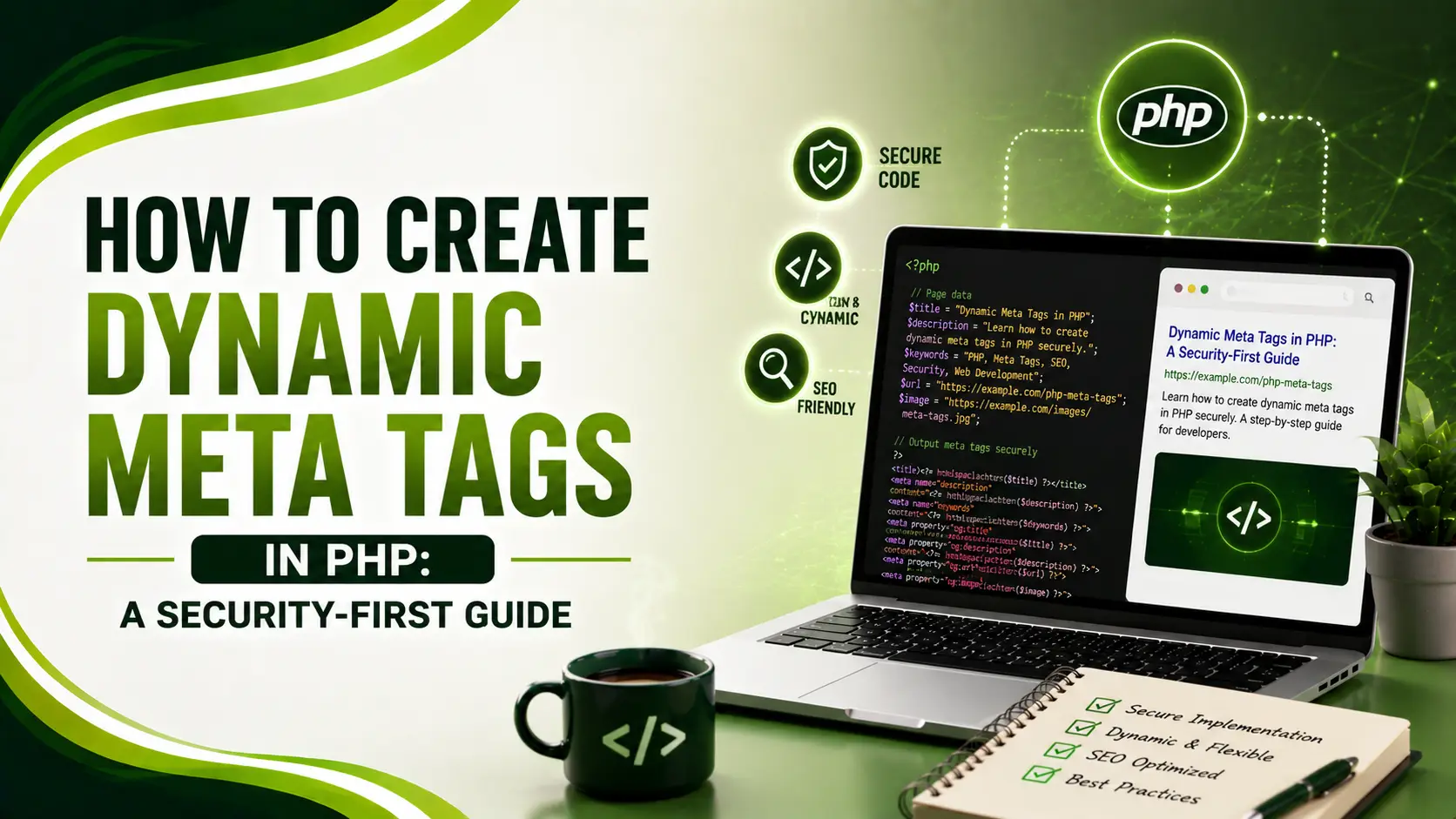
Dynamic meta tags in PHP done wrong is a real XSS vector. Here's the escaping, truncation, and Open Graph pattern that actually holds up in production.
Table of Contents
ToggleCreating dynamic meta tags in PHP means generating the title, description, and Open Graph tags for each page from real data, a database row, a route parameter, a CMS field, instead of hardcoding the same static tags across every page. Done wrong, this becomes a genuine security hole. Done right, it's the difference between a blue, un-clickable link and a rich card people actually tap.
01Dynamic Meta Tags in PHP: The Core Pattern
The fundamental pattern is consistent across every implementation worth copying: fetch the page-specific data early, before any HTML output begins, provide a sensible fallback if that data is missing, then escape every single value before it touches the page.
That last step is the one most tutorials gloss over, and it's exactly where real vulnerabilities show up in production. Server-side rendering also matters for a separate reason: relying on client-side JavaScript to inject meta tags is far less predictable for crawlers and for users who view source or have JavaScript disabled.
02Basic Dynamic Title and Description
A widely used pattern from real-world PHP forums fetches meta values from a database using a prepared statement, then falls back to site-wide defaults if no row exists for that page.
<?php
// Assume $pdo is a PDO instance connected earlier
$page = basename($_SERVER['SCRIPT_NAME'], '.php');

$stmt = $pdo->prepare(
  'SELECT meta_title, meta_description FROM page_meta WHERE page_key = ? LIMIT 1'
);
$stmt->execute([$page]);
$row = $stmt->fetch(PDO::FETCH_ASSOC) ?: [];

// Fall back to site defaults when no row exists
$title = $row['meta_title'] ?? 'Default Site Title';
$description = $row['meta_description'] ?? 'Default site description.';
?>
<title><?= htmlspecialchars($title, ENT_QUOTES, 'UTF-8') ?></title>
<meta name="description" content="<?= htmlspecialchars($description, ENT_QUOTES, 'UTF-8') ?>">
03Why htmlspecialchars() Isn't Optional
SecureFlag's security knowledge base is explicit about the mechanism: PHP's built-in htmlspecialchars() and htmlentities() encode problematic characters in output specifically to prevent XSS vulnerabilities, converting characters like <, >, and quotes into their safe HTML entity equivalents before the browser ever sees them as markup.
The flag matters as much as the function call itself. FlatCoding's guide is specific: by default, htmlspecialchars() only converts double quotes, leaving single quotes untouched. Since meta tag content sits inside a double-quoted HTML attribute, an unescaped single quote alone won't break things, but any dynamic value that could end up in a single-quoted context needs ENT_QUOTES to convert both quote types.
A HackerOne disclosure documented a stored XSS vulnerability in a popular Node.js metadata-scraping library, triggered specifically through unsanitized Open Graph meta properties later rendered into HTML. The lesson translates directly to PHP: any value sourced from an external page, a database, or user input, including meta tag content itself, must be escaped before output, regardless of how trustworthy the source seems.
04Adding Dynamic Open Graph Tags
RichDevTools' guide notes what Open Graph tags actually control: how a page renders as a card when shared on Slack, Facebook, LinkedIn, or Discord. A clean pattern loops over an associative array of properties, escaping each value the same way as the title and description.
<?php
$ogTags = [
  'og:title'       => $article->title,
  'og:description' => $article->excerpt,
  'og:image'       => $article->ogImageUrl,
  'og:url'         => $article->canonicalUrl,
  'og:type'        => 'article',
  'og:site_name'   => 'Brandella Journal',
];

foreach ($ogTags as $property => $content) {
  echo '<meta property="' . htmlspecialchars($property, ENT_QUOTES, 'UTF-8')
     . '" content="' . htmlspecialchars($content, ENT_QUOTES, 'UTF-8')
     . '">' . PHP_EOL;
}
?>
Without a twitter:card tag, X (formerly Twitter) may show no preview at all, even when every Open Graph tag is present and correct. Twitter checks its own tags first, falling back to Open Graph values only when a twitter:-prefixed tag is missing, so it's worth setting both explicitly rather than assuming Open Graph alone covers every platform.
05Safely Truncating Long Dynamic Content
Database-sourced descriptions are often longer than the SERP display limit. Truncating with a plain substr() risks cutting a word in half, or worse, splitting a multi-byte UTF-8 character and corrupting the output entirely.
function truncateMetaDescription($text, $maxLength = 155) {
  $text = trim($text);

  if (mb_strlen($text, 'UTF-8') <= $maxLength) {
    return $text;
  }

  // mb_ functions are essential here to avoid breaking multi-byte characters
  $truncated = mb_substr($text, 0, $maxLength, 'UTF-8');

  // Trim back to the last full word to avoid a mid-word cut
  $lastSpace = mb_strrpos($truncated, ' ', 0, 'UTF-8');
  if ($lastSpace !== false) {
    $truncated = mb_substr($truncated, 0, $lastSpace, 'UTF-8');
  }

  return $truncated . '…';
}
06Handling Paginated and Faceted Pages
A meta description that's identical across every page of a paginated series creates duplicate content signals at scale. A common pattern appends the page number directly to the description, keeping each page's meta tags distinguishable.
$currentPage = filter_input(INPUT_GET, 'page', FILTER_VALIDATE_INT) ?: 1;

$description = truncateMetaDescription($baseDescription, 140);

if ($currentPage > 1) {
  $description .= " — Page {$currentPage}";
}

// For highly dynamic pages like search results or faceted filters,
// consider noindex instead of trying to write a unique description for each combination
if ($isFacetedSearchPage) {
  echo '<meta name="robots" content="noindex, follow">';
}
This connects directly to canonical tag strategy for pagination, which our canonical tag implementation guide covers in depth, each paginated page should self-reference its own canonical rather than pointing back to page one.
07htmlspecialchars() Flags Compared
Choosing the right escaping flag matters more than most tutorials suggest.
| Flag | Converts | Use When |
|---|---|---|
| ENT_COMPAT (default) | Double quotes only | Rarely sufficient for attribute output |
| ENT_QUOTES | Both double and single quotes | Always, for any HTML attribute content |
| ENT_NOQUOTES | Neither quote type | Almost never appropriate for meta tags |
| ENT_QUOTES | ENT_HTML5 | Both quotes, HTML5-correct entities | Modern sites targeting HTML5 documents |
08Implementation Checklist
A short list to confirm before shipping dynamic meta tags to production.
Always use ENT_QUOTES, the default flag only escapes double quotes, leaving a real gap.
Provide a fallback for every field, missing database rows shouldn't produce empty meta tags.
Truncate with mb_ functions, plain substr() can corrupt multi-byte UTF-8 characters.
Generate tags server-side, before any HTML output, for reliable crawler and no-JS support.
Set both Open Graph and Twitter Card tags, don't assume one platform's fallback covers the other.
09Common Questions
For standard text output in an HTML attribute, yes, provided you use the ENT_QUOTES flag. For more complex sanitization needs, a dedicated library like HTML Purifier offers finer control.
htmlspecialchars() encodes a small set of characters: &, <, >, and quotes. htmlentities() encodes every character that has an HTML entity equivalent, offering broader but usually unnecessary coverage for meta tag content.
Server-side PHP is more reliable for SEO. Client-side JavaScript injection can work for some bots, but server-rendered output in the initial HTML is far more predictable for crawlers and users without JavaScript enabled.
A plain substr() truncation cuts at an exact character count regardless of word boundaries. Trim back to the last space before the limit, and use mb_ functions to avoid corrupting multi-byte characters.
It's safer to set them explicitly. Twitter checks its own twitter:-prefixed tags first and only falls back to Open Graph values when they're missing, and without any twitter:card tag, no preview may render at all.
Related Articles
What We Learn Today
Fetch meta data early, before any HTML output begins
Always escape with htmlspecialchars() and ENT_QUOTES
Provide fallback defaults for missing database rows
Use mb_ functions to truncate multi-byte text safely
Server-side rendering beats client-side JS for crawler reliability
Set explicit Twitter Card tags alongside Open Graph
Build a Complete PHP SEO Toolkit
Dynamic meta tags pair naturally with SEO-friendly URLs and sitemap generation. Explore both guides next.
Related Posts


Previous Post
Next Post
Previous Post

Next Post




- Artificial Intelligence
- Content
- Core Web Vitals
- Development
- Digital Marketing
- Display Advertising
- Google Ads
- Google Search Console
- GTM
- HTML
- HTML CSS
- JavaScript
- Keyword Research
- Link Building
- LinkedIn Ads
- Local SEO
- Meta Ads
- Mobile SEO
- Off-Page SEO
- On-Page SEO
- Paid Media
- Paid Media Analytics
- PHP
- PPC Strategy
- Python
- SEO
- SEO Basics
- SEO Tools
- Social
- Technical SEO