What Is Entity SEO? Why Google Cares More About 'Who' Than 'What' in 2026
Google's Knowledge Graph holds 500B+ facts. Entity SEO is why "who is saying it" now matters more than "what it says" for AI citations in 2026.

In this article
- Why "Who" Now Matters More Than "What"
- Keyword SEO vs. Entity SEO
- The Building Blocks of Entity Establishment
- Is Entity SEO Worth Prioritizing for Your Site?
- What Organization Schema Looks Like in Practice
- Entity Signals at a Glance
- How to Check If Google Already Recognizes You as an Entity
- Why This Matters More With Every AI Search Update
- Entity SEO for Local and Small Businesses
- Common Entity SEO Mistakes That Undermine Recognition
- FAQs on Entity SEO
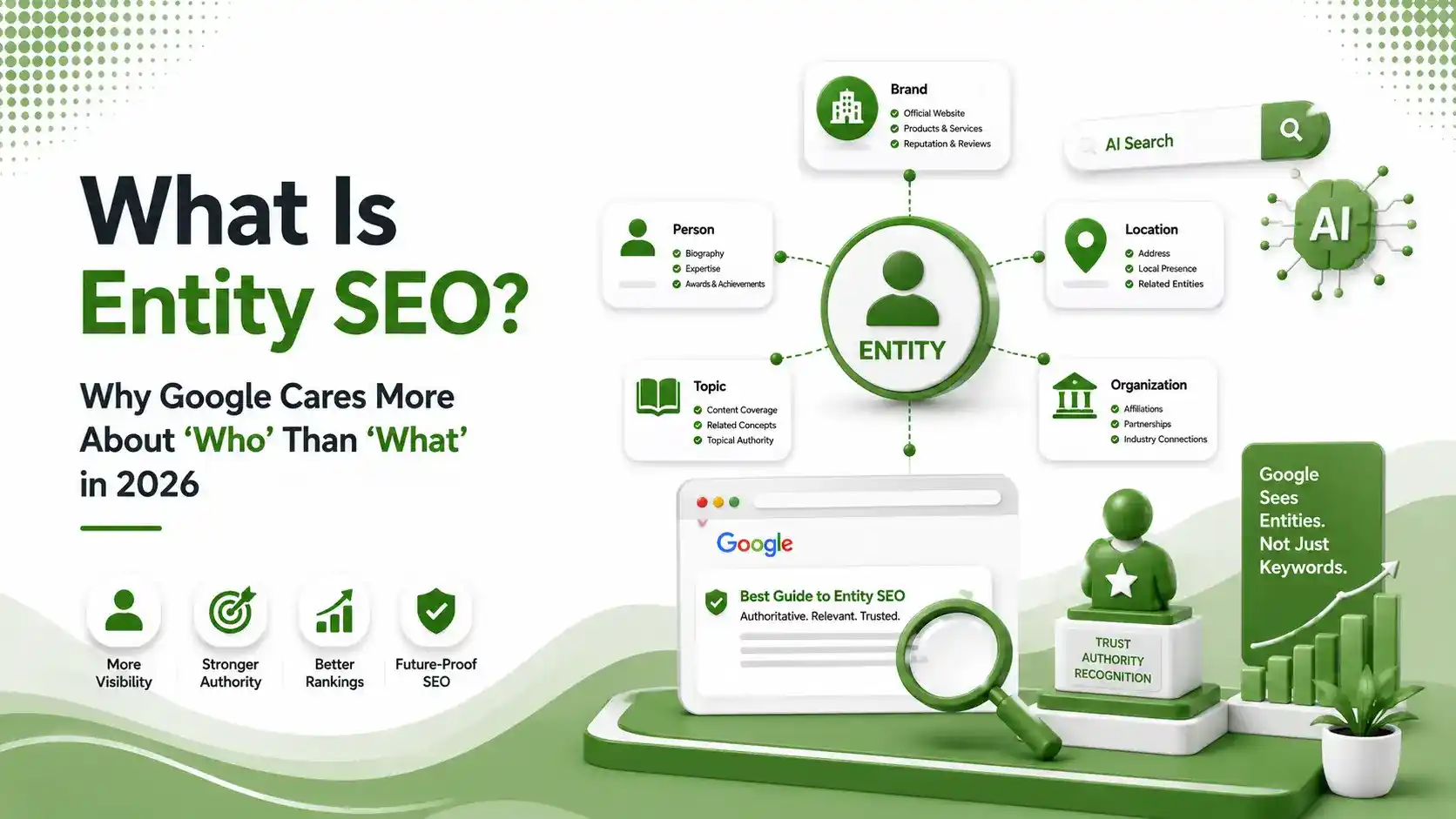
Google's Knowledge Graph now holds an estimated 500 billion facts about 5 billion entities, and Gemini is trained directly on it. That single fact quietly rewired SEO. Google stopped asking "what does this page say" and started asking "who is saying it, and do I trust them." That shift is entity SEO, and in 2026 entity SEO decides who gets cited and who gets skipped.
An entity, in Google's own framing, is any uniquely identifiable thing: a person, place, organization, product, or concept that can be defined and distinguished from every other entity.
The keyword "apple" could mean the fruit, the company, or a person's name. An entity is the specific thing behind the word, disambiguated and confirmed.
This ties directly into our guide to schema markup for SEO and AI search. Schema is the mechanism. Entity SEO is the strategy that mechanism serves.
facts currently held in Google's Knowledge Graph across 5 billion+ entities
of AI Overview citations reportedly come from domains already ranking in Google's top 10
domains already using the sameAs schema property to confirm entity identity
Why "Who" Now Matters More Than "What"
Traditional SEO optimized for what a page said, matching keywords and phrases to search queries.
Entity SEO optimizes for who is saying it, whether Google can confidently connect your content to a specific, verified, trusted entity. That single distinction is the core of entity SEO as it works today.
This is the practical difference behind the "things, not strings" idea Google introduced back in 2012.
A search engine that understands entities can connect your brand to a location entity, an industry entity, and a list of people entities, then use those connections to decide how much to trust what you publish.
Keyword SEO vs. Entity SEO
Keyword-Focused SEO
Entity SEO
The Building Blocks of Entity Establishment
Organization Schema With sameAs
According to Stackmatix's guide to Organization schema, the highest-impact properties are name, url, logo, and sameAs links to Wikipedia, Wikidata, and verified social profiles.
Consistency Above Everything Else
According to OrganiKPI's guide to the sameAs property, three fields must be identical everywhere your entity appears: name, canonical URL, and description. Inconsistency in these blocks Google's entity merge entirely.
A Wikidata Entry
Wikidata feeds directly into Google's Knowledge Graph. According to Forest SD's 2026 entity SEO guide, the Knowledge Graph has become more open to smaller organizations, and a qualifying Wikidata entry can meaningfully accelerate entity recognition, even without a full Wikipedia article.
Person Schema for Authors
Individual author entities, complete with credentials, affiliations, and their own sameAs links, feed directly into E-E-A-T signals, since AI systems increasingly attribute trust to specific people, not just brands.
Explicit Entity Relationships in Content
According to CrawlVision's entity-based SEO guide, content should make relationships between entities explicit rather than isolated, mirroring how a knowledge graph actually connects concepts.
Is Entity SEO Worth Prioritizing for Your Site?
Not every business needs a Knowledge Panel to benefit from entity signals. Tap through both perspectives.
Local businesses, subject-matter experts, and niche organizations with consistent, verifiable information across the web tend to see faster entity recognition.
According to Forest SD's guide referenced above, local businesses and niche creators increasingly earn Knowledge Panels through deliberate entity work, something that used to be reserved for major brands.
Newer brands with little external footprint, inconsistent business information across directories, or no verified social presence take longer to establish. According to DigitalApplied's 2026 entity SEO guide, entity establishment is realistically a months-long process, not an overnight fix.
What Organization Schema Looks Like in Practice
This is the foundational code most entity SEO work builds on top of, typically placed once, site-wide.
{
  "@context": "https://schema.org",
  "@type": "Organization",
  "name": "Brandella Journal",
  "url": "https://www.brandella.in",
  "logo": "https://www.brandella.in/logo.png",
  "sameAs": [
    "https://www.linkedin.com/company/brandella",
    "https://www.wikidata.org/wiki/Q000000"
  ]
}
A minimal Organization schema block establishing entity identity through sameAs links
Entity Signals at a Glance
| Signal | What It Does | Effort Required |
|---|---|---|
| Organization schema | Establishes core brand identity and sameAs links | Low, one-time setup |
| Wikidata entry | Feeds directly into Google's Knowledge Graph | Moderate, requires notability check |
| Person schema for authors | Builds individual author trust and E-E-A-T signals | Low to moderate, per author |
| Consistent NAP and profiles | Confirms entity identity across the web | Ongoing maintenance |
| Knowledge Panel claim | Public confirmation of entity recognition | Only available once Google recognizes the entity |
How to Check If Google Already Recognizes You as an Entity
Search your brand name directly in Google and look for a Knowledge Panel appearing on the right side of results. Its presence is the clearest public confirmation that Google has recognized you as a distinct entity.
Beyond that, the Google Knowledge Graph Search API lets you query directly for whether your brand has an existing entry, according to Stackmatix's guide to entity-based SEO and topical authority.
If a Knowledge Panel does appear, claim and verify it through Google Search Console. According to Growthvibe's entity SEO guide, claiming ownership gives you some control over which details are displayed and confirms the entity genuinely belongs to you.
Why This Matters More With Every AI Search Update
Ranking well no longer guarantees a citation. According to DigitalApplied's 2026 entity guide, entity clarity is what tells Google which top-10 result is actually the authoritative source for a given claim, even among several ranking pages covering the same topic.
This connects directly to the citation mechanics we covered in our piece on AI Overviews and getting cited, and the terminology debate in our AEO vs SEO vs GEO breakdown.
Entity SEO is the layer underneath all three, since none of them work if Google cannot confidently identify who you are in the first place.
According to Wire Innovation's guide to SEO entities, this is exactly why entity-based optimization prioritizes intent and relevance over keyword density alone.
Entity SEO for Local and Small Businesses
Entity SEO can sound like something reserved for major global brands, but the fundamentals scale down surprisingly well for smaller businesses too.
A local business benefits from entity SEO the same way a national brand does: consistent name, address, and phone number across every directory, a Google Business Profile that matches your website exactly, and Organization schema that ties everything together with sameAs links.
The advantage for smaller businesses is actually structural.
A local entity has fewer conflicting signals to untangle than a large enterprise with dozens of subsidiaries, regional sites, and historical name changes. Clean, consistent entity SEO signals can establish recognition faster for a focused local business than for a sprawling corporate structure.
Common Entity SEO Mistakes That Undermine Recognition
Beyond inconsistent sameAs links, a few other mistakes show up repeatedly in entity SEO audits. Dead or redirected sameAs URLs are a common one, quietly breaking the very connections meant to confirm your identity.
Another frequent issue is thin structured data. Implementing basic Organization schema once and considering entity SEO complete misses the point entirely. Comprehensive entity SEO covers services, locations, people, and content relationships, not just a single schema block.
A third mistake is ignoring entity relationships in the content itself. Schema alone cannot compensate for content that never mentions how your brand connects to related industry entities, locations, or concepts your audience actually searches for.
FAQs on Entity SEO
What We Learn Today
An entity is a specific, disambiguated thing, not just a keyword.
Google's Knowledge Graph holds 500B+ facts across 5 billion entities.
Organization schema with sameAs links is the fastest entry point.
Consistency in name, URL, and description matters more than volume.
Entity clarity now decides which top-10 result gets the AI citation.
Small businesses can earn Knowledge Panels too, given consistent signals.