
Now Reading: Large Language Models Explained: 5 Key Concepts
-
01
Large Language Models Explained: 5 Key Concepts
Large Language Models Explained: 5 Key Concepts

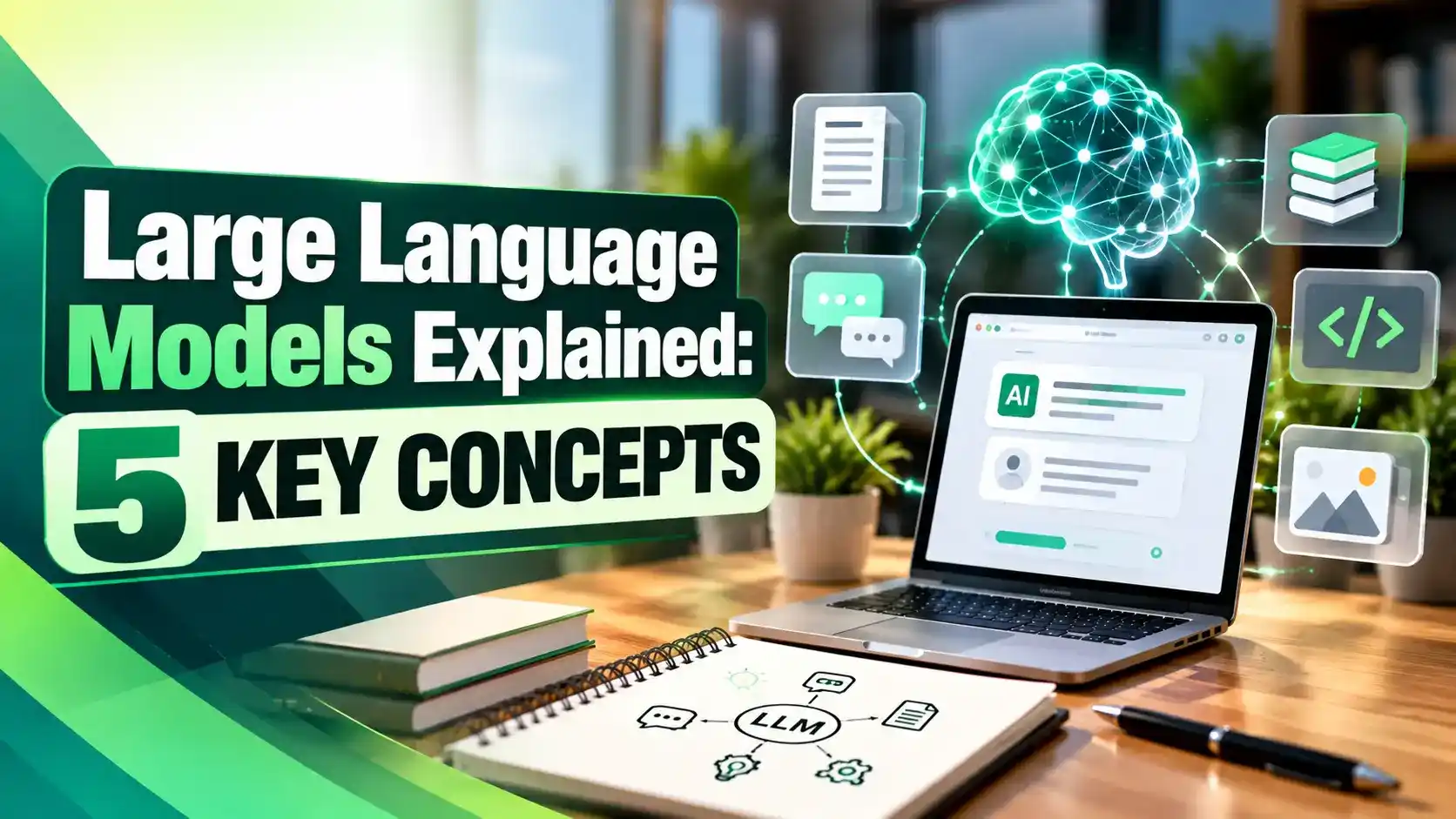
Large language models sit behind every AI chat tool marketers now use daily. This guide breaks down tokens, parameters, context windows, and hallucinations in plain language, then connects it all to why these models now shape AI search and AEO.
Hey! If you keep hearing the phrase "large language models" in every marketing meeting and nodding along without really knowing what sits under the hood, this one is for you.
You type a question into ChatGPT, Claude, or Gemini, and a few seconds later a fluent, confident answer appears. It feels like magic, but it is not. Large language models are the engine behind that answer, and once you understand five core ideas about how they actually work, prompting gets easier, your AI search strategy gets sharper, and you stop being surprised when the model gets something wrong.
What Are Large Language Models, Really?
Large language models are computer programs trained on enormous amounts of text so they can predict, generate, and work with human language. At a basic level, a large language model is a next word predictor on a massive scale, calculating which word is statistically most likely to come next and repeating that process until it has produced a full answer.
That sounds simple for tools as capable as ChatGPT or Claude. The trick is scale. Trained on a huge slice of the public internet, books, articles, code, and conversation, the next word prediction ends up capturing grammar, facts, reasoning patterns, and even tone and style.
For a marketer, the practical takeaway is this: a large language model does not "know" things the way a person does. It generates the most probable continuation of your prompt based on patterns it absorbed during training, and that distinction matters every time you rely on one for research, drafting, or strategy.
How Training, Tokens, and Parameters Actually Work
Before a model can predict anything, it has to be trained, and training breaks text down into small chunks called tokens rather than whole words. A token can be a full word, part of a word, or even punctuation. OpenAI's own help documentation puts it plainly: one token is roughly four characters of English text, about three quarters of a word, so a 100 word paragraph is closer to 133 tokens once it is tokenized, per OpenAI's token guide. Tokens matter for a practical reason: pricing, prompt limits, and document size are measured in tokens, not words, so a long style guide can hit a ceiling faster than a word count alone suggests.
Parameters are a different piece of the puzzle. They are the internal values a model adjusts during training to get better at predicting the next token, and IBM describes them as the weights and biases a model learns automatically, plus the hyperparameters a team sets to guide that learning, per IBM's explainer on LLM parameters. The largest large language models today, including GPT, Gemini, and Llama family models, run into the billions of parameters, part of why they can hold so much nuance and still sound natural. More parameters generally mean more capability and more computing cost, so bigger is not automatically the right tool for every task.
Tip
If you are pasting long documents into a large language model and getting cut off, the problem is almost always tokens, not words. Trim headers, boilerplate, and repeated legal text first, since every token you remove is one more token the model can spend on your actual question.
The Major AI Models Marketers Should Know
You do not need to memorize every large language model on the market, but four families come up constantly in marketing tools, browser extensions, and AI search results: OpenAI's GPT line, Anthropic's Claude, Google's Gemini, and Meta's Llama.
Each one has its own strengths, pricing, and context window, the amount of text a model can consider at once. TechCrunch reported that Claude Sonnet 4 expanded to a one million token context window, roughly five times its earlier limit, while GPT-5 offered 400,000 tokens, Gemini 2.5 Pro offered 2 million tokens, and Llama 4 Scout offered 10 million tokens at the time, per TechCrunch's coverage of the expansion.
| Model Family | Maker | Known For | Context Window Reported |
|---|---|---|---|
GPT-5 | OpenAI | General assistant, ChatGPT, API tools | 400,000 tokens |
| Claude Sonnet 4 | Anthropic | Long document work, coding, writing | 1,000,000 tokens |
| Gemini 2.5 Pro | Search integration, multimodal tasks | 2,000,000 tokens | |
| Llama 4 Scout | Meta | Open weight model, self hosted use | 10,000,000 tokens |
Large language models from these four makers power most of what marketers already touch day to day, from AI Overviews in Google search to chat assistants embedded inside CRM and content tools, which is exactly why understanding how they behave is no longer optional background knowledge.
How Marketers Actually Interact With These Models
Most marketers never touch how large language models are trained. The real, everyday interaction happens through prompting, the instructions you type to steer a model toward a useful answer. A prompt works best as a short brief rather than a search query: state the audience, the format, and one concrete example of tone, and the output moves closer to what you wanted on the first try.
Context windows, covered above, decide how much background you can hand a model at once, a brand guide, a transcript, a spreadsheet of product data, before it runs out of room. That is where retrieval augmented generation, usually shortened to RAG, comes in. Instead of relying only on what a model memorized during training, a RAG system fetches relevant passages from a live source, a document library or a website, and hands them to the model alongside your question. Our guide to retrieval augmented generation explained breaks that pattern down step by step.
This is also where answer engines quietly connect to your content. Many AI search tools lean on a RAG style approach to decide what to cite, so a page that is clear, specific, and well structured is simply more retrievable than one that is vague, even if both rank similarly in traditional search, according to HubSpot's glossary entry on retrieval augmented generation.
Tip
Keep a short library of three or four proven prompts for your most repeated tasks, a product description brief, a meta description request, a social caption format, and reuse them instead of rebuilding a prompt from scratch every time. Our prompt engineering guide for marketing professionals has a longer template you can borrow from.
The Real Limits of This Technology
Large language models are confident even when they are wrong, and that single trait causes more marketing mistakes than almost anything else on this list. A hallucination is a confident, fluent, fabricated answer, a made up statistic, a quote that was never said, a source that does not exist.
OpenAI's own research team explained why this happens in plain terms: standard training rewards guessing over admitting uncertainty, the same way a multiple choice test with no penalty for wrong answers encourages guessing rather than leaving a question blank. In one internal comparison, a model that abstained from answering 52% of the time still landed a similar accuracy score to a model that almost never abstained, because the second model's extra guesses produced far more errors, per OpenAI's research post on why language models hallucinate. For a deeper look, see our guide to AI hallucinations.
Knowledge cutoffs are the second limit worth remembering. Large language models are trained on data collected up to a certain date, so they do not know anything that happened after that point unless paired with live retrieval or a search tool. That is a second reason retrieval augmented generation matters: it lets a model reach past its own training cutoff for anything time sensitive, a pricing change, a new product launch, or this week's algorithm update.
Anthropic's Claude Sonnet 4 context window grew to one million tokens in 2025, about five times its earlier limit, while OpenAI's GPT-5 sat at 400,000 tokens and Meta's Llama 4 Scout reached 10 million tokens, according to TechCrunch, a reminder that context window size varies enormously across large language models and genuinely changes what you can hand one at once.
Common Mistakes Marketers Make With This Technology
Most of the frustration marketers feel with large language models comes down to a handful of repeated habits, not a flaw in the tools themselves.
Why This Technology Matters for AI Search and AEO
Large language models are no longer just a chat window on the side. They now sit directly inside search, powering AI Overviews, chat based answer engines, and the assistants shoppers ask for product recommendations, which is exactly why answer engine optimization, AEO, has become a real discipline alongside traditional SEO.
A recent citation study from Semrush analyzed nearly 4,000 domain appearances across ChatGPT, Gemini, Google AI Overviews, and Google AI Mode, and found that 61.7% of those appearances were what the study called ghost citations, a source link included with no actual brand name mentioned in the answer text, per Semrush's ghost citations study. Only 13.2% included both a citation and a named mention, and engines cited sources far more often than they named brands, 74.9% versus 38.3% overall.
That gap is exactly why understanding how these models retrieve and summarize content matters for marketing teams, not just engineering teams. A clear, well structured, specifically worded page is more likely to get pulled, cited, and in the best case, actually named in the answer rather than buried in a link nobody reads. Pairing this with our guide to AI for SEO and our breakdown of AI agents transforming digital marketing gives you a fuller picture of where this is heading next.
A large language model is a computer program trained on huge amounts of text that predicts the most likely next word given everything written before it, then repeats that process to generate full answers, explanations, or drafts.
Tokens are the small chunks, roughly three quarters of a word each, that text gets broken into so a model can read and generate it. Parameters are the internal values the model learns during training that shape how it predicts the next token.
They are separate large language models built by different companies, OpenAI, Anthropic, Google, and Meta, and they differ in context window size, pricing, tone, and where they show up, from chat apps to search results to self hosted tools.
Standard training rewards a confident guess over an honest "I don't know," so a large language model will often generate a fluent, plausible sounding answer even when it has no real basis for it, a behavior researchers call hallucination.
Large language models now power AI Overviews and chat based answer engines, retrieving and summarizing web content to answer queries directly, so how well your content can be found, parsed, and cited by these models increasingly shapes your visibility.
Learn Today
Token
A small chunk of text, roughly three quarters of a word, that a model reads and generates.
Parameter
An internal value a model learns during training that shapes its predictions.
Context Window
The amount of text a model can consider at once, measured in tokens.
Hallucination
A confident but fabricated answer a model generates without a real basis.
Retrieval Augmented Generation
Pairing a model with live retrieved sources instead of relying only on training data.
Knowledge Cutoff
The date after which a model has no training data and genuinely does not know what happened.
Put This Technology to Work the Right Way
Explore more Brandella Journal guides on SEO and digital marketing.