
Now Reading: Social Media Listening: 7 Essential Tools and Tips
-
01
Social Media Listening: 7 Essential Tools and Tips

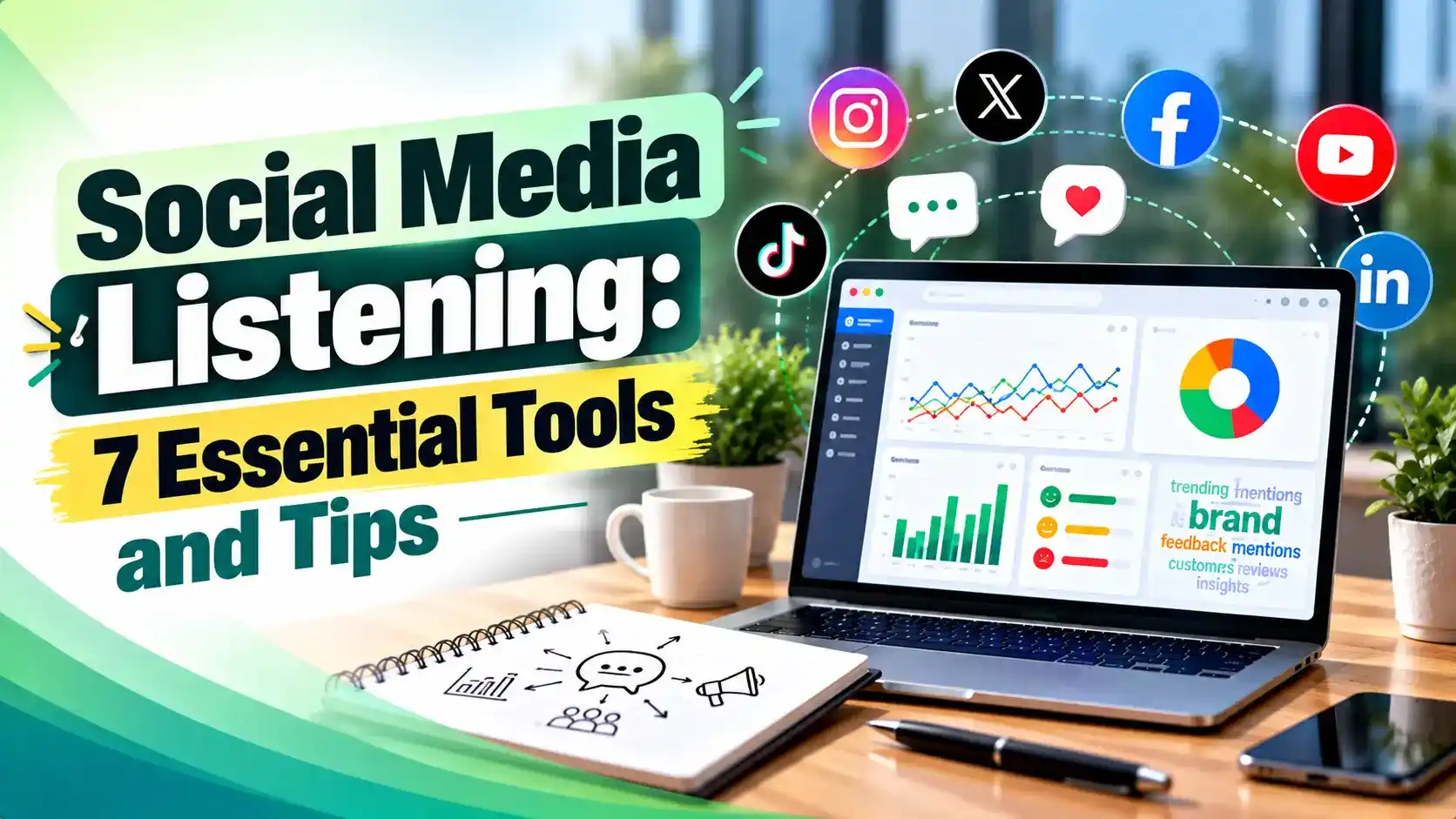
Social media listening turns scattered mentions into a real early warning system for brand reputation, competitor tracking, and crisis response. This guide breaks down how sentiment analysis works, compares 7 essential tools like Brandwatch, Sprout Social, and Mention, and flags the mistakes that quietly sink most listening programs.
Hey! If you've ever typed your own brand name into a search bar at midnight just to see what people are saying about you, this one's for you.
What if you didn't have to guess? Social media listening turns that nervous late night search habit into an actual system, one that tells you what your audience thinks before a small complaint turns into a trending complaint.
What Social Media Listening Actually Means
Most marketers use "monitoring" and "listening" like they're the same thing. They aren't. Social monitoring is about right now: new mentions, comments, and tags that need a reply today. Social media listening looks across weeks or months of conversation to find patterns, sentiment shifts, and emerging themes, according to Meltwater.
Think of it as the difference between answering a ringing phone and reading the trend line in your call volume. One keeps a customer happy today. The other tells you why three customers called about the same thing this month, and whether a fourth is about to.
The two work best together. Monitoring feeds the real time reactions into a bigger pool, and social media listening turns that pool into direction for the next campaign, the next product fix, or the next piece of content. It's worth remembering just how large that pool is: roughly two in three people worldwide use social media at least once a month, per the Digital 2026 Global Overview Report cited by Meltwater.
Why It Matters for Brand Reputation
Reputation rarely breaks in one dramatic moment. It erodes quietly, in comment sections and group chats, long before a brand notices. That's the gap social media listening is built to close, and enough marketers now treat it as core infrastructure: 76% of marketing professionals worldwide already use social listening software, and another 7% are evaluating it, according to Statista data reported by Brand24.
The stakes are higher than most teams assume. Ogilvy's APAC Believability Index 2026, also cited by Brand24, found that 93% of consumers who lose faith in a brand churn silently and rarely contact the brand directly, which means the complaint you never see is the one costing you the most.
This is where a tool like tracking the right social KPIs pairs naturally with listening data. Volume and engagement numbers tell you what happened; sentiment and theme tracking tell you why.
Tip
Set up a boolean alert that excludes your own brand handles and sponsored posts before you start reading results. It cuts out noise fast and keeps your early social media listening reports focused on organic conversation, not your own marketing output.
Competitor Tracking and Market Research
Share of voice is one of the clearest wins from running this kind of research well. Instead of guessing how you stack up against a rival, you can see the actual volume and tone of conversation around each brand side by side.
The category itself has grown fast enough to prove the demand is real. The global social media listening market was valued around $12.15 billion in 2026, with The Business Research Company forecasting it could reach roughly $22.6 billion by 2030, as reported by Brand24.
Market research teams also use this data to spot white space: product complaints nobody else is solving, or a feature request that keeps repeating across a competitor's audience. Pairing that with your own influencer tracking work often surfaces creators already talking about your category, whether they mention your brand or not.
The payoff shows up in documented results, not just theory. Brand24 points to a single day campaign that drove 100% growth in brand discussion volume and a 7% lift in actual bookings for Uber, plus a separate agency case where acting on forum and community mentions, not just social posts, produced a reported 1000% jump in views within weeks, per Brand24.
Product and support teams tap into that same raw conversation for a different reason: catching one recurring complaint about a specific feature before it turns into a wave of support tickets, then routing that pattern straight to the product roadmap instead of waiting on a formal survey months later.
Using It for Crisis Management
A crisis rarely announces itself with a headline first. It usually starts as a spike, a sudden jump in mention volume or a fast swing in sentiment on one post, long before a journalist notices.
That's exactly what alerting is designed to catch. Talkwalker, now operating as Hootsuite's listening engine, lets teams set saved searches with keywords and boolean operators and sends real time alerts the moment sentiment shifts or a trend spikes, per Hootsuite. Catching that spike early is often the whole difference between a quiet correction and a full blown crisis with executives suddenly crowding into one call.
Speed matters because so few teams can actually move fast once an insight lands. Separate research from Sprout Social, also referenced by Brand24, found that while 93% of professionals call social intelligence important for future growth, only about 10% can act on an insight within hours.
Ninety three percent of consumers who lose confidence in a brand simply churn without ever filing a complaint, per Ogilvy's APAC Believability Index 2026, cited by Brand24. The silence is exactly what social listening is built to surface.
Tip
Build a simple escalation rule before you need it: any sentiment swing beyond a set threshold on a core keyword gets routed straight to whoever owns your company page strategy and customer support lead, not just the social team.
How Sentiment Analysis Actually Works
Sentiment analysis is the engine underneath most social media listening dashboards. Natural language processing scans each mention and tags it positive, negative, or neutral, then rolls thousands of those tags into one trend line.
The sophistication varies a lot by vendor. Mention's model, for example, covers 31 languages, tracks seven emotion types, and reports an F1 accuracy score of 82% from a model trained on roughly 2.5TB of data, according to Mention. Brandwatch's Iris AI goes further still, surfacing emerging themes automatically and detecting emotions such as joy or anger within a saved search, per Brandwatch.
None of this is perfect. Sarcasm, local slang, and mixed emotion in a single post still trip up automated models, which is why most serious social media listening workflows let a human analyst correct a mislabeled mention rather than trusting the score blindly.
Image and video are the newer frontier. Platforms like Talkwalker and YouScan can now recognize a brand's logo inside a photo or clip with no caption text at all, which matters since so much Instagram and TikTok chatter never types the brand name out loud, per Brandwatch.
7 Essential Tools Worth Comparing
There's no single best platform, only the best fit for your budget and the channels your audience actually lives on. Here are seven worth shortlisting.
Match the tool to the actual job rather than the marketing hype around it. A small team chasing quick alerts on direct mentions needs far less horsepower than an enterprise comms team tracking sentiment across thirty plus channels and dozens of countries at once, and that's really a data coverage question as much as a budget one.
| Tool | Best For |
|---|---|
| Brandwatch | Enterprise consumer research and AI theme detection |
| Sprout Social | Combined publishing, analytics, and listening in one dashboard |
| Hootsuite (Talkwalker) | Crisis alerts and multilingual sentiment at scale |
| Mention | Affordable alerts for small teams and agencies |
| Brand24 | Budget friendly reporting with clear mention sourcing |
| Meltwater | Media intelligence alongside social conversation data |
| YouScan | Image recognition for fashion, beauty, and auto brands |
Scale differs wildly between these. Sprout Social says its platform processes up to 50,000 posts per second and analyzes an average of 600 million messages a day, based on a Forrester Total Economic Impact study it commissioned, per Sprout Social. Hootsuite's Talkwalker engine, meanwhile, covers roughly 150 million websites and more than 30 social channels across 239 countries, per Hootsuite.
Mention sits at the more accessible end, with plans starting near $41 a month and a 14 day free trial, while still covering more than 1 billion sources and 249 languages, per Mention. If you're layering this into broader Facebook and community management work, the lighter tools are often enough to start.
Common Mistakes to Avoid
Most failed listening programs don't fail because the tool was wrong. They fail because the setup or the follow through was weak.
None of this needs to be complicated to start. A single well built alert, checked weekly, already beats the midnight search habit most brands start with. Treat your first month of social media listening as a baseline, not a verdict, and let the patterns build before you act on any single spike.
Social monitoring tracks and responds to individual mentions as they happen. Social media listening analyzes that same conversation over weeks or months to find sentiment trends, emerging topics, and competitor comparisons that a single reply never would.
Mention and Brand24 are generally the most accessible starting points, with Mention's entry plan priced near $41 a month and a free trial available, while still covering a huge range of web and social sources.
It's useful but imperfect. Mention reports an 82% accuracy score for its sentiment model, and most vendors recommend a human reviewer correct mislabeled mentions, especially ones involving sarcasm or mixed emotion.
Yes. A spike alert on mention volume or a sudden sentiment swing is often the earliest warning a brand gets, well before a story reaches mainstream coverage, which gives a comms team time to respond instead of just reacting.
Weak follow through, not weak software. Many in house teams struggle to turn findings into decisions other departments act on, which is usually a process gap rather than a tool problem.
Learn Today
Social Monitoring
Tracking and responding to individual mentions in real time.
Sentiment Analysis
Automated tagging of a mention as positive, negative, or neutral.
Share of Voice
Your brand's percentage of total conversation versus named competitors.
Boolean Query
A search built with AND, OR, and NOT operators to narrow or widen results.
Spike Alert
An automatic notice sent when mention volume jumps sharply in a short window.
Brand Health
A composite view of sentiment, volume, and share of voice over time.
Turn Scattered Mentions Into a Real Social Media Listening Habit
Explore more Brandella Journal guides on SEO and digital marketing.