
- Home
- SEODiscover the latest updates from across the United States, including politics, culture, economy, and trending stories. Stay informed on the key events shaping the nation and the topics everyone’s talking about.
- Technical SEOLearn technical SEO concepts including crawling, indexing, XML sitemaps, robots.txt, canonical tags, site architecture, and website performance.
- Local SEOOptimize your business for local seo with Google Business Profile, local citations, reviews, maps, and location-based SEO.
- Mobile SEOImprove your website’s mobile seo performance with responsive design, mobile-first indexing, usability, and page speed optimization.
- On-Page SEOExplore on-page seo optimization techniques such as title tags, meta descriptions, headings, URLs, internal linking, and content optimization.
- Off-Page SEODiscover off-page SEO strategies such as backlinks, digital PR, brand mentions, outreach, and authority building.
- SEO ToolsExplore the best SEO tools for keyword research, technical audits, backlink analysis, rank tracking, and website optimization.
- Core Web VitalsLearn how to improve Core Web Vitals including LCP, INP, CLS, page speed, and overall user experience for better rankings.
- Keyword ResearchLearn how to find profitable keywords, analyze search intent, evaluate competition, and build effective keyword strategies.
- Link BuildingMaster ethical link building techniques, backlink analysis, outreach methods, guest posting, and authority growth strategies.
- Google Search ConsoleLearn how to use Google Search Console to monitor indexing, fix errors, analyze search performance, and improve SEO.
- SEO BasicsLearn the fundamentals of search engine optimization (SEO Basics), including how search engines work, SEO terminology, and beginner-friendly best practices.
- Paid Media
- Display AdvertisingLearn display advertising strategies, banner ads, audience targeting, remarketing, Google Display campaigns, and optimization techniques.
- Google AdsLearn Google Ads strategies, campaign setup, bidding, keywords, Performance Max, Search Ads, and optimization techniques.
- LinkedIn AdsLearn LinkedIn Ads strategies for B2B marketing, lead generation, audience targeting, campaign optimization, and paid social advertising.
- Meta AdsLearn Meta Ads strategies for Facebook and Instagram, including campaign setup, targeting, retargeting, and performance optimization.
- Paid Media AnalyticsLearn paid media analytics, including CPC, CTR, CPA, ROAS, conversion tracking, attribution, reporting, and campaign performance analysis.
- PPC StrategyLearn effective PPC strategies, campaign planning, bidding, keyword targeting, landing pages, conversion optimization, and more.
- ContentTransform your living spaces with inspiration, tips, and trends in interior design. From minimalist decor to bold statements, find ideas for every style and budget.
- Social
- Digital MarketingExplore stories and advice on living your best life. From personal growth to entertainment, dive into the latest in lifestyle trends and inspiration.
- Artificial IntelligenceStay informed about health and wellness with expert advice, fitness tips, and the latest medical breakthroughs. Your guide to a healthier and happier life.
- DevelopmentYou will find development related educational articles
- GTMLearn Google Tag Manager (GTM) with practical guides for tags, triggers, variables, tracking, conversions, and website analytics implementation.
- HTMLLearn HTML with simple tutorials, examples, tags, elements, attributes, and best practices for building modern web pages.
- HTML CSSLearn HTML CSS together with practical tutorials, examples, layouts, styling techniques, responsive design, and modern web development practices.
- HTML JSLearn HTML JS – JavaScript with practical tutorials and examples for adding interactivity, dynamic content, events, and functionality to web pages.
- JavaScriptExplore JavaScript tutorials, examples, concepts, and practical techniques for creating interactive and dynamic websites and web applications.
- PHPLearn PHP programming with practical tutorials, examples, functions, syntax, and web development techniques for beginners and developers.
- PythonLearn Python programming with practical tutorials, examples, syntax, functions, automation techniques, and useful programming concepts.
- Home
- SEODiscover the latest updates from across the United States, including politics, culture, economy, and trending stories. Stay informed on the key events shaping the nation and the topics everyone’s talking about.
- Technical SEOLearn technical SEO concepts including crawling, indexing, XML sitemaps, robots.txt, canonical tags, site architecture, and website performance.
- Local SEOOptimize your business for local seo with Google Business Profile, local citations, reviews, maps, and location-based SEO.
- Mobile SEOImprove your website’s mobile seo performance with responsive design, mobile-first indexing, usability, and page speed optimization.
- On-Page SEOExplore on-page seo optimization techniques such as title tags, meta descriptions, headings, URLs, internal linking, and content optimization.
- Off-Page SEODiscover off-page SEO strategies such as backlinks, digital PR, brand mentions, outreach, and authority building.
- SEO ToolsExplore the best SEO tools for keyword research, technical audits, backlink analysis, rank tracking, and website optimization.
- Core Web VitalsLearn how to improve Core Web Vitals including LCP, INP, CLS, page speed, and overall user experience for better rankings.
- Keyword ResearchLearn how to find profitable keywords, analyze search intent, evaluate competition, and build effective keyword strategies.
- Link BuildingMaster ethical link building techniques, backlink analysis, outreach methods, guest posting, and authority growth strategies.
- Google Search ConsoleLearn how to use Google Search Console to monitor indexing, fix errors, analyze search performance, and improve SEO.
- SEO BasicsLearn the fundamentals of search engine optimization (SEO Basics), including how search engines work, SEO terminology, and beginner-friendly best practices.
- Paid Media
- Display AdvertisingLearn display advertising strategies, banner ads, audience targeting, remarketing, Google Display campaigns, and optimization techniques.
- Google AdsLearn Google Ads strategies, campaign setup, bidding, keywords, Performance Max, Search Ads, and optimization techniques.
- LinkedIn AdsLearn LinkedIn Ads strategies for B2B marketing, lead generation, audience targeting, campaign optimization, and paid social advertising.
- Meta AdsLearn Meta Ads strategies for Facebook and Instagram, including campaign setup, targeting, retargeting, and performance optimization.
- Paid Media AnalyticsLearn paid media analytics, including CPC, CTR, CPA, ROAS, conversion tracking, attribution, reporting, and campaign performance analysis.
- PPC StrategyLearn effective PPC strategies, campaign planning, bidding, keyword targeting, landing pages, conversion optimization, and more.
- ContentTransform your living spaces with inspiration, tips, and trends in interior design. From minimalist decor to bold statements, find ideas for every style and budget.
- Social
- Digital MarketingExplore stories and advice on living your best life. From personal growth to entertainment, dive into the latest in lifestyle trends and inspiration.
- Artificial IntelligenceStay informed about health and wellness with expert advice, fitness tips, and the latest medical breakthroughs. Your guide to a healthier and happier life.
- DevelopmentYou will find development related educational articles
- GTMLearn Google Tag Manager (GTM) with practical guides for tags, triggers, variables, tracking, conversions, and website analytics implementation.
- HTMLLearn HTML with simple tutorials, examples, tags, elements, attributes, and best practices for building modern web pages.
- HTML CSSLearn HTML CSS together with practical tutorials, examples, layouts, styling techniques, responsive design, and modern web development practices.
- HTML JSLearn HTML JS – JavaScript with practical tutorials and examples for adding interactivity, dynamic content, events, and functionality to web pages.
- JavaScriptExplore JavaScript tutorials, examples, concepts, and practical techniques for creating interactive and dynamic websites and web applications.
- PHPLearn PHP programming with practical tutorials, examples, functions, syntax, and web development techniques for beginners and developers.
- PythonLearn Python programming with practical tutorials, examples, syntax, functions, automation techniques, and useful programming concepts.
Now Reading: How the Google Ads Auction Works Behind the Scenes
-
01
How the Google Ads Auction Works Behind the Scenes
- Home//
- SEO//Discover the latest updates from across the United States, including politics, culture, economy, and trending stories. Stay informed on the key events shaping the nation and the topics everyone’s talking about.
- Technical SEO//Learn technical SEO concepts including crawling, indexing, XML sitemaps, robots.txt, canonical tags, site architecture, and website performance.
- Local SEO//Optimize your business for local seo with Google Business Profile, local citations, reviews, maps, and location-based SEO.
- Mobile SEO//Improve your website’s mobile seo performance with responsive design, mobile-first indexing, usability, and page speed optimization.
- On-Page SEO//Explore on-page seo optimization techniques such as title tags, meta descriptions, headings, URLs, internal linking, and content optimization.
- Off-Page SEO//Discover off-page SEO strategies such as backlinks, digital PR, brand mentions, outreach, and authority building.
- SEO Tools//Explore the best SEO tools for keyword research, technical audits, backlink analysis, rank tracking, and website optimization.
- Core Web Vitals//Learn how to improve Core Web Vitals including LCP, INP, CLS, page speed, and overall user experience for better rankings.
- Keyword Research//Learn how to find profitable keywords, analyze search intent, evaluate competition, and build effective keyword strategies.
- Link Building//Master ethical link building techniques, backlink analysis, outreach methods, guest posting, and authority growth strategies.
- Google Search Console//Learn how to use Google Search Console to monitor indexing, fix errors, analyze search performance, and improve SEO.
- SEO Basics//Learn the fundamentals of search engine optimization (SEO Basics), including how search engines work, SEO terminology, and beginner-friendly best practices.
- Paid Media//
- Display Advertising//Learn display advertising strategies, banner ads, audience targeting, remarketing, Google Display campaigns, and optimization techniques.
- Google Ads//Learn Google Ads strategies, campaign setup, bidding, keywords, Performance Max, Search Ads, and optimization techniques.
- LinkedIn Ads//Learn LinkedIn Ads strategies for B2B marketing, lead generation, audience targeting, campaign optimization, and paid social advertising.
- Meta Ads//Learn Meta Ads strategies for Facebook and Instagram, including campaign setup, targeting, retargeting, and performance optimization.
- Paid Media Analytics//Learn paid media analytics, including CPC, CTR, CPA, ROAS, conversion tracking, attribution, reporting, and campaign performance analysis.
- PPC Strategy//Learn effective PPC strategies, campaign planning, bidding, keyword targeting, landing pages, conversion optimization, and more.
- Content//Transform your living spaces with inspiration, tips, and trends in interior design. From minimalist decor to bold statements, find ideas for every style and budget.
- Social//
- Digital Marketing//Explore stories and advice on living your best life. From personal growth to entertainment, dive into the latest in lifestyle trends and inspiration.
- Artificial Intelligence//Stay informed about health and wellness with expert advice, fitness tips, and the latest medical breakthroughs. Your guide to a healthier and happier life.
- Development//You will find development related educational articles
- GTM//Learn Google Tag Manager (GTM) with practical guides for tags, triggers, variables, tracking, conversions, and website analytics implementation.
- HTML//Learn HTML with simple tutorials, examples, tags, elements, attributes, and best practices for building modern web pages.
- HTML CSS//Learn HTML CSS together with practical tutorials, examples, layouts, styling techniques, responsive design, and modern web development practices.
- HTML JS//Learn HTML JS – JavaScript with practical tutorials and examples for adding interactivity, dynamic content, events, and functionality to web pages.
- JavaScript//Explore JavaScript tutorials, examples, concepts, and practical techniques for creating interactive and dynamic websites and web applications.
- PHP//Learn PHP programming with practical tutorials, examples, functions, syntax, and web development techniques for beginners and developers.
- Python//Learn Python programming with practical tutorials, examples, syntax, functions, automation techniques, and useful programming concepts.
- Home
- Paid Media
- Google Ads
- How the Google Ads Auction Works Behind the Scenes
How the Google Ads Auction Works Behind the Scenes

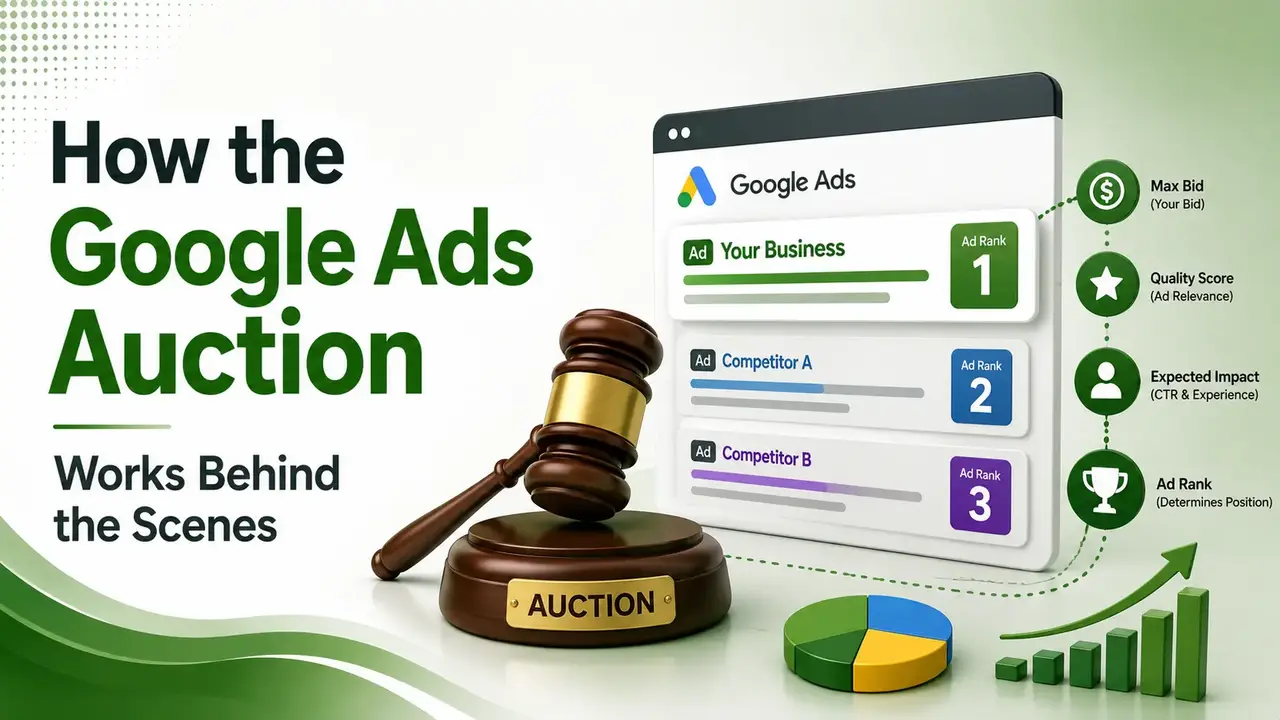
The Google Ads auction resolves faster than a blink, and the highest bidder doesn't automatically win. Here's the six-step sequence, the second-price pricing model, and a calculator to estimate your own Ad Rank against a competitor.
Table of Contents
ToggleEvery time someone searches on Google, an entire auction resolves in roughly 200 milliseconds, faster than a single blink. The advertiser willing to pay the most does not automatically win. Here is exactly what happens behind the scenes, in the split second between a search query and the ads that appear.
The Google Ads auction works by evaluating every eligible ad for a search against a combined score called Ad Rank, which factors in bid amount, ad quality, expected impact of extensions, and the specific context of that search.
The winner is then charged only slightly more than the ad ranked directly below it, not their full maximum bid.
This connects directly to our guide on Google Ads Quality Score. Quality Score is the input. The auction mechanism covered here is where that input actually gets put to work.
the roughly 100-300 millisecond window in which an entire ad auction resolves
factors Google's own documentation lists as making up Ad Rank
the small amount added above the actual cost needed to beat the next competitor
The Six-Step Sequence Behind Every Google Ads Auction
According to Google Ads' own help documentation on the auction, the process follows a consistent sequence every single time.
Why the Highest Bidder Doesn't Automatically Win
According to OVM Agency's breakdown of how the Google Ads auction works, a competitor bidding far more can still lose the top spot if their ad quality is weak, since relevance is weighted heavily, sometimes more heavily than the raw bid itself.
How the Second-Price Auction Actually Sets Your Cost
According to DigitalApplied's complete 2026 breakdown of the Google Ads auction, actual CPC is calculated as the next competitor's Ad Rank divided by your own Quality Score, plus one cent.
This means every point gained in Quality Score functions as a compounding discount at the exact same ad position, rather than requiring a higher bid to hold that spot.
Ad Rank vs. Quality Score: Two Related but Different Things
These two terms get confused constantly, even by experienced advertisers. Tap through both to see the actual distinction.
Quality Score is a diagnostic estimate visible in your dashboard, rated 1 to 10, intended to give you a general sense of ad quality. We covered this in full in our Quality Score guide.
Ad Rank is calculated fresh, in real time, the instant a search actually triggers your ad to compete. It incorporates Quality Score alongside bid, extensions, thresholds, and search context, none of which is ever displayed as a single visible number.
Ad Rank Estimator
Enter your max bid and Quality Score to estimate your Ad Rank, then compare it against a competitor.
Ad Rank Estimator
A simplified estimate using Ad Rank = Max Bid × Quality Score
Enter your numbers above and click calculate.
The Six Official Factors Behind Ad Rank
| Factor | What It Covers |
|---|---|
| Your bid | The maximum you're willing to pay per click |
| Ad and landing page quality | Summarized in your Quality Score |
| Ad Rank thresholds | Minimum quality bar an ad must clear to show at all |
| Auction competitiveness | How close competing Ad Ranks are to each other |
| Search context | Device, location, time, and nature of the search terms |
| Expected impact of extensions | Sitelinks, callouts, and other ad formats used |
Why the Auction Rewards Relevance Over Raw Budget
According to Dotidot's guide to how Google Ads auctions work, Google designed the auction specifically to balance advertiser bids against user experience, since showing irrelevant ads would drive users away from search entirely.
According to River Stone Marketing Solutions' complete guide to the auction, when relevance breaks down, it typically shows up first as a rising cost-per-acquisition problem.
It rarely appears as an obvious Quality Score warning, which is why the underlying signals feeding the Google Ads auction matter more than the visible diagnostic number alone.
What Happens Behind the Scenes When You Raise a Bid
Raising a bid changes only one input into the Google Ads auction, the Max CPC component of Ad Rank. It does nothing to improve Quality Score, extension impact, or how well your ad matches search context.
This is why two advertisers can raise their bids by the same amount and see completely different results in the Google Ads auction.
The one with a stronger Quality Score converts that bid increase into a larger jump in Ad Rank, since the two values multiply together rather than simply adding.
According to Google's own documentation referenced above, the competitiveness of the specific auction also matters. A crowded auction with several closely matched Ad Ranks behaves differently than a sparse one with a single dominant advertiser, even at identical bid and Quality Score levels.
How Smart Bidding Changes Your Role in the Google Ads Auction
According to Factors' 2026 guide to improving Ad Rank, ad extensions like sitelinks, callouts, and structured snippets can boost Ad Rank at no extra cost, since they factor directly into the expected impact of extensions component.
Automated bidding strategies still submit a bid into every individual Google Ads auction on your behalf, just far more frequently and with more granular signals than a human adjusting bids manually ever could.
According to Holinex Digital's beginner guide to how Google Ads work in 2026, AI now handles the large majority of these moment-to-moment bidding decisions, while advertisers focus on setting goals, budgets, and the creative inputs the system uses to compete in each Google Ads auction.
Common Misunderstandings About the Google Ads Auction
The most common misunderstanding is assuming budget alone determines who wins. As covered throughout this guide, a modest bid paired with strong Quality Score regularly beats a much larger bid paired with weak relevance.
A second misunderstanding is treating Ad Rank as a fixed, visible score. It is recalculated fresh for every single Google Ads auction, shifting with device, location, time of day, and which competitors happen to be bidding at that exact moment.
According to Semrush's guide to Google Ads bid strategy, the auction competitiveness factor specifically means a small gap between two Ad Ranks produces a fairly even contest.
A large gap makes the higher-ranked ad far more likely to win, though often at a higher cost for that certainty.
FAQs on the Google Ads Auction
Related Articles
What We Learn Today
Every Google Ads auction resolves in roughly 100-300 milliseconds.
Ad Rank, not raw bid alone, determines who wins and in what position.
Six official factors make up Ad Rank, per Google's own documentation.
The auction uses a modified second-price model, not a pay-your-bid model.
Higher Quality Score acts as a compounding discount at the same position.
Relevance is deliberately weighted to protect long-term user trust in search.
Related Posts
Previous Post
Next Post
Previous Post
Next Post


- Artificial Intelligence
- Content
- Core Web Vitals
- Development
- Digital Marketing
- Google Ads
- Google Search Console
- GTM
- HTML
- HTML CSS
- JavaScript
- Keyword Research
- Link Building
- Local SEO
- Meta Ads
- Mobile SEO
- Off-Page SEO
- On-Page SEO
- Paid Media
- Paid Media Analytics
- PHP
- PPC Strategy
- Python
- SEO
- SEO Basics
- SEO Tools
- Social
- Technical SEO