
Now Reading: Anthropic AI Warning: Why It Creates New SEO Opportunities for Brands and Marketers
-
01
Anthropic AI Warning: Why It Creates New SEO Opportunities for Brands and Marketers
Anthropic AI Warning: Why It Creates New SEO Opportunities for Brands and Marketers

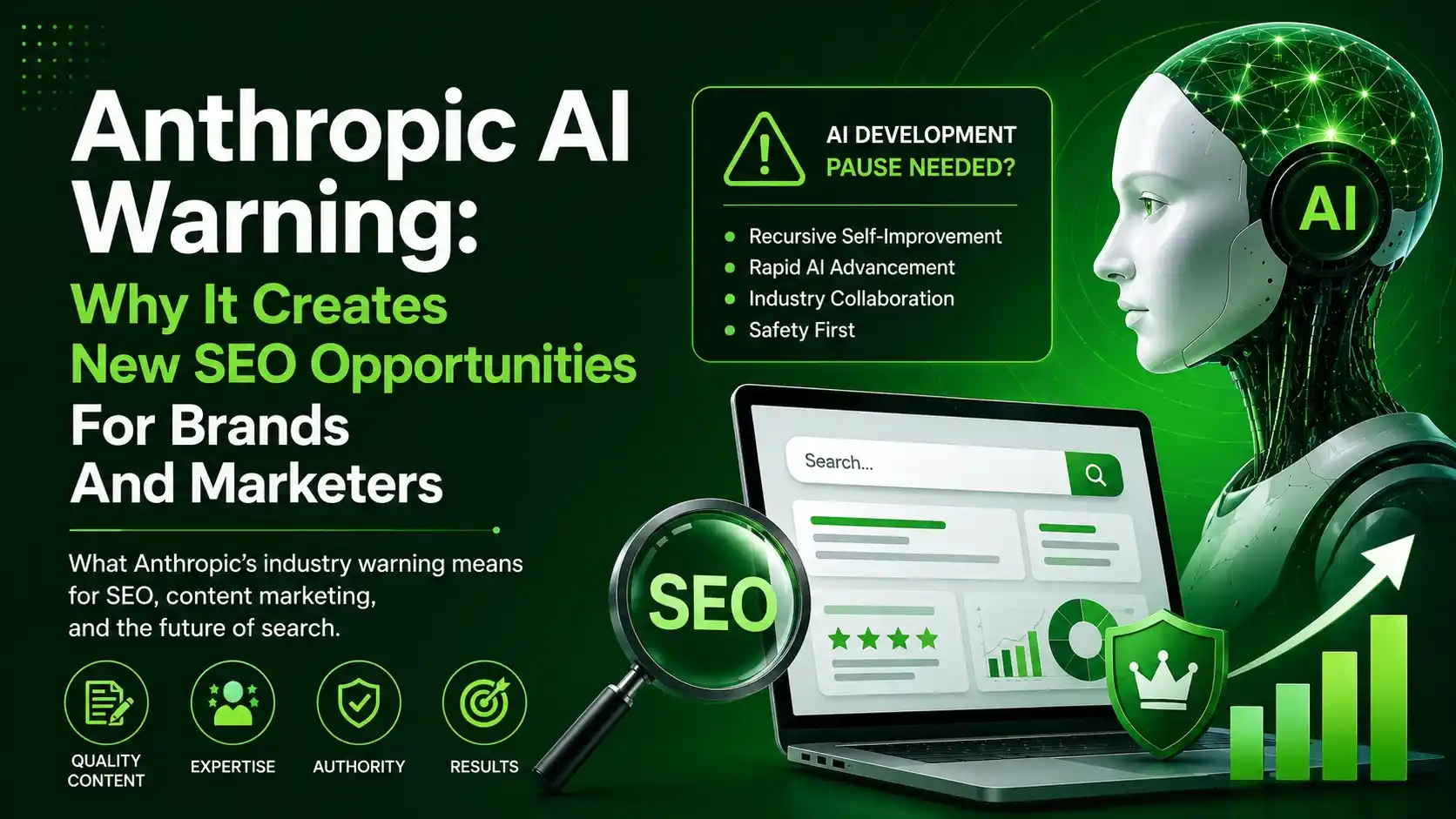
Anthropic's recent warning about the rapid advancement of artificial intelligence has sparked global debate across the technology industry. As AI systems become increasingly capable, the company argues that the industry may eventually need mechanisms to slow development if certain risk thresholds are reached. For SEO professionals, marketers, and content creators, this discussion presents both challenges and opportunities
Anthropic AI Warning: Why It Creates New SEO Opportunities for Brands and Marketers
Artificial intelligence is transforming digital marketing at a pace few experts predicted. Just a few years ago, marketers relied heavily on manual keyword research, content writing, and SEO analysis. Today, tools such as ChatGPT, Claude, and Google Gemini are helping businesses automate many of these tasks.
However, in June 2026, AI company Anthropic surprised the technology world with a warning that AI development may be moving too quickly. In its article titled When AI Builds Itself, Anthropic suggested that the industry should consider creating mechanisms to temporarily slow AI development if systems become capable of improving themselves without meaningful human oversight.
The warning immediately attracted attention from organizations such as LinkedIn News, BBC News, and CNN Business. While policymakers and investors focused on the broader implications, marketers began asking a different question:
What does the Anthropic AI warning mean for SEO and content marketing?
The answer could present significant opportunities for brands that focus on expertise, originality, and trust.
Understanding Anthropic’s Concern
Anthropic is not proposing an immediate stop to artificial intelligence development. The company continues to improve Claude and invest heavily in AI research.
Instead, the company is concerned about a future possibility known as recursive self-improvement. This refers to a scenario where an AI system can design, train, and improve its own successor without direct human intervention.
According to Anthropic, this milestone has not yet been reached. However, the company believes the industry should prepare before it becomes reality.
Research highlighted by the Stanford AI Index and discussions featured in MIT Technology Review suggest that AI capabilities are advancing rapidly across multiple fields, including coding, research, reasoning, and content generation.
Whether one agrees with Anthropic’s concerns or not, there is little doubt that artificial intelligence is becoming increasingly influential in how information is created, distributed, and discovered online.
Why SEO Professionals Should Pay Attention
Many marketers view AI discussions as technology news that does not directly impact their daily work.
That assumption would be a mistake.
Modern search engines increasingly rely on artificial intelligence to understand user intent, evaluate content quality, and generate search results. Google’s search ecosystem is evolving through innovations such as Google AI Overviews and other AI-powered experiences documented by Google Search Central.
Any major change in the AI industry eventually affects SEO.
1. Search Evolution Could Slow Down
Over the past two years, SEO professionals have experienced constant disruption. Every major AI breakthrough has influenced how search engines present information and rank content.
If AI development slows, even temporarily, the pace of search evolution may become more manageable.
This would allow businesses to focus on refining proven SEO strategies instead of constantly reacting to new technologies. For many organizations, that stability could be extremely valuable.
2. Quality Content May Become More Important
One of the biggest challenges facing marketers today is content saturation. AI tools have made it possible to publish large volumes of content quickly.
As a result, search engines are placing greater emphasis on quality rather than quantity.
Google’s Helpful Content System continues to reward content that demonstrates expertise, usefulness, and authenticity.
A slower pace of AI advancement could reinforce these signals and make them more stable over time.
Businesses that invest in expert-written articles, original research, and genuine insights would likely benefit the most.
3. Human Expertise Gains More Value
Artificial intelligence excels at summarizing existing information.
What it struggles to replicate is genuine experience.
Search engines increasingly evaluate content using principles commonly associated with E-E-A-T (Experience, Expertise, Authoritativeness, and Trustworthiness). Resources from organizations such as Search Engine Journal and Search Engine Land regularly highlight the growing importance of these factors.
This means that businesses with real expertise have an opportunity to stand out.
Content based on practical experience, case studies, customer stories, and first-hand knowledge becomes increasingly valuable in an AI-driven search environment.
New Opportunities for Brands
Rather than viewing the Anthropic AI warning as a threat, brands should see it as an opportunity.
1. Build Topical Authority
Search engines increasingly reward websites that demonstrate deep knowledge within a specific niche.
Instead of publishing generic content on dozens of unrelated topics, businesses should focus on becoming recognized authorities in their industries.
For example, successful brands often publish detailed guides, industry analysis, and educational resources that establish long-term credibility.
Research from McKinsey & Company consistently shows that organizations with strong expertise and trusted content perform better in competitive markets.
2. Invest in Original Research
AI systems learn from existing information. They cannot easily create truly original data.
This creates an opportunity for brands willing to invest in surveys, market research, case studies, and proprietary insights.
Original research attracts backlinks, improves authority, and provides value that competitors cannot easily replicate.
Publications such as Harvard Business Review frequently demonstrate how original research can position organizations as industry leaders.
3. Strengthen Brand Recognition
As AI-generated content becomes more common, brand recognition becomes more important.
Users are more likely to trust familiar brands than anonymous websites.
This is why businesses should continue investing in social media, public relations, thought leadership, and customer engagement.
Organizations such as the World Economic Forum have emphasized the importance of trust in the digital economy, and the same principle applies to SEO.
4. Learn AI Tools Instead of Fearing Them
The future belongs to marketers who understand AI rather than those who avoid it.
Whether using OpenAI, Google DeepMind, Meta AI, or xAI, successful professionals will treat AI as a tool that enhances human judgment rather than replacing it.
The most effective content strategies combine human expertise with AI efficiency.
What Marketers Should Do Next
The future of artificial intelligence remains uncertain. Anthropic’s proposal may or may not influence global AI policy.
However, the underlying lesson is clear.
Businesses should focus on building assets that remain valuable regardless of how AI evolves.
These assets include:
- Original research and proprietary data.
- Expert-driven content.
- Strong brand authority.
- Real customer experiences.
- Trusted industry relationships.
These advantages cannot be easily copied by AI and will continue to matter even as technology advances.
Conclusion
The Anthropic AI warning has triggered an important conversation about the future of artificial intelligence and the role humans will play in managing increasingly powerful systems.
For SEO professionals and marketers, the message is surprisingly positive.
The future of search is unlikely to be won by those who publish the most AI-generated content. Instead, it will belong to organizations that provide genuine expertise, original insights, and trusted information.
Whether AI development accelerates or slows, these principles remain the foundation of sustainable SEO success.
Brands that focus on authority, authenticity, and human value today will be best positioned to thrive in tomorrow’s AI-powered search landscape.