
Now Reading: Structuring HTML for Better AI Crawlability: A 7 Step Guide
-
01
Structuring HTML for Better AI Crawlability: A 7 Step Guide
Structuring HTML for Better AI Crawlability: A 7 Step Guide

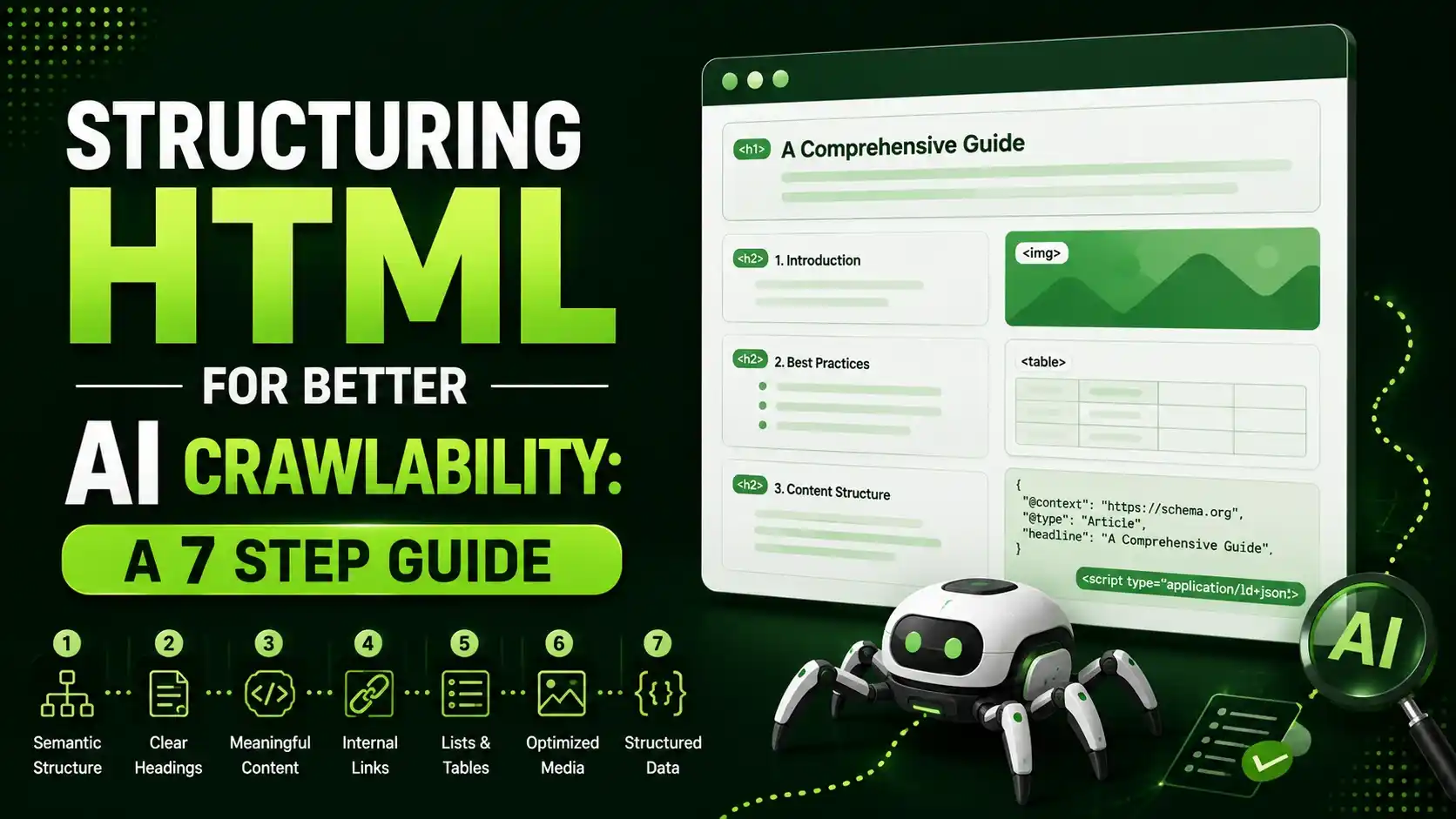
A practical, proof-backed guide to AI crawlability, covering semantic HTML, robots.txt, llms.txt, and structured data for GPTBot, ClaudeBot, and other AI crawlers.
Quick heads up before we get into it. A growing slice of your traffic now comes from a bot that never clicks a button, never scrolls, and in a lot of cases never runs a single line of your JavaScript, so the markup choices that used to matter only for accessibility and Googlebot now matter for a whole new audience too.
You have probably already checked your Core Web Vitals and your meta tags a dozen times, but has anyone checked what GPTBot, ClaudeBot, or Perplexity actually see when they hit your page? AI crawlability is about exactly that gap, the difference between what a human visitor experiences in a rendered browser and what a much simpler, much less patient crawler is able to extract from your raw markup.
What Is AI Crawlability?
AI crawlability describes how easily an AI system, whether it is training a model, answering a live user question, or indexing content for a chat based search product, can fetch a page and correctly extract its actual meaning from the markup alone.
This is a different bar than traditional SEO crawlability. A page can rank well in Google, which renders JavaScript through a full browser engine, while still being nearly unreadable to an AI crawler that only ever sees the first HTTP response.
A useful mental model: if you viewed your page's source with JavaScript disabled and stripped every class name, would the content and its structure still make sense? That is roughly what a lot of AI crawlers are working with.
Multiple named crawlers now fall under this umbrella. OpenAI's own documentation lists GPTBot, which gathers content for model training, alongside OAI-SearchBot and ChatGPT-User, which serve live search and user initiated requests respectively. Anthropic documents a similar three bot setup: ClaudeBot for training, Claude-User for live queries, and Claude-SearchBot for search quality.
OpenAI and Anthropic are far from the only two labs running crawlers against your pages. Known Agents' own directory catalogs dozens of named AI agents, assistants, and data providers across more than a dozen categories, which is a useful reality check on just how many distinct clients your AI crawlability actually needs to hold up for.
Why Semantic HTML Drives AI Crawlability
An AI crawler extracting a page's meaning leans heavily on the same signal a screen reader does: real semantic elements, not class names alone. A <nav>, a <main>, and a properly nested heading outline tell a simple parser exactly where the actual content starts and where the boilerplate ends.
<main>
  <article>
    <h1>Complete Guide to Trail Shoes</h1>
    <p>...</p>
  </article>
</main>
We covered the mechanics of this in detail in our semantic HTML guide, including a real accessibility tree proof that div only markup produces zero landmark roles. The same missing landmarks that hurt a screen reader hurt an AI crawler's ability to isolate your actual content from navigation and footer clutter.
Per the HTML living standard's own sections definition, elements like main, article, and nav carry a formally defined structural meaning, and MDN's own landmark role documentation confirms browsers expose that same meaning through implicit ARIA roles automatically, with zero extra attributes required.
Good AI crawlability also depends on descriptive link text and a heading outline that reads like a real table of contents, since a crawler extracting structure has no visual layout to lean on the way a sighted human does.
Proof: What an AI Crawler Sees vs What a Browser Renders
To make this concrete, we built a real local server hosting a page whose product description is loaded entirely from a separate API call after the page shell arrives, exactly like a real single page app.

Before touching a real crawler, a small scoring function that mirrors the structural signals this article covers was checked against five real combinations.
Then we made two real requests against that same live page: a plain HTTP GET with zero JavaScript execution, simulating a non rendering AI crawler, and a real Chromium page load through Playwright, simulating a full browser.

Real local server, real HTTP GET, real Chromium. The description text genuinely does not exist anywhere in the raw response, only in the DOM after JavaScript runs.
The plain HTTP fetch never saw the description text at all, because it genuinely does not exist anywhere in the initial response, not even inside the script source. The real browser saw it every time, because it actually executed the fetch and updated the DOM before we read the page content.
According to Google's own JavaScript SEO documentation, Googlebot itself only renders pages in a second, delayed rendering pass, well after the first crawl. Most AI crawlers, unlike Googlebot, never run that rendering pass at all.
This is the single most useful test you can run for AI crawlability on your own site: fetch a key page with JavaScript disabled and see what is actually left. If the answer is close to nothing, that page's AI crawlability is close to nothing too, regardless of how it looks in a real browser.
Controlling AI Crawlers With robots.txt
Every named AI crawler respects the same robots.txt mechanism traditional search crawlers do, targeted by its own user agent string.
User-agent: GPTBot
Disallow: /

User-agent: ClaudeBot
Crawl-delay: 1
Per Anthropic's own guidance, ClaudeBot respects a standard Disallow directive for a full block or a Crawl-delay directive to slow it down, without needing to touch anything else on the site.
Every crawler behaves independently, so allowing OpenAI's live search bot while disallowing its training focused bot is a completely valid, common configuration. For the full baseline mechanics, see our complete robots.txt guide.
- Name each AI crawler explicitly. A blanket rule for one user agent does not apply to another by default.
- Decide per crawler, not per company. A training bot and a live search bot from the same company can be treated differently.
- Recheck the rules periodically. New AI crawlers and renamed user agents appear regularly.
None of this blocks or unblocks AI crawlability by itself, it only decides which crawlers get the chance to evaluate it in the first place. The structural work covered in the rest of this guide is what determines what they find once they arrive.
llms.txt and AI Crawlability
A newer, complementary file sits alongside robots.txt specifically for this audience. The llms.txt proposal, first published by Jeremy Howard, defines a plain markdown file at the site root that gives an AI system a curated, navigable overview instead of forcing it to parse a full page of navigation and boilerplate.
# Brandella Journal

## Guides
- [HTML Semantic Elements](https://brandella.in/html-semantic-elements-explained/)
An llms.txt file does not replace good HTML AI crawlability, it supplements it. A crawler that cannot parse your actual pages will not be helped much by a tidy index pointing at them. See our dedicated llms.txt guide and our broader AI friendly website checklist for the full setup.
Structured Data and Heading Hierarchy
Structured data gives an AI crawler an explicit, machine readable summary of what a page is about, rather than forcing it to infer that meaning from prose alone. Three signals in particular move the needle most for AI crawlability, and none of them require rebuilding your templates from scratch.
| Signal | What It Gives an AI Crawler |
|---|---|
| Nested heading outline | A real table of contents it can follow without guessing |
| Schema markup | An explicit type and set of properties, not an inferred guess |
| Descriptive link text | A real signal about the linked page's topic, out of context |
Per Google's own structured data introduction, schema markup exists specifically to describe page content in a standardized vocabulary that a machine, not just a human reader, can parse reliably. See what is schema markup for a full implementation walkthrough.
A skipped heading level, jumping from an h2 straight to an h4, does not just annoy accessibility tools. It breaks the outline an AI crawler is trying to follow, the same way a missing chapter number would confuse a reader skimming a table of contents.
Google's own web.dev guidance on rendering strategies makes a related point worth remembering here: the rendering approach that is best for a human visitor's speed is not automatically the one that is best for AI crawlability, since a fast, client heavy build can still leave a crawler with almost nothing to read.
Common Mistakes That Hurt AI Crawlability
The most damaging mistake for AI crawlability is putting the actual content, not just secondary widgets, entirely behind client side rendering with no server rendered fallback, exactly the gap our real proof above demonstrated.
The second is a heading outline that exists purely for visual sizing rather than real document structure, where a designer picked h3 because it looked the right size, not because it belonged at that level.
The third is vague, repeated link text like "click here" or "read more" scattered across a page, which gives an AI crawler nothing usable when it encounters that link outside its full visual context.
The fourth is treating AI crawlability as a one time fix rather than an ongoing practice, since new crawlers and new AI products keep appearing, and a page built today should still hold up as more of this traffic arrives.
None of this requires abandoning a JavaScript heavy build, it just means the core content a reader or a crawler actually needs should exist in server rendered, semantic markup, with any purely interactive extras layered on top rather than replacing it.
No. Most run a plain HTTP fetch with no rendering engine, which is exactly what our real test above demonstrated. Treat client side only content as invisible to this class of crawler unless proven otherwise.
No. Googlebot and an AI training crawler like GPTBot are entirely separate, and blocking one through robots.txt has no direct effect on the other.
No, it is optional and complementary. It helps a crawler navigate efficiently, but good AI crawlability still comes down to the pages themselves, not the index pointing at them.
No. It makes your content easier to parse correctly and more likely to be understood accurately, but no markup guarantees a specific AI system will cite or feature a given page.
Traditional SEO crawlability mostly assumes Googlebot's full rendering pipeline. AI crawlability has to assume a simpler client that may only ever see the raw first response, a stricter bar for the same markup.
Learn Today
AI Crawlability
How easily an AI system can fetch a page and correctly extract its meaning from the raw markup alone.
GPTBot
OpenAI's crawler that gathers web content used to train its generative AI models.
ClaudeBot
Anthropic's crawler that collects web content for training and development of Claude.
llms.txt
A proposed markdown file at the site root giving AI systems a curated, navigable content overview.
Structured Data
Markup in a standardized vocabulary that describes page content in a way a machine can parse reliably.
Client Side Rendering
Building page content in the browser via JavaScript, often invisible to a non rendering crawler.
Ready to Check Your Own Pages?
Fetch one of your key pages with JavaScript disabled and see exactly what an AI crawler would actually find. That one test tells you more about your real AI crawlability than any checklist can.