
- Home
- SEODiscover the latest updates from across the United States, including politics, culture, economy, and trending stories. Stay informed on the key events shaping the nation and the topics everyone’s talking about.
- Technical SEOLearn technical SEO concepts including crawling, indexing, XML sitemaps, robots.txt, canonical tags, site architecture, and website performance.
- Local SEOOptimize your business for local seo with Google Business Profile, local citations, reviews, maps, and location-based SEO.
- Mobile SEOImprove your website’s mobile seo performance with responsive design, mobile-first indexing, usability, and page speed optimization.
- On-Page SEOExplore on-page seo optimization techniques such as title tags, meta descriptions, headings, URLs, internal linking, and content optimization.
- Off-Page SEODiscover off-page SEO strategies such as backlinks, digital PR, brand mentions, outreach, and authority building.
- SEO ToolsExplore the best SEO tools for keyword research, technical audits, backlink analysis, rank tracking, and website optimization.
- Core Web VitalsLearn how to improve Core Web Vitals including LCP, INP, CLS, page speed, and overall user experience for better rankings.
- Keyword ResearchLearn how to find profitable keywords, analyze search intent, evaluate competition, and build effective keyword strategies.
- Link BuildingMaster ethical link building techniques, backlink analysis, outreach methods, guest posting, and authority growth strategies.
- Google Search ConsoleLearn how to use Google Search Console to monitor indexing, fix errors, analyze search performance, and improve SEO.
- SEO BasicsLearn the fundamentals of search engine optimization (SEO Basics), including how search engines work, SEO terminology, and beginner-friendly best practices.
- Paid Media
- Display AdvertisingLearn display advertising strategies, banner ads, audience targeting, remarketing, Google Display campaigns, and optimization techniques.
- Google AdsLearn Google Ads strategies, campaign setup, bidding, keywords, Performance Max, Search Ads, and optimization techniques.
- LinkedIn AdsLearn LinkedIn Ads strategies for B2B marketing, lead generation, audience targeting, campaign optimization, and paid social advertising.
- Meta AdsLearn Meta Ads strategies for Facebook and Instagram, including campaign setup, targeting, retargeting, and performance optimization.
- Paid Media AnalyticsLearn paid media analytics, including CPC, CTR, CPA, ROAS, conversion tracking, attribution, reporting, and campaign performance analysis.
- PPC StrategyLearn effective PPC strategies, campaign planning, bidding, keyword targeting, landing pages, conversion optimization, and more.
- ContentTransform your living spaces with inspiration, tips, and trends in interior design. From minimalist decor to bold statements, find ideas for every style and budget.
- Social
- Digital MarketingExplore stories and advice on living your best life. From personal growth to entertainment, dive into the latest in lifestyle trends and inspiration.
- Artificial IntelligenceStay informed about health and wellness with expert advice, fitness tips, and the latest medical breakthroughs. Your guide to a healthier and happier life.
- DevelopmentYou will find development related educational articles
- GTMLearn Google Tag Manager (GTM) with practical guides for tags, triggers, variables, tracking, conversions, and website analytics implementation.
- HTMLLearn HTML with simple tutorials, examples, tags, elements, attributes, and best practices for building modern web pages.
- HTML CSSLearn HTML CSS together with practical tutorials, examples, layouts, styling techniques, responsive design, and modern web development practices.
- HTML JSLearn HTML JS – JavaScript with practical tutorials and examples for adding interactivity, dynamic content, events, and functionality to web pages.
- JavaScriptExplore JavaScript tutorials, examples, concepts, and practical techniques for creating interactive and dynamic websites and web applications.
- PHPLearn PHP programming with practical tutorials, examples, functions, syntax, and web development techniques for beginners and developers.
- PythonLearn Python programming with practical tutorials, examples, syntax, functions, automation techniques, and useful programming concepts.
- Home
- SEODiscover the latest updates from across the United States, including politics, culture, economy, and trending stories. Stay informed on the key events shaping the nation and the topics everyone’s talking about.
- Technical SEOLearn technical SEO concepts including crawling, indexing, XML sitemaps, robots.txt, canonical tags, site architecture, and website performance.
- Local SEOOptimize your business for local seo with Google Business Profile, local citations, reviews, maps, and location-based SEO.
- Mobile SEOImprove your website’s mobile seo performance with responsive design, mobile-first indexing, usability, and page speed optimization.
- On-Page SEOExplore on-page seo optimization techniques such as title tags, meta descriptions, headings, URLs, internal linking, and content optimization.
- Off-Page SEODiscover off-page SEO strategies such as backlinks, digital PR, brand mentions, outreach, and authority building.
- SEO ToolsExplore the best SEO tools for keyword research, technical audits, backlink analysis, rank tracking, and website optimization.
- Core Web VitalsLearn how to improve Core Web Vitals including LCP, INP, CLS, page speed, and overall user experience for better rankings.
- Keyword ResearchLearn how to find profitable keywords, analyze search intent, evaluate competition, and build effective keyword strategies.
- Link BuildingMaster ethical link building techniques, backlink analysis, outreach methods, guest posting, and authority growth strategies.
- Google Search ConsoleLearn how to use Google Search Console to monitor indexing, fix errors, analyze search performance, and improve SEO.
- SEO BasicsLearn the fundamentals of search engine optimization (SEO Basics), including how search engines work, SEO terminology, and beginner-friendly best practices.
- Paid Media
- Display AdvertisingLearn display advertising strategies, banner ads, audience targeting, remarketing, Google Display campaigns, and optimization techniques.
- Google AdsLearn Google Ads strategies, campaign setup, bidding, keywords, Performance Max, Search Ads, and optimization techniques.
- LinkedIn AdsLearn LinkedIn Ads strategies for B2B marketing, lead generation, audience targeting, campaign optimization, and paid social advertising.
- Meta AdsLearn Meta Ads strategies for Facebook and Instagram, including campaign setup, targeting, retargeting, and performance optimization.
- Paid Media AnalyticsLearn paid media analytics, including CPC, CTR, CPA, ROAS, conversion tracking, attribution, reporting, and campaign performance analysis.
- PPC StrategyLearn effective PPC strategies, campaign planning, bidding, keyword targeting, landing pages, conversion optimization, and more.
- ContentTransform your living spaces with inspiration, tips, and trends in interior design. From minimalist decor to bold statements, find ideas for every style and budget.
- Social
- Digital MarketingExplore stories and advice on living your best life. From personal growth to entertainment, dive into the latest in lifestyle trends and inspiration.
- Artificial IntelligenceStay informed about health and wellness with expert advice, fitness tips, and the latest medical breakthroughs. Your guide to a healthier and happier life.
- DevelopmentYou will find development related educational articles
- GTMLearn Google Tag Manager (GTM) with practical guides for tags, triggers, variables, tracking, conversions, and website analytics implementation.
- HTMLLearn HTML with simple tutorials, examples, tags, elements, attributes, and best practices for building modern web pages.
- HTML CSSLearn HTML CSS together with practical tutorials, examples, layouts, styling techniques, responsive design, and modern web development practices.
- HTML JSLearn HTML JS – JavaScript with practical tutorials and examples for adding interactivity, dynamic content, events, and functionality to web pages.
- JavaScriptExplore JavaScript tutorials, examples, concepts, and practical techniques for creating interactive and dynamic websites and web applications.
- PHPLearn PHP programming with practical tutorials, examples, functions, syntax, and web development techniques for beginners and developers.
- PythonLearn Python programming with practical tutorials, examples, syntax, functions, automation techniques, and useful programming concepts.
Now Reading: AEO vs SEO vs GEO: What’s the Actual Difference in 2026?
-
01
AEO vs SEO vs GEO: What’s the Actual Difference in 2026?
- Home//
- SEO//Discover the latest updates from across the United States, including politics, culture, economy, and trending stories. Stay informed on the key events shaping the nation and the topics everyone’s talking about.
- Technical SEO//Learn technical SEO concepts including crawling, indexing, XML sitemaps, robots.txt, canonical tags, site architecture, and website performance.
- Local SEO//Optimize your business for local seo with Google Business Profile, local citations, reviews, maps, and location-based SEO.
- Mobile SEO//Improve your website’s mobile seo performance with responsive design, mobile-first indexing, usability, and page speed optimization.
- On-Page SEO//Explore on-page seo optimization techniques such as title tags, meta descriptions, headings, URLs, internal linking, and content optimization.
- Off-Page SEO//Discover off-page SEO strategies such as backlinks, digital PR, brand mentions, outreach, and authority building.
- SEO Tools//Explore the best SEO tools for keyword research, technical audits, backlink analysis, rank tracking, and website optimization.
- Core Web Vitals//Learn how to improve Core Web Vitals including LCP, INP, CLS, page speed, and overall user experience for better rankings.
- Keyword Research//Learn how to find profitable keywords, analyze search intent, evaluate competition, and build effective keyword strategies.
- Link Building//Master ethical link building techniques, backlink analysis, outreach methods, guest posting, and authority growth strategies.
- Google Search Console//Learn how to use Google Search Console to monitor indexing, fix errors, analyze search performance, and improve SEO.
- SEO Basics//Learn the fundamentals of search engine optimization (SEO Basics), including how search engines work, SEO terminology, and beginner-friendly best practices.
- Paid Media//
- Display Advertising//Learn display advertising strategies, banner ads, audience targeting, remarketing, Google Display campaigns, and optimization techniques.
- Google Ads//Learn Google Ads strategies, campaign setup, bidding, keywords, Performance Max, Search Ads, and optimization techniques.
- LinkedIn Ads//Learn LinkedIn Ads strategies for B2B marketing, lead generation, audience targeting, campaign optimization, and paid social advertising.
- Meta Ads//Learn Meta Ads strategies for Facebook and Instagram, including campaign setup, targeting, retargeting, and performance optimization.
- Paid Media Analytics//Learn paid media analytics, including CPC, CTR, CPA, ROAS, conversion tracking, attribution, reporting, and campaign performance analysis.
- PPC Strategy//Learn effective PPC strategies, campaign planning, bidding, keyword targeting, landing pages, conversion optimization, and more.
- Content//Transform your living spaces with inspiration, tips, and trends in interior design. From minimalist decor to bold statements, find ideas for every style and budget.
- Social//
- Digital Marketing//Explore stories and advice on living your best life. From personal growth to entertainment, dive into the latest in lifestyle trends and inspiration.
- Artificial Intelligence//Stay informed about health and wellness with expert advice, fitness tips, and the latest medical breakthroughs. Your guide to a healthier and happier life.
- Development//You will find development related educational articles
- GTM//Learn Google Tag Manager (GTM) with practical guides for tags, triggers, variables, tracking, conversions, and website analytics implementation.
- HTML//Learn HTML with simple tutorials, examples, tags, elements, attributes, and best practices for building modern web pages.
- HTML CSS//Learn HTML CSS together with practical tutorials, examples, layouts, styling techniques, responsive design, and modern web development practices.
- HTML JS//Learn HTML JS – JavaScript with practical tutorials and examples for adding interactivity, dynamic content, events, and functionality to web pages.
- JavaScript//Explore JavaScript tutorials, examples, concepts, and practical techniques for creating interactive and dynamic websites and web applications.
- PHP//Learn PHP programming with practical tutorials, examples, functions, syntax, and web development techniques for beginners and developers.
- Python//Learn Python programming with practical tutorials, examples, syntax, functions, automation techniques, and useful programming concepts.
- Home
- SEO
- SEO Basics
- AEO vs SEO vs GEO: What’s the Actual Difference in 2026?
AEO vs SEO vs GEO: What’s the Actual Difference in 2026?

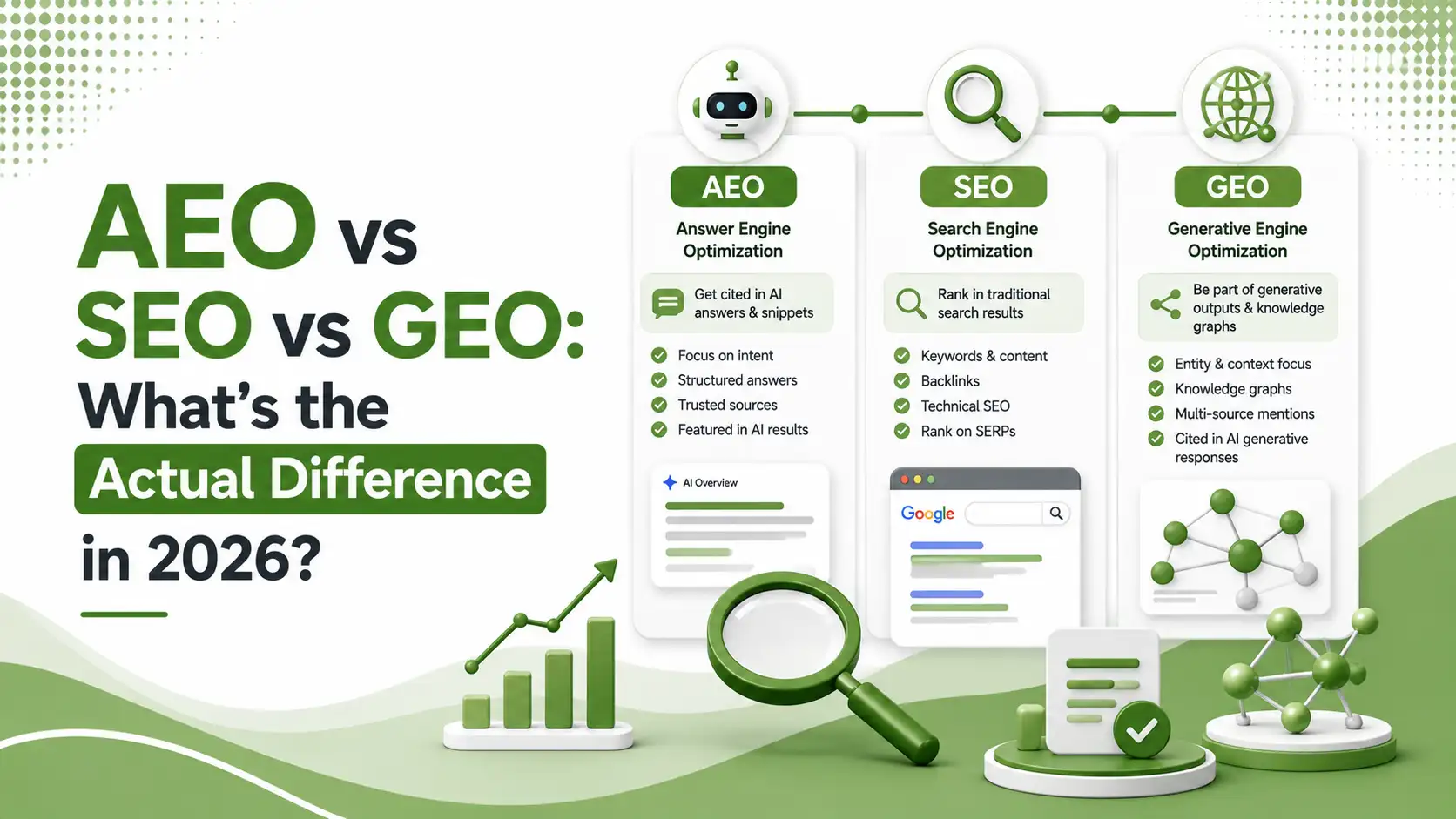
SEO, AEO, and GEO get used interchangeably, but they optimize for entirely different surfaces and KPIs. Here's a clear, no-spin breakdown of what each one actually means, with practical code examples.
Table of Contents
ToggleSEO, AEO, and GEO get thrown around in the same sentence like they mean the same thing. They don't, and the confusion is costing marketers real strategy time. Here is the actual, working difference between the three, with no agency sales pitch attached.
SEO gets you a ranking. AEO gets you the answer. GEO gets you cited by an AI system that never shows a ranked list at all. Each optimizes for a different surface, a different KPI, and increasingly, a different piece of your content.
We already covered the mechanics of getting cited in our Generative Engine Optimization guide and our piece on why AI Overviews are eating clicks. This article puts all three terms side by side so the difference actually sticks.
of Google searches now end without a click, going straight to a zero-click answer
reduction in click-through rate for top-ranking pages when an AI Overview appears
higher AI citation rate for content specifically optimized for generative engines
The One-Sentence Definition of Each
Strip away the acronym soup and each term answers a different question about where your content shows up.
Optimizing to rank as a listed result on a traditional search engine results page.
Optimizing to be extracted as the direct answer inside a snippet, AI Overview, or voice response.
Optimizing to be the cited source an AI system pulls from when it generates an answer, like ChatGPT or Perplexity.
Here is the same logic written out as a decision path, the way you might actually think through where to focus content strategy for a given page.
// Simplified content-strategy decision logic
function chooseOptimization(surface) {
  if (surface === "Google SERP") {
    return "SEO"; // rank in the list of links
  }
  if (surface === "AI Overview" || surface === "Featured Snippet" || surface === "Voice Assistant") {
    return "AEO"; // become the direct answer
  }
  if (surface === "ChatGPT" || surface === "Perplexity" || surface === "Claude") {
    return "GEO"; // become the cited source
  }
}
A simplified way to think about which discipline applies to which surface
How They Actually Differ in Practice
| Factor | SEO | AEO | GEO |
|---|---|---|---|
| Primary goal | Rank in search results | Become the direct answer | Get cited by AI systems |
| Target surface | Google, Bing SERPs | Snippets, AI Overviews, voice | ChatGPT, Perplexity, Claude |
| Success metric | Ranking position, clicks | Answer extraction, impressions | Citations, brand mentions |
| Content format | Comprehensive pillar pages | Direct, extractable answers | Specific, well-sourced, entity-rich content |
| User outcome | Clicks through to your site | Often zero-click, high visibility | Almost always zero-click |
Is GEO Just AEO With a Different Name?
Not everyone agrees, and it is worth hearing both sides before picking a camp.
Some practitioners argue AEO and GEO describe the same underlying strategy, just named differently.
According to Profound's comparison of the two terms, both aim to get content selected and reused by AI-driven answer systems, and the split is more about branding preference than a real technical distinction.
Others draw a sharper line. According to a 2026 AEO optimization guide, AEO focuses on classic search engines and their built-in AI features, like Google's AI Overviews.
GEO, by contrast, focuses specifically on standalone AI tools such as ChatGPT and Perplexity that sit entirely outside the traditional search engine ecosystem.
Five Things Worth Knowing About How These Overlap
None of Them Replace SEO
According to Jasper's 2026 GEO and AEO guide, traditional SEO fundamentals, like technical health, content depth, and authority, still form the base layer both AEO and GEO build on top of.
They Reward Different Content Shapes
SEO favors comprehensive pillar pages. AEO favors short, direct, extractable answers. GEO favors specific, well-sourced, entity-rich passages a model can lift cleanly.
GEO Rarely Sends a Click
According to Atak Interactive's breakdown of the three disciplines, when an AI tool answers a question directly, users typically get the answer and never click through at all.
The Ranking Signals Genuinely Differ
Research cited in industry analysis shows the factors driving traditional rankings are meaningfully different from what drives inclusion in an LLM-generated answer, so a page ranking well for SEO is not automatically GEO-ready.
Brands Are Running All Three Together
According to Nico Digital's 2026 guide to the three disciplines, the brands compounding visibility in 2026 stopped debating which term is correct and started running SEO, AEO, and GEO as one integrated program.
Why This Confusion Costs Marketing Teams Real Time
Vendor pitches rarely help. Agencies and tool providers often use SEO, AEO, and GEO interchangeably in marketing copy, which makes it harder for in-house teams to know what they are actually buying or measuring.
According to Digital Agency Network's 2026 comparison guide, the practical relationship between the three has changed completely even though none of the acronyms is replacing the others.
Treating them as synonyms leads teams to measure the wrong thing, like tracking only clicks when the actual goal was AI citation volume.
This confusion also shows up in how content briefs get written. A brief asking for "SEO content" that is secretly meant to also perform for AEO and GEO usually falls short.
It typically produces content that does none of the three particularly well, since each discipline rewards a slightly different structure.
A Practical Way to Structure Content for All Three
Rather than writing three separate versions of every page, most 2026 guidance points toward a single hub-and-spoke structure that serves all three disciplines from one content set.
According to DevexHub's 2026 guide to winning search, answers, and AI, a comprehensive pillar page still anchors the SEO layer, built around genuine topical depth rather than keyword stuffing.
Around that pillar, focused sections written in direct, answer-first language handle the AEO layer, since each section can stand alone as a snippet-ready response to a specific question.
According to Arc Intermedia's 2026 guide to the new search landscape, the GEO layer then comes from making sure that same content includes specific data points, named sources, and clear entity references an AI model can cite with confidence.
What AEO-Friendly Content Actually Looks Like
AEO rewards a specific content shape: the answer up front, in plain language, structured so a machine can lift it cleanly. Here is a simplified example of how that looks marked up on a page.
<h2>What is AEO?</h2>
<p>
  AEO (Answer Engine Optimization) is the practice of
  structuring content so it gets extracted as a direct answer
  by AI-powered search features.
</p>
<!-- Direct answer first, explanation follows below -->
Answer-first structure: the definition comes before any supporting detail
Weighing SEO, AEO, and GEO as One Program
What Running All Three Gets You
What It Requires
How to Measure Success Across SEO, AEO, and GEO
Clicks alone no longer tell the full story of whether your content strategy is working. Each discipline needs its own measurement approach, tracked separately rather than folded into one generic report.
For SEO, the familiar metrics still apply: ranking position, organic traffic, and click-through rate from the search results page. These numbers remain meaningful, since traditional search still drives real transactional traffic.
For AEO, look at featured snippet ownership, People Also Ask appearances, and impressions in Search Console even when clicks stay flat.
A page can be doing excellent AEO work while showing declining click numbers, simply because it is winning the zero-click answer instead of the click itself.
For GEO, the clearest signal comes from directly querying AI tools your audience actually uses. Run the questions your customers would ask through ChatGPT, Perplexity, and Google AI Mode, and track whether your brand gets mentioned or cited.
Pairing this with a rise in direct brand-name search volume over time gives a reasonably reliable read on whether your GEO efforts are translating into real awareness.
FAQs on SEO vs. AEO vs. GEO
Related Articles
What We Learn Today
SEO optimizes for ranking. AEO optimizes for being the answer. GEO optimizes for being the cited source.
Over a third of Google searches now end without a click at all.
None of the three disciplines replace each other. SEO remains the foundation.
Practitioners disagree on whether AEO and GEO are truly different or just differently named.
GEO rarely drives a click, but it builds brand mind share that converts later.
Answer-first, entity-rich content tends to serve all three disciplines at once.
Related Posts
Previous Post
Next Post
Previous Post
Next Post

- Artificial Intelligence
- Content
- Core Web Vitals
- Development
- Digital Marketing
- Google Ads
- Google Search Console
- GTM
- HTML
- HTML CSS
- JavaScript
- Keyword Research
- Link Building
- Local SEO
- Meta Ads
- Mobile SEO
- Off-Page SEO
- On-Page SEO
- Paid Media
- Paid Media Analytics
- PHP
- PPC Strategy
- Python
- SEO
- SEO Basics
- SEO Tools
- Social
- Technical SEO