

Now Reading: SEO AEO GEO: What is the difference?
-
01
SEO AEO GEO: What is the difference?

SEO, AEO, and GEO are not the same. Ranking on Google is no longer enough. Today, visibility happens across search engines, answer boxes, and AI platforms like ChatGPT and Gemini. Learn the real difference and why modern brands must optimize for rankings, extraction, and AI citations to stay visible in 2026.
SEO AEO GEO Are not the Same Thing
For years, digital marketing had one clear objective: Rank on Google.
If your website reached position one, you were winning. Traffic increased. Leads followed. Revenue improved.
But search is no longer just search.
Today, visibility does not happen in one place. It happens across multiple systems, including traditional search engines and AI-powered platforms. And that changes everything.
Most brands are still optimizing only for SEO.
But ranking is no longer the full picture.
To truly understand modern visibility, we need to understand three different layers: SEO, AEO, and GEO.
They are connected. But they are not the same.
Understanding SEO
SEO stands for Search Engine Optimization. It focuses on improving your website so that it ranks higher in traditional search engine results.
When someone types a query into Google, SEO helps your page appear in the organic listings.
SEO primarily focuses on the following:
-
Keyword Optimization
Selecting relevant keywords and placing them strategically in titles, headings, and body content so search engines understand what your page is about. -
Technical Structure
Improving website speed, mobile responsiveness, indexing, internal linking, and crawlability so search engines can properly access and evaluate your site. -
Backlinks and Authority
Earning links from other websites to signal credibility and trust. -
User Experience
Ensuring your content is readable, structured, and easy to navigate.
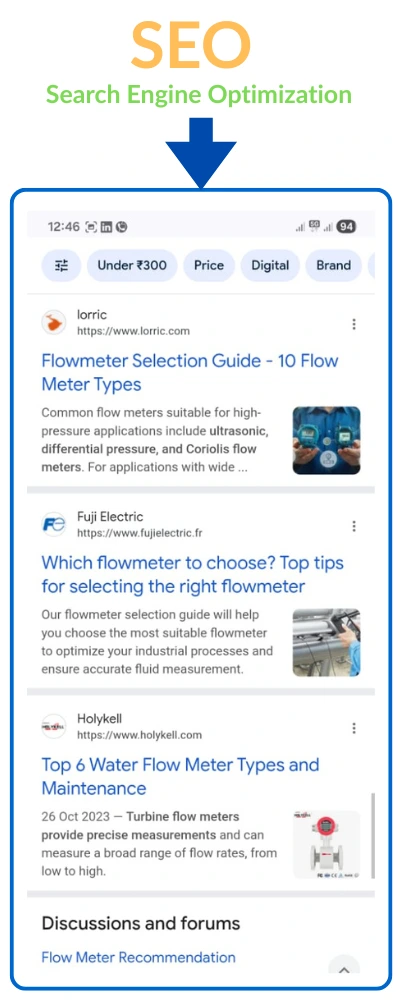
SEO – Search Engine Optimization
The main objective of SEO has always been simple: rank higher and drive traffic.
But here is the challenge.
You can rank number one and still not be the answer people see.
Understanding AEO
AEO stands for Answer Engine Optimization.
This focuses on getting your content selected as the direct answer within search results.
Instead of only appearing as a clickable link, your content may be extracted and displayed directly inside:
- Google featured snippets
- AI summaries
- Voice search responses
- People Also Ask sections
When someone asks a question like “What is AEO?” search engines often display a short paragraph taken from a website.
That extraction is AEO visibility.
AEO requires content to be structured differently. It focuses on the following:
-
Clear and Direct Definitions
Short, precise explanations that answer a specific question immediately. -
Structured Formatting
Using headings, clean paragraphs, and organized explanations that are easy for algorithms to extract. -
Question-Based Content
Writing content around real user queries instead of only keywords. -
Clarity Over Complexity
Avoiding unnecessary jargon so your answer is easy to understand and summarize.
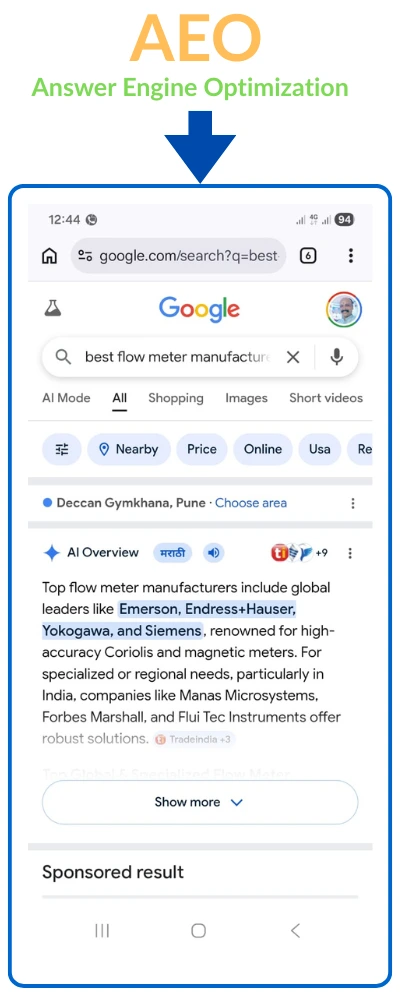
AEO – Answer Engine Optimization
The objective of AEO is not just ranking.
It is being selected.
And selection requires clarity.
Understanding GEO
GEO stands for Generative Engine Optimization.
This is the newest layer of visibility. It focuses on being cited or referenced inside AI-generated responses from platforms like ChatGPT, Gemini, Perplexity, and Claude.
When users ask AI tools complex questions, the AI generates an answer instead of showing a list of links.
Sometimes those answers include references or brand mentions.
If your brand is included in that response, that is GEO visibility.
GEO depends heavily on:
-
Authority Signals Across the Web
Mentions, citations, and recognition from other trusted platforms. -
Topical Depth and Expertise
Publishing comprehensive content that demonstrates deep knowledge rather than surface-level information. -
Brand Trust and Credibility
Author bios, case studies, original research, and consistent thought leadership. -
Digital Footprint Consistency
Being visible not just on your own website but across articles, interviews, communities, and discussions.
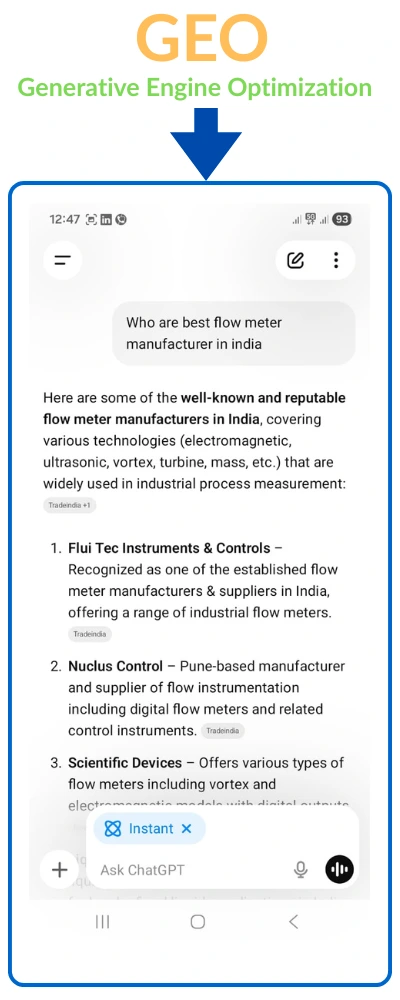
GEO – Generative Engine Optimization
Here is something important to understand.
AI systems do not simply copy search rankings.
They evaluate patterns of trust, clarity, and authority.
That means you can rank number one and still not be cited in AI-generated answers.
Why SEO Alone Is Not Enough Anymore
User behavior has changed dramatically.
People now ask conversational questions. They expect summarized answers. They use AI assistants instead of clicking multiple websites.
If someone asks an AI tool, “Explain the difference between SEO and GEO,” they may never open a traditional search engine.
That means visibility is expanding beyond search result pages.
Ranking is still important.
But ranking alone is not enough.
The Three Layers of Modern Visibility
Modern visibility operates across three interconnected layers.
-
SEO Builds the Foundation
Without strong technical structure and keyword alignment, your content may never be discovered. -
AEO Improves Extractability
Structured answers and clear explanations increase your chance of being selected as the featured answer. -
GEO Builds Authority for AI Citations
A strong brand presence increases your chance of being referenced in AI-generated responses.
When combined, these three layers define your true digital visibility.
The Reframing of SEO
Here is an important perspective.
Many strategies now labeled as AEO and GEO have existed within strong SEO practices for years.
- Clear structure.
- Helpful answers.
- Authority building.
- Topical depth.
These were always part of high-quality SEO.
What has changed is not the foundation.
What has changed is the objective.
Earlier, SEO focused on rankings.
Now, the objective has expanded to include selection, extraction, citation, and trust.
The fundamentals remain.
The ecosystem has evolved.
Ranking vs Being Chosen
Let’s understand the difference in mindset.
Traditional SEO asks, “How do I rank higher?”
Modern visibility asks, “How do I become the trusted source?”
You can generate traffic and still not be cited.
You can publish regularly and still not be selected as the answer.
Because AI systems evaluate clarity, structure, authority, and trust signals — not just ranking position.
Being visible today means being trusted by algorithms that summarize the internet.
What Winning in 2026 Really Means
Winning in 2026 requires a broader strategy.
It requires:
-
Strong SEO foundations that ensure discoverability.
-
Structured content that improves extractability for answer engines.
-
Authority-driven brand building that improves AI citation probability.
The goal is no longer just rankings.
The goal is becoming the source.
When search engines and AI systems consistently select your content as the answer, your brand moves from being one of many results to being the trusted reference.
That is a completely different level of visibility.
What we learn today about SEO AEO GEO?
Are you optimizing only for rankings?
Or are you optimizing for selection, citation, and AI visibility too?
Search is evolving.
AI is reshaping how answers are delivered.
And brands that adapt early will not just survive this shift — they will lead it.
Because in the new era of search, traffic is good.
But trust is better.
And being cited is powerful.